If there was ever a riddle asking the listener to name something that has become bigger and shorter at the same time, distributed denial-of-service attacks (DDoS) would be an acceptable answer. According to a new report from Arbor Networks about the third quarter of 2013, the average attack size now stands at 2.64 Gbps for the year, an increase of 78 percent from 2012. The number of attacks monitored by the firm that are more than 20 Gbps experienced massive growth, to the tune of a 350 percent increase so far this year. Meanwhile, the length of the vast majority of attacks (87 percent) has gone down to less than an hour. “Shorter duration attacks are not inherently harder to detect, but they can be harder to mitigate,” says Gary Sockrider, solutions architect for the Americas, Arbor Networks. “Many organizations today rely on network- or cloud-based mitigation of DDoS attacks. Because they rely on rerouting attack traffic to scrubbing centers, there is a small delay in mitigation while routing or domain name changes propagate. “Ideally you want to have mitigation capabilities on your own network that can react immediately without the need for redirection. I think it’s safe to say that if you have absolutely no mitigation capabilities, then shorter attacks are better. However, if your only protection has inherent delays, then shorter attacks potentially cannot be stopped.” Barrett Lyon, founder of DDoS mitigation firm Prolexic Technologies and now CTO of Defense.net, says that shorter DDoS attacks also have the added benefit of minimizing an attacker’s exposure. “The longer it runs, the more things are obviously clogged up and the more reactive network engineers become,” he observes. “When network engineers start researching a problem like that — congestion in their network or why is this computer slow — it exposes the botnet and makes it much vulnerable than it would be otherwise. So if it’s a short attack but big, [attackers] can kind of quickly see and size up their target. They can quickly determine … what’s the best bang for the buck when it comes to attacking.” A clear trend of increasing attack sizes has emerged during the past several years, Sockrider says. “I believe there [is] a combination of factors enabling this trend,” he says. “First, there is increased availability of simple-to-use tools for carrying out attacks with little skill or knowledge. Second, there is a growing proliferation of DDoS-for-hire services that are quite inexpensive. Third, increasingly powerful workstations and servers that get compromised also have significantly faster connections to the Internet from which to generate attacks.” The largest monitored and verified attack size during the quarter was 191 Gbps, according to the firm. Fifty-four percent of attacks this year are more than 1 Gbps, up from 33 percent in 2012. Some 37 percent so far this year are between 2 Gbps and 10 Gbps. Another general trend is of attacks moving to the application layer. In fact, while volumetric attacks are still common, they are now frequently combined with application-layer and state exhaustion attacks, Sockrider says. In some cases, DDoS attacks have served as diversions meant to draw attention from other activities, such as bank fraud. For example, a report published in April by Dell SecureWorks noted how DDoS attacks were launched after fraudulent wire and automatic clearing house (ACH) transfers. “Most people that follow DDoS trends are aware of the really high-profile attacks against government and financial institutions, but in reality the most common targets are actually business and e-commerce sites,” Sockrider says. “We’re also seeing increased attacks in the online gaming industry, where attacks are waged for competitive advantage. Additionally, some organizations are taking collateral damage because they reside in a data center, and they happen to share infrastructure with a high-profile target. The bottom line is that in the current environment, every organization is a potential target.” Source: http://www.darkreading.com/attacks-breaches/ddos-attacks-grow-shorter-but-pack-more/240162741
See more here:
DDoS Attacks Grow Shorter But Pack More Punch

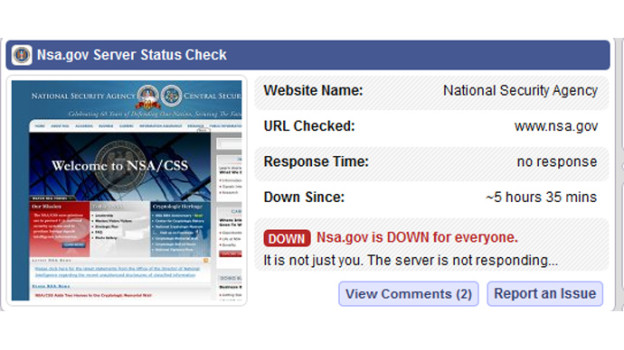
 The website for the United States National Security Agency suddenly went offline Friday. NSA.gov has been unavailable globally as of late Friday afternoon, and Twitter accounts belonging to people loosely affiliated with the Anonymous hacktivism movement have suggested they are responsible. Twitter users @AnonymousOwn3r and @TruthIzSexy both were quick to comment on the matter, and implied that a distributed denial-of-service attack, or DDoS, may have been waged as an act of protest against the NSA Allegations that those users participated in the DDoS — a method of over-loading a website with too much traffic — are currently unverified, and @AnonymousOwn3r has previously taken credit for downing websites in a similar fashion, although those claims have been largely contested. The crippling of NSA.gov comes amid a series of damning national security documents that have been disclosed without authorization by former intelligence contractor Edward Snowden. The revelations in the leaked documents have impassioned people around the globe outraged by evidence of widespread surveillance operated by the NSA, and a massive “Stop Watching Us” rally is scheduled for Saturday in Washington, DC. DDoS attacks are illegal in the United States under the Computer Fraud and Abuse Act, or CFAA, and two cases are currently underway in California and Virginia in which federal judges are weighing in on instances in which members of Anonymous allegedly used the technique to take down an array of sites during anti-copyright campaigns waged by the group in 2010 and 2011. In those cases, so-called hacktivsits are reported to have conspired together to send immense loads of traffic to targeted websites, rendering them inaccessible due to the overload.