Category Archives: DDoS Criminals

Bart ransomware victims get free decryptor

AVG malware analyst Jakub Kroustek has devised a decryptor for Bart ransomware, and the company has made it available for download (for free). Bart ransomware This particular piece of malware was first spotted in late June, being delivered via spam emails sent out by the Necurs botnet – the botnet that’s responsible for the onslaught of Locky ransomware and the Dridex Trojan. Bart is not your typical crypto ransomware as it doesn’t encrypt victims’ files. … More ?

See the original article here:
Bart ransomware victims get free decryptor

Whitepaper: Does your DDoS protection strategy address the changing threat landscape?

When it comes to DDoS attacks, you need a protection strategy that quickly adapts to the increasing sophistication of today’s attackers and the other current changes and trends in the DDoS threat landscape. Find out: What are the newest trends in Network and Applicative DDoS attacks What are the implications on your DDoS protection strategy How Incapsula’s DDoS Protection service addresses the new protection requirements. DDoS Downtime Calculator Incapsula’s DDoS Downtime Calculator is designed to … More ?

More:
Whitepaper: Does your DDoS protection strategy address the changing threat landscape?

68 gov’t websites attacked

Several Philippine government websites have been subjected to various forms of cyberattacks following the release of the ruling on the arbitration case filed by the Philippines against China. The STAR learned yesterday that at least 68 websites have been subjected to attacks, which included attempts of hacking and defacement, slowdowns and distributed denial of service attacks. Among those at the receiving end were agencies such as the Department of National Defense, the Philippine Coast Guard, Department of Foreign Affairs, Department of Health, the Presidential Management Staff and the gov.ph domain registry website. The website of the Bangko Sentral ng Pilipinas was also subjected to a supposed hacking, although authorities were able to immediately foil it. The websites of these agencies were all accessible yesterday. The source of the attacks has yet to be determined, although initial investigation supposedly pointed to an entity supposedly operating from the Netherlands. The Permanent Court of Arbitration (PCA) that issued the ruling on the Philippine case is based in The Hague in the Netherlands. The Information and Communications Technology Office, the precursor of the newly created Department of Information and Communications Technology, has yet to respond to request for comment regarding the cyberattacks. The Department of Science and Technology earlier provided additional protection to Philippine government websites amid repeated incidents of defacements and denial of service attacks. PCA website hacking Earlier, a cyber-security company reported that the PCA website was infected with a malware by “someone from China” in July 2015. Citing information from ThreatConnect Inc., Bloomberg Business reported the attack happened in the midst of the week-long hearing on the jurisdiction of the arbitration case filed by Manila against Beijing over the territorial dispute in the South China Sea. Gaelle Chevalier, a case manager at the PCA, told Bloomberg that they “have no information about the cause of the problems.” Source: http://www.philstar.com/headlines/2016/07/16/1603250/68-govt-websites-attacked

Read the article:
68 gov’t websites attacked

IoT Devices Are Being Hacked By Lizard Squad To Execute DDoS Attacks

People who have been following the tech news may recall the name Lizard Squad. This hacker collective has been a major pain in the neck for computer users all over the world. But it looks like they are changing tactics. Instead of relying on computer botnets, they are now enslaving other internet-connected devices to wreak more havoc. Lizard Squad Is Still On The Scene While most people agree the Internet of Things is a magnificent concept, it also poses a significant security risk. The majority of Internet-connected devices is not equipped with proper security precautions. In theory, any device connected to the internet can be hacked and taken over by malicious individuals. That seems to what Lizard Squad is showcasing already. The collective has been making a name for itself by using compromised computers to execute DDoS attacks around the world. But it looks like the Internet of Things is their new favorite target as of late. With millions of connected devices to choose from, creating a botnet has never been easier. Over the past few months, Lizard Squad hacked CCTV cameras and webcams all over the world to execute its DDoS attacks. Targets ranged from banks to governments, and gaming sites to ISPs. Albeit internet-connected devices are not always as powerful as a computer, they are much easier to control remotely. Plus, a lot of less-powerful devices combined can still pack quite the punch. Top put this into perspective, some of the recent Lizard Squad attacks managed to drive 400 Gbps of data to specific websites and servers. That is quite a lot of computer requests to bring down any network, or at least cripple it severely. Interestingly enough, it remains unknown whether or not Lizard Squad is trying to force targets to pay up to get rid of the attacks altogether. These attacks paint a worrisome picture for the future of Internet of Things security, though. The vast majority of devices will need to be made a lot more secure before they are actively used on the Internet. Computers are not safe from harm, either, though, as hacker collectives will try to exploit any weakness in any device. Source: http://themerkle.com/iot-devices-are-being-hacked-by-lizard-squad-to-execute-ddos-attacks/

More:
IoT Devices Are Being Hacked By Lizard Squad To Execute DDoS Attacks

Chinese gambling site served near record-breaking complex DDoS

Nine vectors used as bad guys try to beat defenders. A chinese gambling company has been pulverised with multiple nine-vector, 470 Gbps, 110 million packet-per-second distributed denial of service (DDoS) attacks, some of the biggest and most complex ever recorded.…

Follow this link:
Chinese gambling site served near record-breaking complex DDoS

Chinese Gambling Company Was Target of a Nine-Vector 470 Gbps DDoS Attack

The attack also reached 110 million packets per second On June 14, a Chinese gambling company was unlucky enough to be at the end of a complex multi-vector DDoS attack that blasted over 470 gigabits per second (Gbps) and over 110 million packets per second (Mpps) at its servers. The attack came after the company had already faced multiple 250+ Gbps attacks in the previous days. The good news is that this 470 Gbps attack only lasted four hours and was deflected by the company’s DDoS mitigation service. Nine-vector DDoS attacks are rare Even if short, the attack itself was extremely complex, with the crooks utilizing nine different attack vectors. Compared to data from the first quarter of 2016, nine-vector DDoS attacks are extremely rare and happen once every 500 attacks (0.2% of all attacks). This particular attack started with a basic network-level assault that wanted to suffocate the network with large amounts of data. It first blasted SYN payloads, then generic TCP and UDP data packets. From the get-go, the attack was different from all the previous attacks, throwing over 300 Gbps at its target from its initial seconds, before growing bigger to reach its peak value. Attack evolved from network to application level Midway through the attack, the crooks completely changed tactics. They stopped the network-level attack and shifted to an application layer DDoS, during which attackers send packets of a smaller size, but in larger numbers to occupy the memory of the receiving servers. Incapsula, the company that was providing DDoS mitigation, said that in Q1 2016, it regularly mitigated application layer 50+ Mpps DDoS attacks every four days, and 80+ Mpps attacks every eight days. Even if this attack exceeded 110 Mpps, the company was able to mitigate the threat. The combination of all these vectors makes this one of the most complex attacks the company saw. In fact, Incapsula said this was the biggest DDoS attack it mitigated in terms of sheer size (470 Gbps) in its entire history. “On a technical level we want to make clear that there isn’t much difference in mitigating 300, 400, or 500 Gbps network layer attacks,” Incapsula’s Igal Zeifman and Ofer Gayer explain. “They’re similar threats, each dealt with in a similar manner. Large attack waves aren’t more dangerous than smaller ones. All you need is a bigger boat.” Source: http://news.softpedia.com/news/chinese-gambling-company-was-target-of-a-nine-vector-470-gbps-ddos-attack-505850.shtml#ixzz4D57R4eWd

Read More:
Chinese Gambling Company Was Target of a Nine-Vector 470 Gbps DDoS Attack

The Network Ops DDoS Playbook

With the prevalence of DDoS attacks, good preparation and planning can go a long way toward making the DDoS response process as manageable, painless, and inexpensive as possible. The Network Ops DDoS Playbook is a guide focused on how to prepare yourself against a DDoS attack on your business and what to do if you are under attack. You’ll find practical tips, best practices and an overview of the cyber security technologies available to protect … More ?

See more here:
The Network Ops DDoS Playbook

A Massive Botnet of CCTV Cameras Involved in Ferocious DDoS Attacks

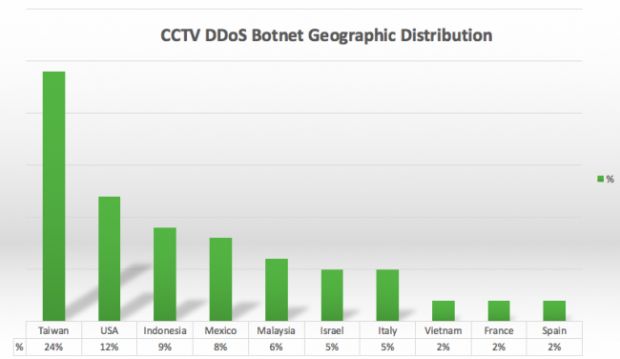
All clues lead back to Chinese DVR vendor TVT A botnet of over 25,000 bots lies at the heart of recent DDoS attacks that are ferociously targeting business around the world. More exactly, we’re talking about massive Layer 7 DDoS attacks that are overwhelming Web servers, occupying their resources and eventually crashing websites. US-based security vendor Sucuri discovered this botnet, very active in the last few weeks, and they say it’s mainly composed of compromised CCTV systems from around the world. Their first meeting with the botnet came when a jewelry shop that was facing a prolonged DDoS attack opted to move their website behind Sucuri’s main product, its WAF (Web Application Firewall). Botnet can crank out attacks of 50,000 HTTP requests per second Sucuri thought they had this one covered, just as other cases where companies that move their sites behind their WAF block the attacks, and eventually the attacker moves on to other targets. Instead, they were in for a surprise. While the initial attack was a Layer 7 DDoS with over 35,000 HTTP requests per second hitting the server and occupying its memory with garbage traffic, as soon as the attackers saw the company upgrade their website, they quickly ramped up the attack to 50,000 requests. For Layer 7 attacks, this is an extraordinarily large number, enough to drive any server into the ground. But this wasn’t it. The attackers continued their assault at this high level for days. Botnet’s nature allowed attacks to carry out attacks at higher volumes Usually, DDoS attacks flutter as the bots come online or go offline. The fact that attackers sustained this high level meant their bots were always active, always online. Sucuri’s research into the incident discovered over 25,513 unique IP addresses from where the attacks came. Some of these were IPv6 addresses. The IPs were spread all over the world, and they weren’t originating from malware-infected PCs, but from CCTV systems. Taiwan accounted for a quarter of all compromised IPs, followed by the US, Indonesia, Mexico, and Malaysia. In total, the compromised CCTV systems were located in 105 countries. Top 10 locations of botnet’s IPs The unpatched TVT firmware comes back to haunt us all Of these IPs, 46 percent were assigned to CCTV systems running on the obscure and generic H.264 DVR brand. Other compromised systems were ProvisionISR, Qsee, QuesTek, TechnoMate, LCT CCTV, Capture CCTV, Elvox, Novus, or MagTec CCTV. Sucuri says that all these devices might be linked to Rotem Kerner’s investigation, which discovered a backdoor in the firmware of 70 different CCTV DVR vendors . These companies had bought unbranded DVRs from Chinese firm TVT. When informed of the firmware issues, TVT ignored the researcher, and the issues were never fixed, leading to crooks creating this huge botnet. This is not the first CCTV-based botnet used for DDoS attacks. Incapsula detected a similar botnet last October. The botnet they discovered was far smaller, made up of only 900 bots . Source: http://news.softpedia.com/news/a-massive-botnet-of-cctv-cameras-involved-in-ferocious-ddos-attacks-505722.shtml#ixzz4CsbxFc4A

Read More:
A Massive Botnet of CCTV Cameras Involved in Ferocious DDoS Attacks

Botnet-powered ballot stuffing suspected in 2nd referendum petition

‘Tiny fraction of the overall count’ however A petition for a second EU referendum in the UK has been hit by suspicions of computer automated ballot stuffing, possibly by politically motivated hackers.…

View article:
Botnet-powered ballot stuffing suspected in 2nd referendum petition