The website of the International Middle East Media Center (IMEMC) is back online after the Palestinian news service, under the auspices of the Palestinian Centre for Rapprochement between People, was forced off-line by a DoS attack and apparently let down by Hosting provider Bluehost. IMEMC and other new media came under increased attack during the Gaza war, while mainstream media were bleeding viewers, listeners and readers to new, alternative and independent news services. A several hundred percent increase in readers of news about the Gaza war may, ultimately, have prompted the UK parliament’s recognition of Palestine. The IMEMC website is under constant attack of one sort or the other, but these attacks increased significantly since the Gaza war, said the editor-in-chief Saed Bannoura to nsnbc. IMEMC’s website ultimately succumbed to a DoS attack on October 14, after the end of armed hostilities, but against the backdrop of the Swedish recognition of Palestine and the UK parliament’s yes vote to the recognition of Palestine on October 13. IMEMC, nsnbc, and a number of other new, independent or alternative media experienced a marked increase for the Palestine – Israel discourse. While nsnbc only registered a minor increase in daily readers, it noticed a marked increase in the number of read articles pertaining Palestine, Israel, and the related international discourse. IMEMC, which specifically covers Palestine and the Palestinian – Israeli discourse, experienced a significant increase in its number of readers and read articles. Saed Bannoura noted that IMEMC also experienced an increased interest in IMEMC’s Facebook page and Twitter account, adding, however, that there was a particular increase in interest for the IMEMC website. Bannoura said: “Our readership increased from two million hits per month to ten million hits per month … We have seen more and more reprints of our articles, and also, Abby Martin of Russia Today, was repeatedly quoting the IMEMC website, our statistics and our reports in her TV coverage” Saed Bannoura noted that IMEMC and other independent media often have people on the ground where major mainstream media are merely repeating the reports from establishment news agencies. It is noteworthy that the IMEMC website succumbed to the DoS attack on October 14, one day after the UK Parliament voted in favor of the recognition of Palestine and only two days after nsnbc published an article that documented an unprecedented level of harassment of alternative media, including IMEMC, nsnbc, Voltairenet, New Eastern Outlook, Land Destroyer Report, Infowars, Drudge Report and others. Mainstream media like the BBC, CNN and other were increasingly forced to adjust their coverage. This ”adjustment” and the flight away from the mainstream to alternatives is likely to have been a significant contributing factor to the landslide in public opinion in the UK, that led to the recognition of Palestine by the UK parliament. Speaking about the decades-long vilification of Palestinians and the misrepresentation of the Palestinian – Israeli discourse in Blockbuster Hollywood movies and mainstream media, Saed Bannoura said: “Well, it’s an unfortunate reality that most of the international media agencies are largely corporate owned and line-up with corporate lobbies. Therefore their coverage is poor to none, regarding Palestine issues, especially when it comes to Palestinian rights”. Another aspect of the involvement of strong corporate and government interest in media coverage is that alternative, internet-based media, are dependent on Hosting providers who often are in direct or indirect corporate relationship with, or dependent on business with major corporations which are known for their cooperation with intelligence agencies. One example is the well-documented cooperation between Google, Microsoft, Apple, and the U.S.’ National Security Agency. IMEMC’s now previous Hosting service, Bluehost, said Saed Bannoura, let IMEMC down when it was subjected to the DoS attack instead of providing any actionable help. Bannoura stressed, “that is their job, that is what we are paying them for”. It is noteworthy that Bluehost has a partnership with SiteLock, which also was involved in a harassment case pertaining nsnbc and others. October 18, nsnbc attempted to contact Bluehost via chat and phone. A sustained attempt to acquire the contact details of a media spokesperson or anyone who could speak on behalf of Bluehost failed. Also repeated direct calls to its violation of terms of service department were consistently answered by an answering machine, saying, “I’m sorry, that’s not a valid extension. Thank you for calling”. IMEMC has migrated the website to another hosting provider for now. Editor-in-chief Saed Bannoura agrees that alternative, new, and independent media could and maybe ought to form some kind of alliance with regard to negotiating with safe and ethical hosting service providers. The IMEMC website is on-line again, but the new media are likely to remain vulnerable as long as they don’t stand united against censorship and harassment. Source: http://www.imemc.org/article/69429
Visit link:
International Middle East Media Center back on-line after DDoS Attack

 Majority of DDoS traffic in 2014 originated from India, says a new research from Symantec. Of the top 50 countries that witnessed the highest volume of originating DDoS traffic, India accounted for 26 percent of all DDoS traffic, followed by the USA with 17 percent, the research said. The results prove India has a high number of bot infected machines and a low adoption rate of filtering of spoofed packets, but may not imply that people behind the attacks are located in India because DDoS attacks are often orchestrated remotely. However, the study indicates that India is emerging as a hotbed to launch these attacks, potentially because of the low cyber security awareness, lack of adequate security practices and infrastructure, said Tarun Kaura, director, Technology Sales at Symantec India. The year 2014 saw an increase in the compromise of Linux servers, including those from cloud providers. These high bandwidth servers are then used as part of a botnet to perform DDoS attacks. The so-called “Booter” services can be hired for as little as INR 300 ($5 USD) to perform DDoS attacks for a few minutes against any target. Longer attacks can be bought for larger prices. They also offer monthly subscription services, often used by gamers to take down competitors. As the most attacked sector globally, the gaming industry experiences nearly 46 percent of attacks, followed by the software and media sectors While it’s not happening on a broad scale now, it’s likely we’ll see an increase in DDoS attacks originating from mobile and IoT devices in the future, Symantec said. DDoS attacks make an online service unavailable by overwhelming it with traffic from multiple sources. A Domain Name Server (DNS) amplification attack is a popular form of DDoS, which floods a publically available target system with DNS response traffic. Symantec’s research indicates that DNS amplification attacks have increased by 183 percent from January to August 2014. Motivations behind DDoS Attacks include hacking and financial blackmail with the threat of taking the business offline personal grudge. It also acts as a diversion technique to distract IT security response teams while a targeted attack is conducted. Source: http://www.infotechlead.com/2014/10/24/india-accounts-26-top-ddos-traffic-symantec-26196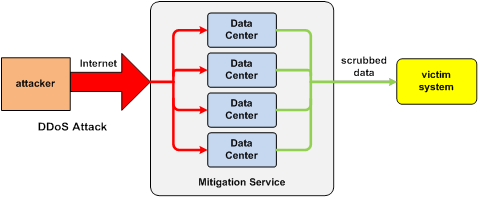
 Various defense strategies can be invoked to defend against DDoS attacks. Many of these depend upon the intensity of the attack. We discuss some of these in this article. Mitigation Strategies Some protection from DDoS attacks can be provided by firewalls and intrusion-prevention systems (systems that monitor for malicious activity). When a DDoS attack begins, it is important to determine the method or methods that the attacker is using. The web site’s front-end networking devices and the server’s processing flow may be able to be reconfigured to stop the attack. UDP Attacks UDP (User Datagram Protocol) attacks send a mass of UDP requests to a victim system, which must respond to each request. One example is a ping attack. It is an enormous influx of ping requests from an attacker that requires the victim server to respond with ping responses. Another example of a UDP attack is when the Internet Control Message Protocol (ICMP) must be used by the server to return error messages. The messages may indicate that a requested service is unavailable or that a host or router cannot be reached. An attacker may send UDP messages to random ports on the victim server, and the server must respond with a “port unreachable” ICMP message. Mitigation Strategy In the case of a UDP attack, the firewall could be configured to reject all UDP messages. True, this would prevent legitimate use of UDP messages, such as pings sent by monitoring services to measure the uptimes and response times of the web site. However, to be shown as failed by a monitoring service is much better than actually being down. SYN Attacks In a SYN attack, a mass of connection requests are sent to the victim server via SYN messages. Typically, the victim server will assign connection resources and will respond with SYN ACK messages. The server expects the requesting client to complete the connections with ACK messages. However, the attacker never completes the connections; and the server soon runs out of resources to handle further connection requests. Mitigation Strategy In this case, the server connection facility could be reconfigured so that it did not assign connection resources until it received the ACK from the client. This would slightly extend the time required to establish a connection but would protect the server from being overwhelmed by this sort of an attack. DNS Reflection Attack A DNS reflection attack allows an attacker to send a massive amount of malicious traffic to a victim server by generating a relatively small amount of traffic. DNS requests with a spoofed victim address are sent to multiple DNS systems to resolve a URL. The DNS servers respond to the victim system with DNS responses. What makes this sort of attack so efficient is that the DNS response is about 100 times as large as the DNS request. Therefore, the attacker only needs to generate 1% of the traffic that will be sent to the victim system. DNS reflection attacks depend upon DNS open resolvers that will accept requests from anywhere on the Internet. DNS open resolvers were supposed to have been removed from the Internet, but 27 million still remain. Mitigation Strategy A defense against DNS reflection attacks is to allow only DNS responses from the domain of the victim server to be passed to the server. Mitigation Services Given a sufficiently large DDoSattack, even the steps mentioned here may not protect a system. If nothing else, the attack can overwhelm the bandwidth of the victim’s connection to the Internet. In such cases, the next step is to use the services of a DDoS mitigation company with large data centers that can spread the attack volume over multiple data centers and can scrub the traffic to separate bad traffic from legitimate traffic. Prolexic, Tata Communications, AT&T, Verisign, CloudFare, and others are examples of DDoS mitigation providers. These services will also monitor the nature of the attack and will adjust their defenses to be effective in the face of an attacker that modifies its strategies as the attack progresses. Legality DDoS attacks are specifically outlawed by many countries. Violators in the U.K. can serve up to ten years in prison. The U.S. has similar penalties, as do most major countries. However, there are many countries from which DDoS attacks can be launched without penalty. With respect to the Spamhaus attack described in Part 1, the CEO of CyberBunker, a Dutch company, was arrested in Spain and was returned to the Netherlands for prosecution. Summary Companies must prepare for the likelihood of losing their public-facing web services and must make plans for how they will continue in operation if these services are taken down. This should be a major topic in their Business Continuity Plans. For instance, in the case of the bank attacks described in Part 1, many banks made plans to significantly increase their call center capabilities to handle customer services should their web sites be taken down by a DDoS attack. DDoS attacks are here to stay. They are motivated by too many factors – retaliation, political statements, aggressive competitors, ransom – and are fairly easy to launch. Botnets can be rented inexpensively. There are even sophisticated tools available on the darknet to launch significant attacks. The defenses against DDoS attacks are at best limited. The ultimate defense is to subscribe to a DDoS mitigation service that can be called upon when needed. Source: http://www.techproessentials.com/ddos-attacks-can-take-down-your-online-services-part-3-defending-against-ddos-attacks/