
Planning on haxing Netflix? Don’t plan it on Facebook NetFlix’s security team has given the open source treatment to three tools it uses to monitor the internet and gather evidence of planned attacks against its infrastructure.…
Category Archives: DDoS Criminals
DDoS attack downs Twitch on news of Amazon acquisition
Just hours after Amazon announced a $970m deal to acquire Twitch, the live video platform for gamers was taken offline temporarily by a distributed denial of service (DDoS) attack. Twitch is the latest in a string of online gaming platforms to be hit by DDoS attacks that have been linked to several groups, including Lizzard Squad, jihadist group Islamic State, and Anonymous. At the weekend, Sony’s PlayStation Network was knocked offline and several others experienced disruptions, including Microsoft’s Xbox Live and Blizzard’s Battle.net. DDoS attacks are commonly used by competitors or activists to take services offline using a variety of techniques that make services impossible to reach. The reason for the DDoS attack on Twitch is unknown, but industry pundits have speculated that it may be linked to concerns about the acquisition by Amazon. Commenting on the weekend disruptions, Dave Larson, CTO at Corero Network Security, said the drivers for launching DDoS attacks are far ranging and difficult to pinpoint in many cases. “Anyone can become a victim at any time and, as the attacks continue to become stronger, longer and more sophisticated, businesses that rely on their online web applications as a revenue source cannot become complacent,” he said. Larson said the latest DDoS attacks underscore the importance of including a DDoS first line of defence as a component of network security architecture. Lancope chief technology officer TK Keanini said that while DDoS was once a resource held by a few of the elite groups on the net, this method of attack is now available to anyone as it is offered as a service. “If you know where to look, and you have some crypto currency in hand, just point and shoot,” he said. According to Keanini, any business connected to the internet is likely to be targeted by a DDoS attack at some point. “But game networks have to work harder than most to remain secure as they are incredibly attractive targets. “Not only are they high profile, with any disruption making the news, but given all the in-game commerce, credit card and personal information is kept up to date and can be monetised by these cyber criminals,” he said. Source: http://www.computerweekly.com/news/2240227573/DDoS-attack-downs-Twitch-on-news-of-Amazon-acquisition
See the original post:
DDoS attack downs Twitch on news of Amazon acquisition
Sony PSN back online after DDoS attack
Sony's PlayStation Network has been hit with and downed by a large DDoS attack this weekend, but is now back online a functioning as it should. “Like other major networks around the world, the Play…
Read the article:
Sony PSN back online after DDoS attack
Chinese Linux Trojan makes the jump to Windows – DDoS attacks largely aimed within China
A CHINESE TROJAN , one of the few to be written for the Linux operating system, has seemingly made the jump to Windows. First reported in May by Russian anti-malware software house Dr Web, the original malware known as “Linux.Dnsamp” is a Distributed Denial of Service (DDoS) Trojan, which, according to the company blog, transfers between Linux machines, altering the startup scripts, collecting and sending machine configuration data to the hackers’ server and then running silently waiting for orders. Now it appears that the same hackers have ported the Trojan to run in Windows as “Trojan.Dnsamp.1? The Windows version gains entry to the system under the guise of a Windows Service Test called “My Test 1?. It is then saved in the system folder of the infected machine under the name “vmware-vmx.exe”. When triggered, just like its Linux counterpart, the Trojan sends system information back to the hackers’ central server and then awaits the signal to start a DDoS attack or start downloading other malicious programs. Fortunately, the vast majority of the attacks using this method were aimed at other Chinese websites, which were attacked 28,093 times, but Dr Web warns that US websites came second with nine percent of attacks. Although the threat of malware is an everyday hazard to most computer users, to find an attack on Linux is much rarer, and to find any kind of malware that has been ported from one operating system to another is almost unheard of. In June, RSS reader service Feedly, note app Evernote and streaming music service Deezer all suffered DDoS attacks. Google is working on Project Shield, an initative designed to help smaller web servers fight off DDoS attacks. Source: http://www.theinquirer.net/inquirer/news/2361245/chinese-linux-trojan-makes-the-jump-to-windows
Follow this link:
Chinese Linux Trojan makes the jump to Windows – DDoS attacks largely aimed within China
DDoS extortion attacks on the rise
While digital ransom attacks come in various types and forms, Distributed Denial of Service (DDoS) attacks are top of the list of methods used by attackers to force money from targeted companies. So says Bryan Hamman, territory manager of Arbor Networks, who points out that in recent weeks, well-known names such as Evernote and Feedly have fallen victim to extortion attacks, but these companies are just the tip of the iceberg when it comes to this very lucrative criminal activity. InfoSecurity Magazine reports that this year the number of network time protocol amplification attacks increased 371.43%. The average peak DDoS attack volume increased a staggering 807.48%. The news aggregator Feedly said it had come under a DDoS attack from cyber criminals, which was preventing users from accessing its service. “Criminals are attacking Feedly with a distributed denial of service attack. The attacker is trying to extort money from us to make it stop. We refused to give in and are working with our network providers to mitigate the attack as best as we can,” said Feedly in a blog post. “‘Pay up or we’ll take your Web site down’, so goes the adage that usually accompanies ransom-based cyber-attacks,” says Hamman. According to Arbor’s ninth annual Worldwide Infrastructure Security Report, DDoS extortion attacks account for 15% of all DDoS attacks. While it may seem like a relatively small percentage, one must consider that as many as 10 000 DDoS attacks occur world-wide every day and the potential cost in damages and reputation can have a significant impact on a targeted organisation, Hamman points out. He explains that DDoS extortion attacks are generally volumetric, high bandwidth attacks launched with the aim of crashing a company’s Web site or server by bombarding it with packets, which originate from a large number of geographically distributed bots. The size of volumetric DDoS attacks continues to increase year on year, and they remain a major threat to enterprises and Internet service providers alike, he adds. “Traditionally, DDoS extortion attacks were used against online gambling sites, around major sporting events. Criminal gangs would initiate attacks that would bring the Web site down just before the event was to start, thus forcing the companies to choose between suffering a major loss in monetary and reputational terms or paying up. Increasingly, however, DDoS attacks are being used to extort money from all sorts of businesses and the reality is that no company should feel safe,” he says. So what is the right response when it comes to extortion demands? Hamman asks. “The answer is simple and always the same – not to give in. Organisations should under no circumstances agree to pay the ransom – it can set a dangerous precedent and encourage more attacks in the future; while it might make the pain go away in the short term, the long-term results are generally not worth it. “Declining to pay comes, of course, with severe consequences – as we saw from recent attacks on Feedly, who suffered from three separate waves of DDoS attacks. However, the company has now recovered from the attack and is operating as normal. Furthermore, it has been praised for its brave decision by the security community and even its own customers,” says Hamman. According to Hamman, many companies still rely on reactive measures such as router filters and firewalls, which are inefficient and not sophisticated enough to protect against organised cyber crime. Instead, he says, organisations need to invest in preventive, multi-layered mitigation, which includes on-premise and cloud protection, as well as allowing for co-operation with their ISP or hosting company. In addition, putting a mitigation strategy in place, should the worst happen, is of crucial importance – especially as only 17% of organisations globally feel they are fully prepared for a security incident. “By building defences, implementing plans ahead of time and refusing to give in, businesses needn’t feel threatened anymore – attackers wanting to make easy money will have to look elsewhere.” Source: http://www.itweb.co.za/index.php?option=com_content&view=article&id=136989:DDoS-extortion-attacks-on-the-rise&catid=265
See the original article here:
DDoS extortion attacks on the rise
Popcorn Time Hit By Massive DDoS Attack
A major fork of the popular Popcorn Time project is currently being subjected to a massive DDoS attack. The whole project has been hit, from the site hosting its source through to its CDN, API and DNS servers. The team tells TorrentFreak that the attack amounts to 10Gbps across their entire network. Every year sees periods when sites in the file-sharing sector are subjected to denial of service attacks. The attackers and their motives are often unknown and eventually the assaults pass away. Early in 2014 many torrent sites were hit, pushing some offline and forcing others to invest in mitigation technology. In May a torrent related host suffered similar problems. Today it’s the turn of the main open source Popcorn Time fork to face the wrath of attackers unknown. TorrentFreak spoke with members of the project including Ops manager XeonCore who told us that the attack is massive. “We are currently mitigating a large scale DDoS attack across our entire network. We are currently rerouting all traffic via some of our high bandwidth nodes and are working on imaging and getting our remaining servers back online to help deal with the load,” the team explain. The attack is project-wide with huge amounts of traffic hitting all parts of the network, starting with the site hosting the Popcorn Time source code. Attack on the source code site – 980Mbps Also under attack is the project’s CDN and API. The graph below shows one of the project’s servers located in France. The green shows the normal traffic from the API server, the blue represents the attack. Attack on the France API server – 931Mbps Not even the project’s DNS servers have remained untouched. At one point two of three DNS servers went down, with a third straining under almost 1Gbps of traffic. To be sure, a fourth DNS server was added to assist with the load. Attack on the Dutch DNS server – peaking at 880Mbps All told the whole network is being hit with almost 10Gbps of traffic, but the team is working hard to keep things operational. “We’ve added additional capacity. Our DNS servers are currently back up and running but there is still severe congestion around Europe and America. Almost 10Gbps across the entire network. Still working on mitigating. API is still online for most users!” they conclude. Nobody has yet claimed responsibility for the attack and it’s certainly possible things will remain that way. Only time will tell when the attack will subside, but the team are determined to keep their project online in the meantime. Source: http://torrentfreak.com/popcorn-time-hit-by-massive-ddos-attack-140814/?utm_source=feedburner&utm_medium=feed&utm_campaign=Feed%3A+Torrentfreak+%28Torrentfreak%29
Read More:
Popcorn Time Hit By Massive DDoS Attack
DOSarrest Adds New DDoS Protection Node in Singapore
DOSarrest Internet Security announced today that they have expanded their DDoS protection cloud into Asia, with a new DDoS mitigation node in Singapore. The new node will work in conjunction with their existing nodes in New York, Los Angeles and London and will have the same connectivity as the others, including multiple 10 Gb/Sec uplinks to multiple carriers. Jag Bains, CTO at DOSarrest states “Having a presence in Asia allows our existing client base to cache and serve traffic closer to Asian visitors for increased performance as well as enabling us to provide excellent web performance and DDoS protection to customer’s servers located in Asia.” Bains adds “The system is incredibly scalable; this also allows us to offer a higher level of protection to all customers due to the added firepower of a new node in the region. Also the additional nodes will allow us to introduce new features and services in the coming month.” Mark Teolis, GM at DOSarrest says “We have a number of initiatives underway in the region and this will help cement these opportunities” Source: http://www.marketwired.com/press-release/dosarrest-adds-new-ddos-protection-node-in-singapore-1937355.htm
See more here:
DOSarrest Adds New DDoS Protection Node in Singapore

Israel-Hamas conflict sparks surge in DDoS attacks
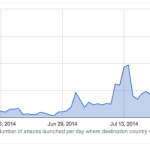 As conflict between Israel and the Palestinian militant Islamist organisation Hamas escalates, new research has revealed the impact politics has had on cyberattack trends. Tension between countries and changing political landscapes can now often be linked to cybercrime campaigns worldwide. From constant spats between the US and China to increased targeting of Syrian and Thai targets during political unrest, digital weaponry is now a key tool for groups to broadcast their own political messages, spy on governmental agencies and steal valuable data. In a new report released by Arbor Networks, anonymized traffic and DDoS attack data from over 290 ISPs that have deployed Arbor’s Peakflow SP product — collated and analyzed as part of Arbor’s ATLAS initiative — it appears that DDoS attacks are rising in number and volume as a result of the Israel-Hamas conflict. The graph below depicts the number of reported DDoS attacks initiated against Israel daily over the 1 June to 3 August period this year: Distributed Denial of Service (DDoS) attacks are used to flood a website or service with traffic to the point systems cannot cope, denying other users access to the website. Arbor detected a rise in the number of DDoS attacks targeting Israel in the first week of July, going from an average of 30 attacks per day to an average of 150 attacks initiated per day in July — peaking at 429 attacks on July 21st. Linking these cyberattacks to political situations, 30 June is when Israel publicly attributed the deaths of three kidnapped Israeli teenagers to Hamas, and on 7 July, “Operation Protective Edge” was launched by the country. As the political conflict raged on, so did the frequency of DDoS attacks until a drop occurred on 28 July lasting through 2 August. Arbor says the drop in attacks roughly correlates with cease fire talks which began 27 July. From 28 July through 2 August, there were 192 attacks recorded in total. On 3 August, the number of DDoS attacks rose sharply, with 268 attacks in total. In addition to the number of DDoS attacks over these time periods, the security researchers also noticed an increase in the peak size of these attacks. In the graph below, we can see that in June, no attacks exceeded 12Gbps. In July, seven DDoS attacks exceeded this size, with the largest peaking at 22.56Gbps on 12 July. When cease-fire talks fell apart on 3 August, the largest DDoS attack was recorded at a size of 29Gbps. The duration of DDoS attacks has also increased. In June, the average duration was 20 minutes — with a peak duration of 24 hours — and in July, the average duration was 1 hour 39 minutes. “As the intensity of the Israeli-Hamas conflict has increased, so has the number, size and duration of the DDoS attacks targeting Israel,” the researchers say. “Additionally, it even appears as if the attackers have made an effort to adhere to the “real world” calls for a cease-fire, resuming their attacks when the cease fire fell through.” Source: http://www.zdnet.com/israel-hamas-conflict-sparks-surge-in-ddos-attacks-7000032375/#ftag=RSS14dc6a9
Original post:
Israel-Hamas conflict sparks surge in DDoS attacks
DDoS attack volumes plummet as NTP servers got patched
Wise to attackers’ exploitation of the Network Time Protocol (NTP) vulnerability to create distributed reflection denial of service (DrDoS) attacks, information security executives thwarted these type…
More here:
DDoS attack volumes plummet as NTP servers got patched
RIA Novosti Website Hit by DDoS Attack
RIA Novosti’s website has fallen foul of a distributed denial-of-service (DDoS) attack by hackers, the agency’s IT specialists reported on Sunday. The mobile version of the website is currently inaccessible. Problems with the website’s full version were also reported for a short period of time. The agency’s terminal for clients has not been hampered. Unidentified hackers first attacked the website of InoSMI. When the attack was neutralized, they attempted to disrupt the work of RIA Novosti’s website. IT specialists are now working to eliminate the disruption that has caused by the attack. This is not the first cyber attack on the news agency. In May 2012, the RIA Novosti website was hit by a DDoS attack from some 2,500 IP-addresses. Another DDoS attack on the agency’s website was carried out in July 2013. Source: http://en.ria.ru/russia/20140803/191676816/RIA-Novosti-Website-Hit-by-Cyber-Attack.html
View the original here:
RIA Novosti Website Hit by DDoS Attack