DDoS attackers are hitting hard, fast and with no breaks in between, leading to record-breaking attacks over hours or even days, according to Nexusguard’s Q1 2017 Threat Report. Those record-breaking attacks over Valentine’s Day, Chinese New year and other ‘typically quiet’ periods during the season. “In APAC, a lengthy attack January 28-31, the period of Chinese New Year, lasted 2 days, 19 hours, and 40 minutes. It was a widespread, disruptive event that left celebrants weary and exhausted upon returning to work,” the report says. DDoS attack volumes have also risen 380% since the same time last year, according to Nexusguard’s statistics, based on 16,600 attacks. While 51% of attacks lasted fewer than 90 minutes, 4% exceeded 1440 minutes. 77.3% of attacks were less than 10Gbps, while 20% were between 10-200Gbps and 2% exceeded 200Gbps. The United States, China and Japan rounded out the top three sources for attacks. The rest of APAC was relatively unused as an attack source. However it’s not just DDoS attacks that are on the rise: HTTP flood attacks jumped 147% in the last quarter alone. It is now one of the leading volumetric attacks, exceeding both TCP and DNS attacks. The company cites the Internet of Things as a major weak point, particularly as the range of insecure devices and connections expodes. DDoS attacks can be persistent and long-lasting, which is a major area of concern. “IoT botnets are only the beginning for this new reign of cyber attacks. Hackers have the scale to conduct gigantic, continuous attacks; plus, teams have to contend with attacks that use a combination of volumetric and application aspects,” comments Nexusguard’s CTO Juniman Kasman. Those attacks are not happening in isolation. 93% of attacks combine application and volumetric vulnerabilities. Multiple DDoS attacks can also overwhelm systems. The company warns that organisations that haven’t invested in – or haven’t upgraded – multi-layered defense mechanisms run the highest risk of attack exposure. “This early data for 2017 shows that enterprises need to employ multi-layered defenses that use nimble resources, including large, redundant scrubbing networks and around-the-clock security operations if they hope to keep from drowning in the deluge of new attacks,” Kasman adds. Source: https://securitybrief.co.nz/story/ddos-attacks-hitting-record-breaking-levels-volumes-increase-380/
Continue reading here:
DDoS attacks hitting ‘record-breaking’ levels as volumes increase 380%
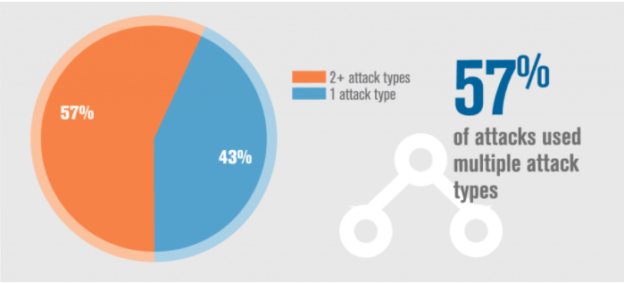
 Information security company Verisign just published its Distributed Denial of Trends Report for Q1 2017. This report talks about changes in the frequency, size, and type of DDoS attack that the company has observed over the first few months of this year. The main takeaway is this: The number of DDoS attacks has plunged by 23 percent compared to the previous quarter. That’s good! However, the average peak attack size has increased by almost 26 percent, making them vastly more potent at taking down websites and critical online infrastructure. That’s bad. The report also notes that attacks are sophisticated in nature, and use several different attack types to take down a website. While 43 percent use just one attack vector, 25 percent use two, and six percent use five. This, obviously, makes it much more difficult to mitigate against. Verisign’s report also talks about the largest DDoS attack observed by the company in Q1. This was a multi-vector attack that peaked at 120 Gbps, and with a throughput of 90 Mpps. Per the report: This attack sent a flood of traffic to the targeted network in excess of 60 Gbps for more than 15 hours. The attackers were very persistent in their attempts to disrupt the victim’s network by sending attack traffic on a daily basis for over two weeks. The attack consisted primarily of TCP SYN and TCP RST floods of varying packet sizes and employed one of the signatures associated with the Mirai IoT botnet. The event also included UDP floods and IP fragments which increased the volume of the attack. So, in short. The attackers were using several different attack types, and they were able to sustain the attack over a long period of time. This shows the attacker has resources, either to create or rent a botnet of that size, and to sustain an attack over two weeks. The fact that DDoS attacks have increased in potency is hardly a surprise. They’ve been getting bigger and bigger, as bad actors figure out they can easily rope insecure Internet of Things (IoT) devices into their botnets. The Mirai botnet, for example, which took down Dyn last year, and with it much of the Internet, consisted of hundreds of thousands of insecure IoT products. The main thing you can gleam from the Verisign report is that DDoS attacks are increasingly professional, for lack of a better word. It’s not 2005 anymore. We’ve moved past the halcyon days of teenagers taking down sites with copies of LOIC they’d downloaded off Rapidshare. Now, it’s more potent. More commoditized. And the people operating them aren’t doing it for shits and giggles. Source: https://thenextweb.com/insider/2017/05/24/report-ddos-attacks-are-less-common-but-theyre-bigger/#.tnw_RJHfi1AZ