LizardStresser makes a messer of Brazil banks, gamer outfits Lizard Squad may be mostly behind bars, but their LizardStresser botnet has spawned more than 100 clones.…
Read More:
Hydra hacker bot spawns internet of things DDoS clones
LizardStresser makes a messer of Brazil banks, gamer outfits Lizard Squad may be mostly behind bars, but their LizardStresser botnet has spawned more than 100 clones.…
Read More:
Hydra hacker bot spawns internet of things DDoS clones
A DDoS attack against a jewelry shop website has lead researchers to the discovery of a CCTV botnet comprised of some 25,000 cameras from around the globe. The website had been repeatedly attacked, first with 35,000 HTTP requests per second and then, when those efforts were thwarted, with 50,000 HTTP requests per second. Looking into the IP addresses from which the attack was coming from, Sucuri researchers discovered that all of them were running the … More ?
See more here:
25,000-strong CCTV botnet used for crippling DDoS attacks
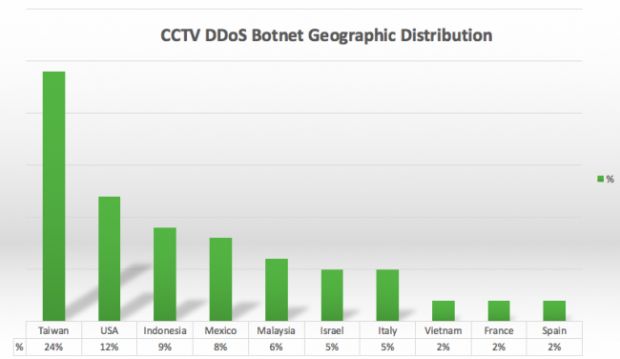
 All clues lead back to Chinese DVR vendor TVT A botnet of over 25,000 bots lies at the heart of recent DDoS attacks that are ferociously targeting business around the world. More exactly, we’re talking about massive Layer 7 DDoS attacks that are overwhelming Web servers, occupying their resources and eventually crashing websites. US-based security vendor Sucuri discovered this botnet, very active in the last few weeks, and they say it’s mainly composed of compromised CCTV systems from around the world. Their first meeting with the botnet came when a jewelry shop that was facing a prolonged DDoS attack opted to move their website behind Sucuri’s main product, its WAF (Web Application Firewall). Botnet can crank out attacks of 50,000 HTTP requests per second Sucuri thought they had this one covered, just as other cases where companies that move their sites behind their WAF block the attacks, and eventually the attacker moves on to other targets. Instead, they were in for a surprise. While the initial attack was a Layer 7 DDoS with over 35,000 HTTP requests per second hitting the server and occupying its memory with garbage traffic, as soon as the attackers saw the company upgrade their website, they quickly ramped up the attack to 50,000 requests. For Layer 7 attacks, this is an extraordinarily large number, enough to drive any server into the ground. But this wasn’t it. The attackers continued their assault at this high level for days. Botnet’s nature allowed attacks to carry out attacks at higher volumes Usually, DDoS attacks flutter as the bots come online or go offline. The fact that attackers sustained this high level meant their bots were always active, always online. Sucuri’s research into the incident discovered over 25,513 unique IP addresses from where the attacks came. Some of these were IPv6 addresses. The IPs were spread all over the world, and they weren’t originating from malware-infected PCs, but from CCTV systems. Taiwan accounted for a quarter of all compromised IPs, followed by the US, Indonesia, Mexico, and Malaysia. In total, the compromised CCTV systems were located in 105 countries. Top 10 locations of botnet’s IPs The unpatched TVT firmware comes back to haunt us all Of these IPs, 46 percent were assigned to CCTV systems running on the obscure and generic H.264 DVR brand. Other compromised systems were ProvisionISR, Qsee, QuesTek, TechnoMate, LCT CCTV, Capture CCTV, Elvox, Novus, or MagTec CCTV. Sucuri says that all these devices might be linked to Rotem Kerner’s investigation, which discovered a backdoor in the firmware of 70 different CCTV DVR vendors . These companies had bought unbranded DVRs from Chinese firm TVT. When informed of the firmware issues, TVT ignored the researcher, and the issues were never fixed, leading to crooks creating this huge botnet. This is not the first CCTV-based botnet used for DDoS attacks. Incapsula detected a similar botnet last October. The botnet they discovered was far smaller, made up of only 900 bots . Source: http://news.softpedia.com/news/a-massive-botnet-of-cctv-cameras-involved-in-ferocious-ddos-attacks-505722.shtml#ixzz4CsbxFc4A
Read More:
A Massive Botnet of CCTV Cameras Involved in Ferocious DDoS Attacks
Watching us and borking you A massive network of hacked CCTV cameras is being used to bring down computers around the world, we’re told.…
Read More:
25,000 malware-riddled CCTV cameras form network-crashing botnet
‘Tiny fraction of the overall count’ however A petition for a second EU referendum in the UK has been hit by suspicions of computer automated ballot stuffing, possibly by politically motivated hackers.…
View article:
Botnet-powered ballot stuffing suspected in 2nd referendum petition
One of the most concerning characteristics of the Godless malware is the ability to receive remote instructions on which app to download and install on mobile devices, without the user’s knowledge. This is called command and control (C&C). Being a DDoS subject matter expert, I believe this has the makings of something more insidious than malicious ads. Nearly one million infected Android devices connected to 4G LTE networks offers some serious firepower for a botnet … More ?
Visit site:
Godless Android malware offers serious firepower to a botnet herder
The international activist hacker group Anonymous Legion is claiming responsibility for an attack on the Minnesota Judicial Branch’s website that rendered it unusable for most of Wednesday. State officials became aware of the “distributed denial-of-service” (DDoS) attack about 8 a.m. Wednesday, around the same time Anonymous Legion e-mailed the Star Tribune. “Servers have also been penetrated and data has been secured, contrary to what they will tell you,” said Anonymous Legion’s e-mail. “This will occur frequently.” The group said the act was executed “collectively, through a global attack.” It is known for DDOS attacks on government websites, among others. The attack is similar to ones that interrupted the site last December. Last year’s attacks were traced to Asia and Canada. The state did not say Wednesday whether the attacks may be linked. “We are in the process of communicating with the FBI Cyber Task Force about this incident,” Beau Berentson, a spokesman for the state court administration office, said in a written statement. The website (www.mncourts.gov), visited by thousands every day looking to access court resources and information, was taken offline as the attack was investigated. Access to the site was restored around 5:15 p.m. “We have no evidence that any secure data has been inappropriately accessed,” Berentson said. Other online resources linked through the website are still functioning, including eFiling and eService, the Court Payment Center and remote access to district and appellate court records. The website was down for several hours from Dec. 21 to 31 in the previous attacks. “In a DDOS attack, an outside entity attempts to overwhelm an online resource with so much network traffic that it is no longer accessible to legitimate users,” State Court Administrator Jeff Shorba said in a January statement about last year’s attacks. “During these attacks, the Minnesota Judicial Branch did not experience any form of data breach or inappropriate access to court records, nor is there any evidence to suggest that the attackers attempted to gain access to Judicial Branch records or information.” Those attacks were reported to the federal government and Canadian authorities. “DDoS attacks are becoming increasingly common against high-profile websites in both the public and private sectors,” Shorba said in January. “While we cannot prevent these attacks from being launched, the Minnesota Judicial Branch is now better prepared to respond to these types of attacks in the future.” Source: http://www.startribune.com/minnesota-courts-website-attacked-again-by-hackers/384003231/
Continue Reading:
Anonymous Legion claims attack on Minnesota courts website
Infamous hacker group Lizard Squad is thought to be at it again, this time taking down Overwatch servers and leaving players unable to join and remain in a session. Over the past week, Blizzard has been experiencing some problems with Battle.net that have made it difficult for players to use the service as intended with games like Overwatch . Now, there’s word that these issues might have been caused by a DDoS attack launched by members of hacker group Lizard Squad. Some users are reporting that they are unable to log in to Battle.net. Others are able to enter, but find themselves kicked out of multiplayer matches in Overwatch for seemingly no reason. Ordinarily, issues like these would be brushed off as being part and parcel of the modern online experience. However, a suspicious tweet from a known Lizard Squad member has led to the group being implicated, according to a report from VG247. The above tweet is being taken as proof that Lizard Squad member AppleJ4ck was involved with the attack. Some Overwatch players responded to his post to vent their annoyance about the situation — to which AppleJ4ck responded, “in a way, I’m doing y’all a favor.” This is not the first time that Lizard Squad has targeted organizations within the video game industry. The group rose to prominence back in 2014, when a coordinated attack brought down the PlayStation Network and Xbox Live over Christmas, causing massive headaches for the companies involved. Of course, the attack was not an unmitigated success for the group, as the high-profile hack made Lizard Squad an immediate target for authorities. Just days later, a 22-year-old alleged to be a part of the organization was the subject of a raid by police in the United Kingdom. However, the strength of a group like Lizard Squad is the fact that they are spread all over the world. Individual members can be found and brought to justice, but it’s difficult to make a concerted attempt to stamp out its activity outright. If the situation is hard on the authorities, then it’s even more challenging for a company like Blizzard. The overwhelming popularity of Overwatch means its hard enough for the company to keep Battle.net afloat at the best of team, never mind when there are hackers on the prowl. Unfortunately, criminal elements like Lizard Squad are part and parcel of the modern online experience. Companies like Blizzard have to take these groups into consideration when operating a service like Battle.net — hackers have the power to ruin the experience for the rest of us, and the only defence is a robust level of security. Source: http://gamerant.com/overwatch-servers-down-ddos-attack-846/
We have all heard the stories of businesses which have suffered debilitating DDoS attacks and, in some cases, succumbing altogether. Take Code Spaces, the web-based SVN and Git hosting provider which suffered such an attack in June 2014 that it was forced to wave the white flag and cease trading after recovering all the data lost would cost too much. Now, a new piece of research from A10 Networks argues businesses face ‘sudden death’ from DDoS if caught unawares. The average company was hit by an average of 15 DDoS attacks per year, according to the survey of 120 IT decision makers, with larger organisations more badly affected. One in three (33%) respondents said they had encountered DDoS attacks of more than 40 Gbps, while one in five had suffered downtimes of more than 36 hours due to the attack. The average attack of those polled lasted 17 hours. More than half (54%) of respondents said they would increase their DDoS budgets in the coming six months, while multi-vector attacks were seen by the majority of those polled (77%) as the most dangerous form of DDoS threat in the future. “DDoS attacks are called ‘sudden death’ for good reason. If left unaddressed, the costs will include business, time to service restoration and a decline in customer satisfaction,” said A10 Networks CTO Raj Jalan. He added: “The good news is our findings show that security teams are making DDoS prevention a top priority. With a better threat prevention system, they can turn an urgent business threat into an FYI-level notification.” Previous research has examined the growing sophistication of DDoS threats. In April, Neustar argued that such DDoS issues were “unrelenting”, with more than seven in 10 global brands polled having been subject to an attack. Source: http://www.appstechnews.com/news/2016/jun/16/businesses-receive-another-warning-over-threat-ddos-attacks/
Continue reading here:
Businesses receive another warning over the threat of DDoS attacks
Distributed denial-of-service attacks have been getting bigger and lasting longer, and for the past few years defenses haven’t kept pace, but that seems to be changing, Gartner analysts explained at the firm’s Security and Risk Management Summit. Gartner tracks the progress of new technologies as they pass through five stages from the trigger that gets them started to the final stage where they mature and are productive. The continuum is known as the Hype Cycle. DDoS defense had reached the so-called Plateau of Productivity – the final stage – in 2012, but then has moved backwards in the Hype Cycle in the past few years into the previous stage – the Slope of Enlightenment – says Gartner analyst Lawrence Orans. That fall, DDoS attacks were 10 times as large as any then seen hit Bank of America, JPMorgan Chase, Wells Fargo, U.S. Bank and PNC Bank using botnets of compromised servers to generate high volumes of traffic against not only HTTP and HTTPS but DNS as well. They also went after protocols including TCP, UDP, and ICMP. That was followed up in 2013 by the use of NTP amplification attacks that used Network Time Protocol servers to swamp networks with responses to requests made from spoofed IP addresses in the target network. “That set DDoS back on its heels,” Orans says. But security vendors and service providers that offer DDoS protection have caught up, and Gartner’s Hype Cycle rating for DDoS defenses will shift again back toward the maturity end of the scale, he says. That’s encouraging because the number of DDoS attacks from the first quarter of 2015 to the first quarter of 2016 more than doubled, according to Akamai’s latest State of the Internet Security report, and mega attacks hit hundreds of gigabits per second. Attacks of 300Gbps and above can be handled by leading DDoS vendors, Orans says, and given the ready availability of DDoS attack kits, it’s important for corporations to pay for this type of protection. Competition among DDoS mitigation providers is increasing, so prices have dropped, he says. Flat fees per month were the norm for DDoS protection services, but now there are more flexible plans. Protection can come in three models. Providers sell access to scrubbing centers, where traffic during a DDoS attack is redirected to a provider’s network where the attack traffic is dropped and only good traffic returned to the customer network. This can cost $5,000 per month and up. Some providers he mentioned: Akamai, Arbor, F5, Neustar, Nexusguard, Radware and Verisign. Some ISPs offer this type of service at a 15% to 20% premium over bandwidth costs, he says. Some ISPs are better at it than others, so customers should check them carefully, particularly newer and regional ones. Many businesses have multiple ISPs, so they should do the math to see if it makes sense to use this option, he says. Some ISPs he mentions: AT&T, CenturyLink, Level 3 and Verizon. Content-delivery networks can also help mitigate DDoS attacks, he says, by virtue of their architecture. CDNs distribute customer Web content around the world so it’s as close as possible to end users. That distribution makes it harder for attackers to find the right servers to hit and diffuses their capabilities. This option isn’t for everyone, he says. It’s not as effective as the others and it doesn’t make sense unless a business needs a CDN anyway to boost its response time. Web application firewalls can help mitigate those DDoS attacks that seek to disrupt use of Web applications. They can be deployed on premises with gear owned by the customer, but internet-hosted and cloud-based WAF services are emerging, Orans says. Cloud-based WAF is fastest growing for mobile devices that must be deployed quickly, he says. Source: http://www.networkworld.com/article/3083797/security/gartner-ddos-defenses-have-been-backsliding-but-starting-a-turnaround.html
See the original article here:
DDoS defenses have been backsliding but starting a turnaround