
Category Archives: DDoS Vendors

Hackers Target Anti-DDoS Firm Staminus

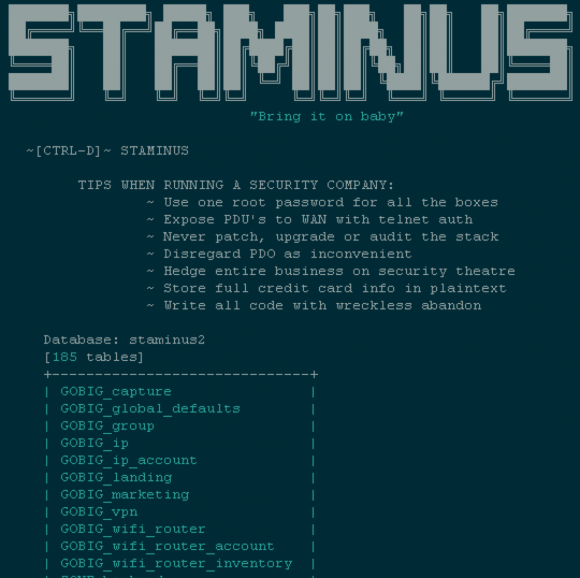
Staminus Communications Inc ., a California-based Internet hosting provider that specializes in protecting customers from massive “distributed denial of service” (DDoS) attacks aimed at knocking sites offline, has itself apparently been massively hacked. Staminus’s entire network was down for more than 20 hours until Thursday evening, leaving customers to vent their rage on the company’s Facebook and Twitter pages. In the midst of the outage, someone posted online download links for what appear to be Staminus’s customer credentials, support tickets, credit card numbers and other sensitive data. Newport Beach, Calif.-based Staminus first acknowledged an issue on its social media pages because the company’s Web site was unavailable much of Thursday. “Around 5am PST today, a rare event cascaded across multiple routers in a system wide event, making our backbone unavailable,” Staminus wrote to its customers. “Our technicians quickly began working to identify the problem. We understand and share your frustration. We currently have all hands on deck working to restore service but have no ETA for full recovery.” Staminus now says its global services are back online, and that ancillary services are being brought back online. However, the company’s Web site still displays a black page with a short message directing customers to Staminus’s social media pages. Meanwhile, a huge trove of data appeared online Thursday, in a classic “hacker e-zine” format entitled, “Fuck ’em all.” The page includes links to download databases reportedly stolen from Staminus and from Intreppid, another Staminus project that targets customers looking for protection against large DDoS attacks. The authors of this particular e-zine indicated that they seized control over most or all of Staminus’s Internet routers and reset the devices to their factory settings. They also accuse Staminus of “using one root password for all the boxes,” and of storing customer credit card data in plain text, which is violation of payment card industry standards. Staminus so far has not offered any additional details about what may have caused the outage, nor has it acknowledged any kind of intrusion. Several Twitter accounts associated with people who claim to be Staminus customers frustrated by the outage say they have confirmed seeing their own account credentials in the trove of data dumped online. I’ve sent multiple requests for comment to Staminus, which is no doubt busy with more pressing matters at the moment. I’ll update this post in the event I hear back from them. It is not unusual for attackers to target Anti-DDoS providers. After all, they typically host many customers whose content or message might be offensive — even hateful — speech to many. For example, among the company’s many other clients is kkk-dot-com, the official home page of the Ku Klux Klan (KKK) white supremacist group. In addition, Staminus appears to be hosting a large number of internet relay chat (IRC) networks, text-based communities that are often the staging grounds for large-scale DDoS attack services. Source: https://krebsonsecurity.com/2016/03/hackers-target-anti-ddos-firm-staminus/
More:
Hackers Target Anti-DDoS Firm Staminus

Brief Downtime Disrupts Bitcoin Exchange Trading

Another day in the Bitcoin world and another crisis has been averted, even though plenty of users were worried when several exchanges experienced the same issue at the same time. Incapsula, the DDoS protection provider for several major Bitcoin exchanges, was experiencing some issues earlier today. As a result, trading was temporarily unavailable, although the issue was rectified rather quickly. However, this “centralized” form of protection is an annoyance for a decentralized ecosystem. While it is of the utmost important for Bitcoin exchanges to have some form of DDoS protection, it is not helpful if all of these platforms use one and the same provider. Bitcoin and digital currency are all about decentralization, yet companies seem to be using one centralized security solution. Granted, Incapsula is one of the market leaders when it comes to DDoS and platform protection services. It only makes sense when companies such as BTCC , Bitstamp , BitFinex , Vaultoro , and others have taken a liking to this company. Not that there is anything wrong with that, as long as there is no outage as Incapsula itself. There is no mention on the Incapsula Twitter account as to what went wrong exactly, or how the matter was resolved in the end. Whichever way the company handled this issue, the issue was sorted in a matter of minutes, which is commendable. Nor do any of the affected Bitcoin exchanges posted any messages on social media either, which is quite disconcerting. Security is the top priority for any Bitcoin exchange platform, as most companies act as a custodian while watching over customer funds. DDoS attacks, hacking attempts, and database breaches need to be avoided at all costs.Incapsula is a well-respected company capable of delivering such a service. But at the same time, this situation begs the question if there are no other companies who can provide this service as well. Granted, security is an innovative business in the online world right now, and there are hundreds of companies in existence who want to be market leaders. Incapsula has secured their spot already– for now – but other players need to emerge and collaborate with Bitcoin platforms to create more decentralization in the security department. Source: http://themerkle.com/news/brief-incapsula-downtime-disrupts-bitcoin-exchange-trading/

Read the article:
Brief Downtime Disrupts Bitcoin Exchange Trading

DDoS protection biz Incapsula knackers its customers’ websites

An unwelcome PITSTOP Glitches at distributed denial-of-service mitigation biz Incapsula left the websites it defends offline twice on Thursday.…

Taken from:
DDoS protection biz Incapsula knackers its customers’ websites

Health orgs hit with cyberattacks every month

Healthcare organizations “are in the crosshairs” of cyber attackers, suffering one hack per month over the last year, with about half experiencing an incident involving the loss or exposure of patient information and another third unsure whether or not data was exposed, according to a new report. Conducted by the Ponemon Institute for security software company ESET, the report questioned 535 IT security practitioners from a variety of healthcare organizations, including private and public providers as well as government agencies, and found an industry beset by security breaches of all kinds. “With cyber attacks against healthcare organizations growing increasingly frequent and complex, there is more pressure to refine cybersecurity strategies,” the report’s authors wrote. “The State of Cybersecurity in Healthcare Organizations” also found that organizations struggle to deal with a variety of threats, including system failures (79 percent), unsecure medical devices (77 percent), cyberattackers (77 percent), employee-owned mobile devices or BYOD (76 percent), identity thieves (73 percent) and unsecure mobile devices (72 percent). Despite citing unsecure medical devices as a top security threat, only 27 percent of respondents said their organization has guidelines for medical devices as part of its cybersecurity strategy. The most common security incident sited was the exploitation of existing software vulnerabilities greater than three months old, according to 78 percent of respondents. Web-borne malware attacks were named by 75 percent of respondents. Following next were exploits of existing software vulnerability less than three months old (70 percent), spear phishing (69 percent) and lost or stolen devices (61 percent), according to the study. What’s more, participating organizations were only partly effective at preventing attacks. Almost half (49 percent) said their organizations experienced situations when cyberattacks have evaded their intrusion prevention systems (IPS), but many respondents (27 percent) were unsure.  Another 37 percent said their organizations have experienced cyber attacks that evaded their anti-virus (AV) solutions or traditional security controls but 25 percent were unsure. On average, organizations have an APT incident every three months. Only 26 percent of respondents say their organizations have systems and controls in place to detect and stop advanced persistent threats (APTs) and 21 percent are unsure. On average, over a 12-month period, organizations had an APT attack about every 3 months (3.46 APT-related incidents in one year), the survey said. As for the consequences of theses breaches, 63 percent of respondents said the primary consequences of APTs and zero day attacks were IT downtime, followed by the inability to provide services (46 percent), while 44 percent said these incidents resulted in the theft of personal information. In addition, DDoS attacks have cost organizations on average $1.32 million in the past 12 months, the survey said. Healthcare organizations in the report spend an average of $23 million on IT and approximately 12 percent is allocated to information security. “Since an average of $1.3 million is spent annually just to deal with DDoS attacks, the business case can be made to increase technology investments to reduce the frequency of successful attacks,” the report said. Source: http://www.govhealthit.com/news/ponemon-health-orgs-hit-cyberattacks-every-month

More:
Health orgs hit with cyberattacks every month

Cyber-crooks now prefer ransomware to botnets. Yep, firms are paying up

CryptoWall most prevalent nasty – survey File-encrypting ransomware has eclipsed botnets to become the main threat to enterprises, according to Trend Micro.…

Continued here:
Cyber-crooks now prefer ransomware to botnets. Yep, firms are paying up

Customers of large NZ website company Zeald have been hit by DDoS attack

Customers of a large New Zealand website design company have had their websites shut down due to a cyber attack believed to target one or more of the company’s customers. Customers of Zeald were informed on Thursday that some clients had experienced outages with their websites in recent weeks. The company, formed in 2001, with thousands of customers in New Zealand and Australia, has told clients the outages were caused by Distributed Denial of Service (DDoS) attacks. These attacks attempt to make an online service unavailable by overwhelming it with traffic from multiple sources. They present a major challenge to making sure people can publish and access important information. “Simply put, a DDoS attack simulates millions of computers trying to access a website at the same time. This puts tremendous stress on the online infrastructure, and can make access to a website difficult, or impossible,” the company said in its email. “We believe these attacks are targeted at one of our customers,” it said. It said the attacks were difficult to resolve and were a rapidly expanding class of security attack. They did not involve ‘hacking’ and did not lead to the loss of confidential information, but they made it impossible to access a site. “They can be created by attackers with limited technical skill but options for dealing with them are extremely limited”. “Working with our upstream providers, we have been able to stop these attacks temporarily by blocking international traffic. Unfortunately, these attacks keep resuming and are no longer isolated to international traffic alone. These attacks are also causing major issues for our upstream providers as well as the other websites and services that they provide,” it said. “If you have experienced any kind of extortion attempt or communication threatening an attack like this please let us know. Any feedback regarding recent threats will be treated in the strictest confidence. If we know the target of the attack there are measures we can put in place to eliminate the problem”. Source: http://www.stuff.co.nz/technology/77539929/customers-of-large-nz-website-company-zeald-have-been-hit-by-cyber-attack

Excerpt from:
Customers of large NZ website company Zeald have been hit by DDoS attack

Repeat DDoS and web application attacks become the norm

Akamai Technologies has shared the latest DDoS and web application attacks numbers in its Q4 2015 State of the Internet report. DDoS attack activity at a glance During Q4, repeat DDoS attacks were the norm, with an average of 24 attacks per targeted customer in Q4. Three targets were subject to more than 100 attacks each and one customer suffered 188 attacks – an average of more than two per day. During Q4, Akamai mitigated … More ?

Visit site:
Repeat DDoS and web application attacks become the norm

You don’t need a website to get hit by DDoS

Just because your business doesn’t have a website, that doesn’t mean it can’t be a victim of a DDoS (distributed denial of service) attack. This sentence might not make much sense at this point, but keep reading. Security firm Kaspersky Lab and researchers B2B International looked at what cyber-crooks go for when attacking businesses and enterprises, and here’s what they came up with: Last year, 16 per cent of companies (globally), were victims of a DDoS attack. Among enterprises, the percentage jumps up to 24. For most, external activities, such as websites, were targeted. Among half, websites had been hit, logins and portals were attacked in 38 per cent of cases, while communications services were attacked 37 per cent of times. Transactional systems had been affected in 25 per cent of cases. But also, in 25 per cent of cases, file servers had been hit, and 15 per cent said their operational systems were targeted. Another 15 per cent said a DDoS attack hit their ISP network connectivity. “It’s important to take a DDoS attack seriously. It’s a relatively easy crime to perpetrate, but the effect on business continuity can be far-reaching. Our study found that alongside the well-publicised impact of an attack, such as website downtime, reputational damage and unhappy customers, DDoS hits can reach deep into a company’s internal systems. It doesn’t matter how small the company is, or whether or not it has a website; if you’re online, you’re a potential target. Unprotected operational systems are just as vulnerable to a DDoS attack as the external website, and any disruption can stop a business in its tracks,” said Evgeny Vigovsky, Head of Kaspersky DDoS Protection, Kaspersky Lab. Source: http://www.itproportal.com/2016/02/29/you-dont-need-a-website-to-get-hit-by-ddos/  

See the original article here:
You don’t need a website to get hit by DDoS

Project Shield: Latest Google product could protect start-up websites from hacker DDoS attacks

On 24 February, Google and its parent company Alphabet opened the doors to Project Shield, a service designed to protect independent news websites with controversial geopolitical messages from distributed denial-of-service (DDoS) attacks. The project, which originates from the Google Ideas branch that was recently extended and rebranded as Jigsaw, has come out of an invite-only beta and is now freely available to any website not owned by a government or political party that passes through the application process. According to a Wired report, sites that have successful applications to the project will then be able to change their site’s domain name configuration which so that it redirects to a Google server. This server effectively creates a “reverse-proxy”, which then filters out malicious traffic. Google claims in an accompanying video (below) that decision to help independent websites from suffering the wrath of hackers is to reduce forced censorship, via online blackouts, for those sites that are delivering sensitive news in regions of political turmoil and/or upheaval. An example given for an early case of Project Shield’s use covers how Yahyanejad, the editor-in-chief of Balatarian.com , managed to take advantage of Google’s system to effectively null a swathe of DDoS digital strikes presumed to be intended to suppress the site’s coverage of the 2009 Iranian presidential election. “Just about anyone who’s published anything interesting has come under an attack at some point,” said Project Shield lead George Conard. “The smaller and more independent voices often don’t have the resources, whether technical or financial, to really put good protections in place…That’s where we come into the picture.” The catch, however, could be a deal breaker for some, despite the obvious positives of the service. While Alphabet executive director Eric Schmidt talks of using Jigsaw-produced schemes as being purpose-built to enable “technology to tackle the toughest geopolitical challenges,” any website making use of Project Shield is required to give Google access to its raw data logs on who is accessing the site itself. While this may cause privacy concerns, the company confirmed to Wired that the data logs will only be kept for a maximum of two weeks. Project Shield product manager CJ Adams said: “We’ve made it very explicit we don’t have the rights to commercialise anything that comes through.” Source: http://www.ibtimes.co.uk/project-shield-latest-google-product-could-protect-start-websites-hacker-ddos-attacks-1546036

Originally posted here:
Project Shield: Latest Google product could protect start-up websites from hacker DDoS attacks