Many people outside China know about the country’s Great Firewall, but probably assume it will have little, if any, impact on their own online activities. However, a fascinating post on Benjamin Sonntag’s blog explains how one of the servers of La Quadrature du Net, the Paris-based digital freedom association he co-founded, and for which his company provides free hosting, was hit by distributed denial of service attacks (DDOS) caused directly by the Great Firewall’s policies. His blog post provides all the technical details: it turned out that the vast majority of the attacks were coming from Chinese IP addresses. Here’s what seems to have happened: China is censoring its Internet, that’s well known to do this, this country censors (among others) DNS [Domain Name System] queries in its network (and also censoring as a side effect, the rare Japanese, Korean or Taiwanese queries going through China) when it answers a DNS query to a censored website, it answers with “any incorrect IP address” instead. That is, instead of letting Chinese Net users access “forbidden” content, the Great Firewall generally re-directs them to some random, presumably harmless, site. But that wasn’t happening here: we see spikes of requests to websites censored in China coming to IP addresses such as those of La Quadrature du Net. Other people had this same issue : http://furbo.org/2015/01/22/fear-china/ So, the end story is that we just saw censored websites requests coming to La Quadrature du Net’s IP address from China, due to how the Chinese Internet censorship is working! Rather than pushing limited traffic to lots of sites, the Great Firewall was sending lots of traffic to just a few. Among the possible explanations for this new behavior, Sonntag offers two that are equally worrying: Maybe one of the system administrator of the great firewall of China is gaining some small and quick money selling DDOS, selling Internet attacks to the highest bidder (in bitcoin? ) and using that censorship system as a weapon Maybe China chose a precise list of targets to send censored traffic to, adding to this technical “useful” process (the censorship) a “nice” one (putting down foreign opponents’ websites)… La Quadrature du Net, as a digital freedom association, seems to be too nice a target (among others of course). Neither is good news for sites in the West. Whatever the real reason for this DDOS attack on La Quadrature, it certainly shows that the operation of the Great Firewall of China can have very direct effects outside that country. Another reason, perhaps, for those in the West to pay closer attention to China’s increasingly harsh approach to online censorship. Source: https://www.techdirt.com/articles/20150204/09454829910/how-great-firewall-china-caused-ddos-attack-france.shtml
More:
How The Great Firewall Of China Caused A DDoS Attack In France
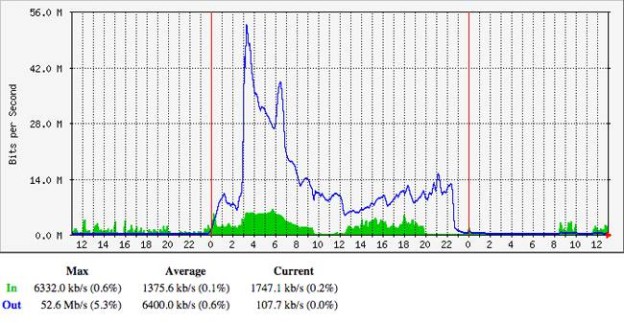
 An upgrade to China’s Great Firewall is having knock-on effects all over the internet, with seemingly random sites experiencing massive traffic spikes. One site owner in North Carolina, Craig Hockenberry, has written up how, after he looked into why his mail server was down, he found 52Mbps of search traffic piling into his system: 13,000 requests per second, or roughly a third of Google’s search traffic. The post goes into some detail over howHockenberry managed to deal with the firehose-blast of requests, all of it coming from China and much of it trying to find Bittorrents or reach Facebook. Short version: he blocked all of China’s IP blocks. Hockenberry is not the only one dealing with a sudden flood of requests, though. There are numerous reports of sysadmins finding that their IP address has appeared in front of the headlights of the Chinese government’s censorship juggernaut, causing them to fall over and forcing them to introduce blocking measures to get back online. After a number of different theories about what was happening, including focussed DDoS attacks and “foreign hackers” – that suggestion courtesy of the Chinese government itself – the overall conclusion of the technical community is that bugs have been introduced into China’s firewall. Particularly, something seems to have gone wrong in how it uses DNS cache poisoning to redirect users away from sites the government doesn’t want them to see. Poison China uses a weak spot of the DNS system to intercept requests coming into and going out of the country. If it spots something it doesn’t like – such as a request for “facebook.com” or “twitter.com” – it redirects that request to a different IP address. For a long while, China simply sent these requests into the ether – i.e. to IP addresses that don’t exist, which has the effect of causing the requests to time out. However, possibly in order to analyze the traffic more, the country has started sending requests to IP addresses used by real servers. Unfortunately, it seems that there have been some configuration mishaps and the wrong IP addresses have been entered. When one wrong number means that a server on the other side of the world suddenly gets hits with the full stream of millions of Chinese users requesting information, well then … that server falls over. The situation has had a broader impact within China. Tens of millions of users weren’t able to access the Web while the government scrambled to fix the problem. According to one Chinese anti-virus vendor, Qihoo 360, two-thirds of Chinese websites were caught up in the mess. China’s DNS infrastructure experts started pointing the finger at unknown assailants outside its system. “The industry needs to give more attention to prevent stronger DNS-related attacks,” said Li Xiaodong, executive director of China’s Internet Network Information Center (CNNIC). Your own medicine The reality, however, is that China has seen the downside to its efforts to reconfigure the basic underpinnings of the domain name system to meet political ends. The network is designed to be widely distributed and route around anything that prevents effective communication. By setting itself up as a bottleneck – and an increasingly huge bottleneck as more and more Chinese users get online – the Chinese government is making itself a single point of failure. The slightest error in its configurations will blast traffic in uncertain directions as well as cut off its own users from the internet. For years, experts have been warning about the “balkanization” of the internet, where governments impose greater and greater constraints within their borders and end up effectively breaking up the global internet. What has not been covered in much detail is the downside to the countries themselves if they try to control their users’ requests, yet make mistakes. Source: http://www.theregister.co.uk/2015/01/26/great_firewall_of_china_ddos_bug/