The list of DDoS attacks in the month of June has made for grim reading. High-profile sites have been targeted by extortion demands, online games got disrupted and at least one company was put out of business as a direct result. While it’s tempting to look for a single cause at the root of this apparent tsunami of distributed denial-of-service activity, the reality is considerably more complex. Online activism, the profit motive and even potential nation-state activity contributed to June’s high volume of DDoS attacks. The only commonality, in fact, may be the ease with which DDoS attacks can be launched. Experts like Molly Sauter, an academic and author of the forthcoming book The Coming Swarm, say that the process is childishly simple. “Literally, if you have a credit card and if you’re bored, it could be anyone,” Sauter told Network World. “It’s so easy to rent a botnet – most of them are out of Russia – and you can rent one for stupid cheap, and then deploy it for a couple of hours, and that’s really all you need to target a major site like Feedly or Evernote.” Sauter’s research focuses on the socio-political aspects of technology. She highlights the attacks, earlier in June, on websites connected to the World Cup’s sponsors and backers, which used the iconography of Anonymous. “I’m seeing a lot of Anonymous-oriented DDoS actions,” she said. Anonymous, according to Sauter, is a useful “brand” for politically motivated DDoS attacks, allowing groups to identify themselves with a particular flavor of political thought, despite no organizational connection to other activists. But the highest-profile attacks in the U.S. this June were not politically motivated – the DDoS attempts that took down RSS reader Feedly and note-taking and personal organization service Evernote drew big headlines, and Feedly, at least, was asked for ransom by its attackers. Feedly didn’t pay up, and, according to Forrester principal analyst Rick Holland, that’s probably for the best. “There’s no guarantee that they’re not going to continue to DDoS you,” he said. “It’s like regular extortion – you start paying people off and then, suddenly, they’re going to keep coming back to you every month.” Holland stopped short of urging a blanket refusal to pay off DDoS extortionists, however, saying that companies need to decide their own cases for themselves, in close consultation with their legal teams. He doesn’t know of any companies that have paid a DDoS ransom, but said that it wouldn’t surprise him to learn that it has happened. “I wouldn’t be surprised if people have gotten DDoS, it didn’t go public, they paid a ransom and that was that, but I have not specifically had those conversations,” he said. IDC research manager John Grady said that the increasing primacy of online services means that extortion-based DDoS attacks are becoming a more serious threat. “When there are direct ties from resource availability to revenue, targeting availability is a quick way to get someone’s attention,” he said. Grady echoed both Sauter’s point about the general cheapness of botnets and Holland’s argument that paying the ransom doesn’t make a company proof against further attacks. What’s more, he said, the growing power of some types of attack swings the balance of power further in favor of the attackers. “Increasingly, the ease of amplifying attacks through DNS or NTP, which can ramp traffic up in the hundreds of gigabit range that we’ve seen become common, gives attacks real economies of scale,” Grady said. Research from Forrester shows that, in addition to volumetric attacks like DNS and NTP (which essentially flood targets with unwanted data), targeted application-level attacks have been on the rise. Application-level incidents had been seen by 42% of DDoS victims surveyed in a 2013 report – just shy of the 44% that suffered volumetric attacks. Moreover, 37% used some combination of techniques. According to a report from Infonetics, that trend has prompted increasing attention for application-level mitigation technology. “An increasing number of application-layer attacks, which older DDoS detection and mitigation infrastructure can’t identify and block, are forcing companies to make new investments in DDoS solutions,” wrote principal security analyst Jeff Wilson in December. What this means is that a DDoS attack, whether it’s motivated by politics or money, is an increasingly unequal struggle. Attack techniques have become easier, cheaper and more powerful at the same time as their effects have become more damaging – and defensive measures have failed to keep pace. “The cost of entry is very low for the attackers and the cost to defend is very high for the targets,” said Holland. He said that the best defense may be to simply be as forewarned as possible, and to make plans in advance for potential DDoS incidents. Many businesses haven’t even considered the potential ramifications of a DDoS. Source: http://www.networkworld.com/article/2449855/security0/bloody-june-what-s-behind-last-month-s-ddos-attacks.html
Continue reading here:
June – The month of DDoS attacks
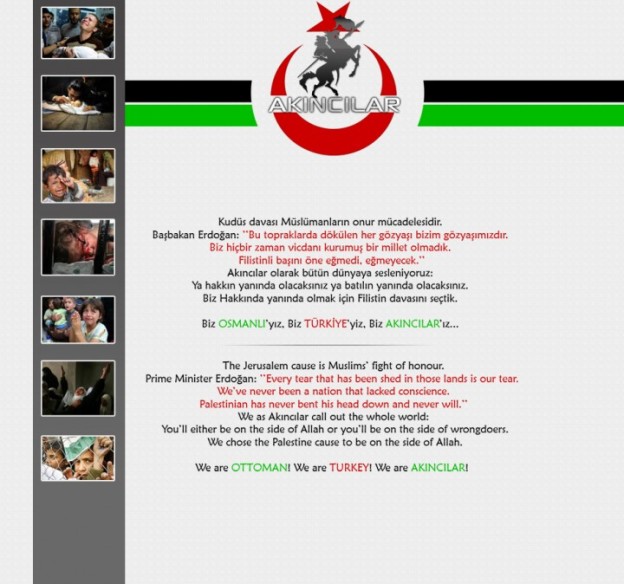
 Hacker collective Anonymous has announced that it has taken down over a thousand of crucial Israeli websites in a huge new coordinated cyber-attack called #OpSaveGaza on 11 July and 17 July, in support of the people of Palestine. Some of the websites, such as the Tel Aviv Police Department’s online presence, are still offline two days after the distributed denial of service (DDoS) attacks, and numerous Israeli government homepages have been replaced by graphics, slogans, and auto-playing audio files made by AnonGhost, the team of hackers who coordinated the attack. The official Israeli government jobs website has had its homepage replaced by a graphic titled “Akincilar”, which is Turkish for the Ottoman Empire’s troops. Akincilar: A graphic and message protesting against the treatment of Palestinians is still replacing the homepage of certain Israeli government websites A message written in English and Turkish – presumably by Turkish hackers – and accompanied by pictures of Palestinians suffering says: “The Jerusalem cause is Muslims’ fight of honour” and says that people who fight for Palestine are “on the side of Allah”. Another Israeli government website now bears an AnonGhost graphic and lists the usernames of 38 hackers. An audio file that auto-plays when the page loads plays music and a synthesized newsreader clip, together with a message beseeching human rights organisations, hackers and activists to attack Israeli websites to become the “cyber shield, the voice for the forgotten people”. AnonGhost’s #OpSaveGaza message has been displayed on many Israeli websites Many of the websites have since been restored. The hackers have also leaked lists of Israeli government email addresses obtained by hacking websites of the Ministry of Immigrant Absorption, the Ministry of Justice, the Ministry of Culture and Sport, the Ministry of Housing and Construction and much more. Israeli websites belonging to restaurants, local businesses, associations, societies, academic foundations and even a symphony orchestra were also attacked, as well as a subdomain belonging to MSN Israel. A message on the main Pastebin page and some of the hacked websites reads : “The act of launching rockets from Gaza sector to Israhell is an acceptable and normal reaction against those pigs, it’s called Resistance and not terrorism. “Israhell never existed its only Palestine, it’s our home. If you are a Hacker, Activist, a Human Right Organisation then hack israel websites and expose to the world their crimes, show to the world how much blood is on their hands, blood of innocent children and women.” Anonymous has previously run another campaign in April targeting Israeli websites, although on a smaller scale. About 500 websites went offline during the OpIsrael campaign and the hackers released the phone numbers and email addresses of some Israeli officials. Source: http://www.ibtimes.co.uk/opsavegaza-anonymous-takes-down-1000-israeli-government-business-websites-1457269