
DDoS attacks can have an amplification factor of 26.5 An independent security researcher that goes by the name of MalwareTech has discovered a way in which he could abuse the ZeroAccess malware’s botnet to launch reflection DDoS attacks with an above-average amplification factor. ZeroAccess is a trojan that infects Windows computers and then starts communication with a C&C (command and control), which in turn tells the trojan to download various types of other, more dangerous malware, usually clickfraud bots or Bitcoin mining software, operating hidden from the user’s view. The ZeroAccess botnet appeared in 2011, and because of an effective rootkit component and P2P-like structure, it even managed to survive a takedown attempt orchestrated by Microsoft in December 2013. ZeroAccess botnet used for amplifying DDoS attacks MalwareTech discovered that ZeroAccess allowed its bots to relay messages from one to another, some acting like smaller servers (supernodes) while the rest were just end-points (workers). To relay orders from the C&C server to supernodes and workers, ZeroAccess used simple UDP packets. Because of its complex mesh structure, when a UDP packet arrived at a supernode, the bot would add more information to the packet, containing various details about the network’s structure. The supernode would add 408 bytes on top of the original 16, for a total of 242 bytes. Since UDP packets can have their destination address spoofed, an attacker that managed to map ZeroAccess’ bot network would be able to send UDP packets to its bots, some of which would then amplify the traffic by 26.5, sending it back to the spoofed destination (the victim’s IP). This scenario is your typical reflection DDoS attack , carrying a 26.5 amplification factor, which is more than double the typical 2-10 amplification factor seen in other types of reflection DDoS attacks. DDoS attacks worked even if bots were behind NATs Theoretically, this wouldn’t have been a problem, since most bots infect users that are sitting behind NATs (Network Address Translation), software programs that translate public IPs to private IP addresses, in order to maximize IPv4 address space usage. That meant that a vast majority of the ZeroAccess botnet wouldn’t have been accessible to a person carrying DDoS attacks via this technique. Unfortunately, MalwareTech found a way around this issue as well, allowing him to involve ZeroAccess supernode bots into DDoS attacks even if sitting behind a router. All of this is only theoretical since the researcher did not want to commit a crime just to test out his theory. Source: http://news.softpedia.com/news/malware-botnet-can-be-abused-to-launch-ddos-attacks-501869.shtml
See the original post:
Malware Botnet Can Be Abused to Launch DDoS Attacks
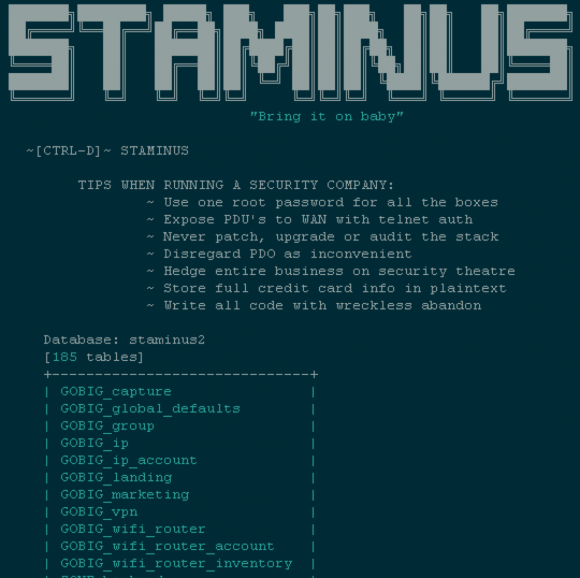
 Staminus Communications Inc ., a California-based Internet hosting provider that specializes in protecting customers from massive “distributed denial of service” (DDoS) attacks aimed at knocking sites offline, has itself apparently been massively hacked. Staminus’s entire network was down for more than 20 hours until Thursday evening, leaving customers to vent their rage on the company’s Facebook and Twitter pages. In the midst of the outage, someone posted online download links for what appear to be Staminus’s customer credentials, support tickets, credit card numbers and other sensitive data. Newport Beach, Calif.-based Staminus first acknowledged an issue on its social media pages because the company’s Web site was unavailable much of Thursday. “Around 5am PST today, a rare event cascaded across multiple routers in a system wide event, making our backbone unavailable,” Staminus wrote to its customers. “Our technicians quickly began working to identify the problem. We understand and share your frustration. We currently have all hands on deck working to restore service but have no ETA for full recovery.” Staminus now says its global services are back online, and that ancillary services are being brought back online. However, the company’s Web site still displays a black page with a short message directing customers to Staminus’s social media pages. Meanwhile, a huge trove of data appeared online Thursday, in a classic “hacker e-zine” format entitled, “Fuck ’em all.” The page includes links to download databases reportedly stolen from Staminus and from Intreppid, another Staminus project that targets customers looking for protection against large DDoS attacks. The authors of this particular e-zine indicated that they seized control over most or all of Staminus’s Internet routers and reset the devices to their factory settings. They also accuse Staminus of “using one root password for all the boxes,” and of storing customer credit card data in plain text, which is violation of payment card industry standards. Staminus so far has not offered any additional details about what may have caused the outage, nor has it acknowledged any kind of intrusion. Several Twitter accounts associated with people who claim to be Staminus customers frustrated by the outage say they have confirmed seeing their own account credentials in the trove of data dumped online. I’ve sent multiple requests for comment to Staminus, which is no doubt busy with more pressing matters at the moment. I’ll update this post in the event I hear back from them. It is not unusual for attackers to target Anti-DDoS providers. After all, they typically host many customers whose content or message might be offensive — even hateful — speech to many. For example, among the company’s many other clients is kkk-dot-com, the official home page of the Ku Klux Klan (KKK) white supremacist group. In addition, Staminus appears to be hosting a large number of internet relay chat (IRC) networks, text-based communities that are often the staging grounds for large-scale DDoS attack services. Source: https://krebsonsecurity.com/2016/03/hackers-target-anti-ddos-firm-staminus/