
More Distributed Denial of Service (DDoS) attacks originated in China than in any other country, followed by Germany and the United States, according to the Q1 2015 State of the Internet – Security Report by cloud services provider Akamai. China is responsible for 23.45% of the world’s DDoS attacks , malicious attempts to make servers unavailable to users by interrupting the services of a host connected to the Internet, while 17.39% came from Germany and 12.18% from the US. The number of Chinese DDoS has risen 66% in attack source IPs compared with the US, although researchers say it could be attributed to the increase in redirected traffic from Asia. The United States was the origin of 32% of DDoS attacks in Q4 2014, with China at 18%. The percentage drop does not indicate a decline in attacks from these countries, but rather a change in proportions as the number of total DDoS attacks worldwide soars. DDoS attacks have increased 117% quarter-over-quarter and 35% quarter-on-quarter. The quarter set a record for the number of DDoS attacks observed over the Prolexic network, while the attack duration is now 43% longer than in Q1 2014, according to the report. The US was the top source country of attacking IPs, at 52%, followed by China at 11% and Brazil at 6%, among source countries for web application attacks. US-based websites were the most targeted for web application attacks in Q1 2015, receiving 82% of attacks , while no other country was targeted for more than 2% of attacks. Retail, media/entertainment and hotel/travel were the most targeted industries for web application attacks in Q1 2015. This stems from previous attacks on the financial service sector, which hardened its security policy significantly. Meanwhile, retail and media attacks and breaches of 2014 signaled that these industries were softer targets, leading attackers to probe them for vulnerabilities. Source: http://www.hotforsecurity.com/blog/china-overtakes-us-as-top-source-of-distributed-denial-of-service-attacks-11929.html
More:
China Overtakes US as Top Source of Distributed Denial of Service Attacks

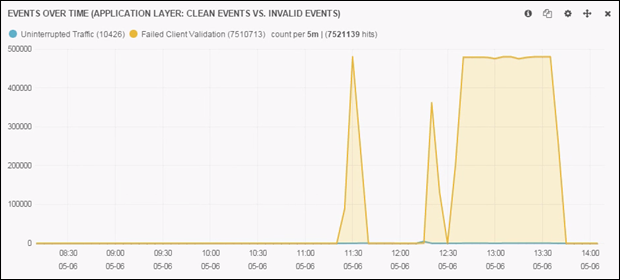
 In 2012, Anonymous introduced HOIC (high orbit ion cannon) as a replacement to LOIC (low orbit ion cannon). Unlike its predecessors, that were built upon C#, and later java. This new DDoS player was built upon the unsuspecting language of Visual Basic. Taught in high school classrooms, Visual Basic was largely seen by the programming community as a means for kids and young programmers to get their feet wet in the experience of programming. Considered by many programmers as grossly inefficient and a memory hog; Visual Basic was an unsuspected carrier for what would become one of the most powerful means of DDoS. One of the popular notions of HOIC has been its ability to randomize variables such as: user agent, referrer and URI, during an attack. In the same manner, an attack tool known as HULK (developed by: Barry Shteiman, 2012), written in Python, was developed in recent history. Within a controlled environment we tested these DDoS tools to judge their effectiveness and total output. In controlled trials the DDoS output of LOIC (Visual Basic on Windows) outperforms the DDoS output HULK (Python on Linux) by +40%. Figure 1: HOIC Test in Stable Windows Environment Figure 2: HULK Test While many of us in the Internet security industry ridicule and downplay the “kiddie hacker;” it is clear that it sometimes only takes a kiddie to build an empire. Lessons in open source economics teach us that in an open access environment, it takes only a small few to bring about radical change and innovation. Today HOIC has become one of the primary tools of groups such as anonymous. From this lesson, we can expect that challenges and sudden changes, will not come from those paid hundreds of thousands a year; but from those small few kiddies, whom are politically motivated and are paid nothing. Source: http://www.dosarrest.com/ddos-blog/how-visual-basic-broke-modern-python-welcome-to-the-world-of-high-orbit-ion-cannon/