
When you start with the premise that capitalism is illegitimate it’s easy to dismiss other people’s property rights. To some people, a political mission matters more than anything, including your rights. Such people (the Bolsheviks come to mind) have caused a great deal of damage and suffering throughout history, especially in the last 100 years or so. Now they’re taking their mission online. You better not get in their way. Molly Sauter, a doctoral student at the Berkman Center at Harvard (“exploring cyberspace, sharing its study & pioneering its development”), has a paper calling the use of DDOS (distributed denial of service) attacks a legitimate form of activism and protest. This can’t go unchallenged. Sauter notes the severe penalties for DDOS attacks under “…Title 18, Section 1030 (a)(5) of the US Code, otherwise known as the CFAA” (Computer Fraud and Abuse Act). This section is short enough that I may as well quote it here verbatim: (5)(A) [Whoever] knowingly causes the transmission of a program, information, code, or command, and as a result of such conduct, intentionally causes damage without authorization, to a protected computer; (B) intentionally accesses a protected computer without authorization, and as a result of such conduct, recklessly causes damage; or (C) intentionally accesses a protected computer without authorization, and as a result of such conduct, causes damage and loss. There are other problems with the CFAA with respect to some legitimate security research and whether it technically falls afoul of the act, but that’s not the issue here. Sauter goes on in some detail with the penalties under Federal law for violating this act and, no argument here, they are extreme and excessive. You can easily end up with many years in prison. This is, in fact, a problem generally true of Federal law, the number of crimes under which has grown insanely in the last 30 or so years, with the penalties growing proportionately. For an informed and intelligent rant on the problem I recommend Three Felonies a Day by Harvey Silverglate. Back to hacktivist DDOS attacks. She cites cases of DDOS attacks committed against Koch Industries, Paypal, the Church of Scientology and Lufthansa Airlines, some of these by the hacktivists who call themselves Anonymous. In the US cases of the attacks against Koch, Paypal and the Church, the attackers received prison time and large fines and restitution payments. In the Lufthansa case, in a German court, the attacker was sentenced to pay a fine or serve 90 days in jail; that sentence was overturned on appeal. The court ruled that “…the online demonstration did not constitute a show of force but was intended to influence public opinion.” This is the sort of progressive opinion, dismissive of property rights, that Sauter regrets is not happening here in the US. She notes, and this makes sense to me, that the draconian penalties in the CFAA induce guilty pleas from defendants, preventing the opportunity for a Lufthansa-like precedent. This is part and parcel of the same outrageous growth of Federal criminal law I mentioned earlier; you’ll find the same incentive to plead guilty, even if you’re just flat-out innocent, all over the US Code. I would join Sauter in calling for some sanity in the sentencing in the CFAA, but I part ways with her argument that political motives are a mitigating, even excusing factor. Sauter’s logic rises from a foundation of anti-capitalism: …it would appear that the online space is being or has already been abdicated to a capitalist-commercial governance structure, which happily merges the interests of corporate capitalism with those of the post-9/11 security state while eliding democratic values of political participation and protest, all in the name of ‘stability.’ Once you determine that capitalism is illegitimate, respect for other people’s property rights is no longer a problem. Fortunately, the law protects people against the likes of Anonymous and other anti-capitalist heroes of the far left. I would not have known or cared about Sauter’s article had it not been for a favorable link to it by Bruce Schneier. Schneier is a Fellow at the Berkman Center. Progressives and other leftists who think DDOS, i.e. impeding the business of a person or entity with whom you disagree in order to make a political point, should consider the shoe on the other foot. If I disagree with Schneier’s positions is it cool for me to crash his web site or those of other organizations with which he is affiliated, such as the Berkman Center, the New America Foundation’s Open Technology Institute, the Electronic Frontier Foundation, the Electronic Privacy Information Center and BT (formerly British Telecom)? I could apply the same principle to anti-abortion protesters impeding access to a clinic. I’m disappointed with Schneier for implying with his link that it’s legitimate to engage in DDOS attacks for political purposes. It’s worth repeating that Sauter has a point about the CFAA, particularly with respect to the sentences. It does need to be reformed — along with a large chunk of other Federal law. The point of these laws is supposed to be to protect people against the offenses of others, not to protect the offender. Source: http://www.zdnet.com/researcher-makes-the-case-for-ddos-attacks-7000034560/
See the original article here:
Researcher makes the case for DDOS attacks
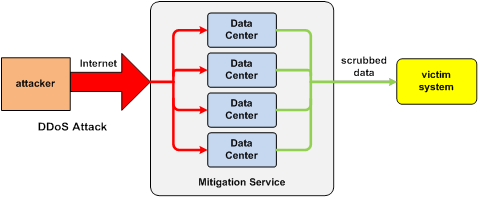
 Various defense strategies can be invoked to defend against DDoS attacks. Many of these depend upon the intensity of the attack. We discuss some of these in this article. Mitigation Strategies Some protection from DDoS attacks can be provided by firewalls and intrusion-prevention systems (systems that monitor for malicious activity). When a DDoS attack begins, it is important to determine the method or methods that the attacker is using. The web site’s front-end networking devices and the server’s processing flow may be able to be reconfigured to stop the attack. UDP Attacks UDP (User Datagram Protocol) attacks send a mass of UDP requests to a victim system, which must respond to each request. One example is a ping attack. It is an enormous influx of ping requests from an attacker that requires the victim server to respond with ping responses. Another example of a UDP attack is when the Internet Control Message Protocol (ICMP) must be used by the server to return error messages. The messages may indicate that a requested service is unavailable or that a host or router cannot be reached. An attacker may send UDP messages to random ports on the victim server, and the server must respond with a “port unreachable” ICMP message. Mitigation Strategy In the case of a UDP attack, the firewall could be configured to reject all UDP messages. True, this would prevent legitimate use of UDP messages, such as pings sent by monitoring services to measure the uptimes and response times of the web site. However, to be shown as failed by a monitoring service is much better than actually being down. SYN Attacks In a SYN attack, a mass of connection requests are sent to the victim server via SYN messages. Typically, the victim server will assign connection resources and will respond with SYN ACK messages. The server expects the requesting client to complete the connections with ACK messages. However, the attacker never completes the connections; and the server soon runs out of resources to handle further connection requests. Mitigation Strategy In this case, the server connection facility could be reconfigured so that it did not assign connection resources until it received the ACK from the client. This would slightly extend the time required to establish a connection but would protect the server from being overwhelmed by this sort of an attack. DNS Reflection Attack A DNS reflection attack allows an attacker to send a massive amount of malicious traffic to a victim server by generating a relatively small amount of traffic. DNS requests with a spoofed victim address are sent to multiple DNS systems to resolve a URL. The DNS servers respond to the victim system with DNS responses. What makes this sort of attack so efficient is that the DNS response is about 100 times as large as the DNS request. Therefore, the attacker only needs to generate 1% of the traffic that will be sent to the victim system. DNS reflection attacks depend upon DNS open resolvers that will accept requests from anywhere on the Internet. DNS open resolvers were supposed to have been removed from the Internet, but 27 million still remain. Mitigation Strategy A defense against DNS reflection attacks is to allow only DNS responses from the domain of the victim server to be passed to the server. Mitigation Services Given a sufficiently large DDoSattack, even the steps mentioned here may not protect a system. If nothing else, the attack can overwhelm the bandwidth of the victim’s connection to the Internet. In such cases, the next step is to use the services of a DDoS mitigation company with large data centers that can spread the attack volume over multiple data centers and can scrub the traffic to separate bad traffic from legitimate traffic. Prolexic, Tata Communications, AT&T, Verisign, CloudFare, and others are examples of DDoS mitigation providers. These services will also monitor the nature of the attack and will adjust their defenses to be effective in the face of an attacker that modifies its strategies as the attack progresses. Legality DDoS attacks are specifically outlawed by many countries. Violators in the U.K. can serve up to ten years in prison. The U.S. has similar penalties, as do most major countries. However, there are many countries from which DDoS attacks can be launched without penalty. With respect to the Spamhaus attack described in Part 1, the CEO of CyberBunker, a Dutch company, was arrested in Spain and was returned to the Netherlands for prosecution. Summary Companies must prepare for the likelihood of losing their public-facing web services and must make plans for how they will continue in operation if these services are taken down. This should be a major topic in their Business Continuity Plans. For instance, in the case of the bank attacks described in Part 1, many banks made plans to significantly increase their call center capabilities to handle customer services should their web sites be taken down by a DDoS attack. DDoS attacks are here to stay. They are motivated by too many factors – retaliation, political statements, aggressive competitors, ransom – and are fairly easy to launch. Botnets can be rented inexpensively. There are even sophisticated tools available on the darknet to launch significant attacks. The defenses against DDoS attacks are at best limited. The ultimate defense is to subscribe to a DDoS mitigation service that can be called upon when needed. Source: http://www.techproessentials.com/ddos-attacks-can-take-down-your-online-services-part-3-defending-against-ddos-attacks/