
According to an independent report published in Korea’s JoongAng Daily, Seoul’s Metropolitan Police Agency has intercepted a cyber attack plot orchestrated by North Korea’s Reconnaissance General Bureau, which successfully shipped malware-infected games to South Korean users which were later on used to launch a DDoS attack against the web site of Incheon Airport. More details: According to the police, the South Korean man, identified by the surname Jo, traveled to Shenyang, northeastern China, starting in September 2009 and met agents of an alleged North Korean trading company. He allegedly asked them to develop game software to be used in the South. Jo purchased dozens of computer game software for tens of millions of won, which was a third the cost of the same kind of software in the South. The games were infected with malignant viruses, of which Jo knew, an official at the police agency said. Jo sold the games to South Korean operators of online games. When people played the games, the viruses used their computers as zombies, through which the cyberattack was launched. This is the second attempt by North Korea in recent months to engage in electronic warfare with South Korea, following the use of GPS jammers causing difficulties in air and marine traffic controls. What’s particularly interesting about North Korea’s infection vector in this campaign, is that it’s not a novel approach to spread malware. Instead, it relies on a chain of trust, from the unknown origin of the produced games, to the sellers claims that they are malware-free, and ultimately targets bargain hunters. In the past, software piracy has proven to be a key driving force behind the growth of malware campaigns internationally. Distribution of malware-infected games greatly reminds me of a case which happened in Eastern Europe in the 90s where a malware coder participating in a popular IT magazine’s coding contest, on purposely backdoored his game, which ended being shipped to thousands of subscribers on a magazine-branded CD. Although a good example of a flawed QA (Quality Assurance) on behalf of the magazine, South Korean authorities claim that the person who purchased the games actually knew that they were infected with malware, hence the lower price for purchasing them. Just how big of a cyber threat is North Korea? It’s an emerging market player, having actively invested in the concept over the years, that’s for sure. In my recent conversation with cyber warfare expert Jeffrey Carr, he pointed out that he doubts Russia or China will knowingly supply the irrational North Korea with cyber warfare ‘know how’. However, Russia or China’s chain of command doesn’t need to know that this outsourcing will ever take place, as North Korea could easily outsource to sophisticated cybercriminals doing it for the money, not for the fame. Summary: Seoul’s Metropolitan Police Agency has intercepted a cyber attack plot orchestrated by North Korea’s Reconnaissance General Bureau, which successfully shipped malware-infected games to South Korean users. Source: http://www.zdnet.com/blog/security/north-korea-ships-malware-infected-games-to-south-korean-users-uses-them-to-launch-ddos-attacks/12383
See more here:
North Korea ships malware-infected games to South Korean users, uses them to launch DDoS attacks
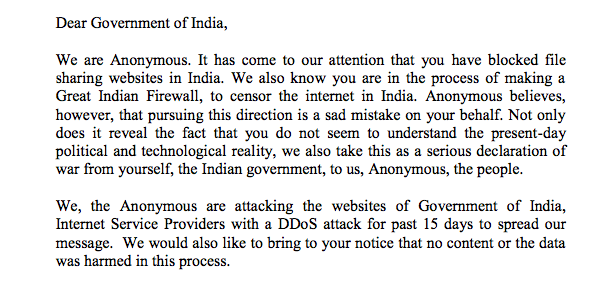
 Last night hacktivist group Anonymous sent out an open letter to the government of India criticizing the government and ISP companies for blocking torrent and video sharing websites. While doing so, the group clarified the definition of a DDoS attack, a type of online attack the group has been ravaging against government websites. Less of a threatening letter and more of a Hacking 101 course book for the government and mainstream media alike, Anonymous clarified that a DDoS attack is not a hack, which is legally defined as unauthorized access to a network. In fact, a DDoS attack is overflowing the server capacity by an excess of user traffic, or in simpler terms a traffic jam of sorts occurs at website server due to the enormous traffic attracted, in this case the large influx of anonymous group members. Anonymous believes this is a peaceful way to protest the government blocks and also states how websites were blocked when there was no court order asking for specific sites to be blocked like the Air India employee Facebook protest pages. The group has made its intentions clear to go after the government and its supporters, the ISPs that are blocking access to torrents and some other sites like Vimeo. It is also urging Indians to participate in peaceful demonstrations across the country on June 9. In meantime read the whole letter below. Source: http://www.bgr.in/news/anonymous-open-letter-to-indian-govt-claims-ddos-attack-on-sites-are-legal/