
CloudFlare spotted a new botnet in the wild which launched massive DDoS attacks aimed at the US West Coast for 10 days in a row. A new monster botnet, which hasn’t been given a name yet, has been spotted in the wild launching massive DDoS attacks. Security experts at CloudFlare said the emerging botnet is not related to Mirai, but it is capable of enormous distributed denial-of-service attacks. If this new botnet is just starting up, it could eventually be as powerful as Mirai. The company has so far spent 10 days fending off DDoS attacks aimed at targets on the US West Coast; the strongest attacks peaked at over 480 gigabits per second (Gbps) and 200 million packets per second (Mpps). CloudFlare first detected the new botnet on November 23; peaking at 400 Gbps and 172 Mpps, the DDoS attack hammered on targets “non-stop for almost exactly 8.5 hours” before the attack ended. CloudFlare’s John Graham-Cumming noted, “It felt as if an attacker ‘worked’ a day and then went home.” The botnet DDoS attacks followed the same pattern the next day, like the attacker was “someone working at a desk job,” except the attacks began 30 minutes earlier. On the third day, the attacks reached over 480 Gbps and 200 Mpps before the attacker decided to knock off a bit early from ‘work.’ Once Thanksgiving, Black Friday and Cyber Monday were over, the attacker changed patterns and started working 24 hours a day. The attacks continued for 10 days; each day the DDoS attacks “were peaking at 400 Gbps and hitting 320 Gbps for hours on end.” That’s not as powerful as the Mirai botnet made up of insecure IoT devices, but this botnet is presumably just getting started. It’s already plenty big enough to bring a site to its knees for hours on end unless it has some decent form of DDoS protection. If it were to be combined with other botnet strains, it might be capable of beating the unprecedented records set by the Mirai attacks. Although CloudFlare never elaborated on what devices the new botnet was abusing for its attacks, the company said it uses different attack software then Mirai. The emerging botnet sends very large Layer 3 and Layer 4 floods aimed at the TCP protocol. Hopefully it’s not using poorly secured internet of things devices as there seems to be an endless supply of IoT devices with pitiful-to-no security waiting to be added to botnets. That’s likely going to get worse, since IoT gadgets are expected to sell in record-breaking numbers this holiday season. It’s just a guess, but it does seem likely that the new botnet is aimed at such devices. CloudFlare posted the new botnet information on Friday, so it is unknown if the attacks have continued since the article was published. Last week, a modified version of the Mirai IoT malware was responsible for creating chaos in Germany and other worldwide locations; the hackers reportedly responsible for attempting to add routers to their botnet apologized for knocking Deutsche Telekom customers offline as it was allegedly not their intention. DDoS attacks may give a blue Christmas to gamers Regarding DDoS attacks, the most recent Akamai State of the Internet/Security Report suggested that gamers might not have the best holiday season. For the past several years, hackers have attacked and sometimes taken down Microsoft’s Xbox and Sony’s PlayStation networks, even Steam, making it impossible for seasoned gamers as well as those who received new gaming platforms for Christmas to enjoy new games and consoles. “Thanksgiving, Christmas, and the holiday season in general have long been characterized by a rise in the threat of DDoS attacks,” the Akamai report stated. “Malicious actors have new tools – IoT botnets – that will almost certainly be used in the coming quarter.” As first pointed out by Network World’s Tim Greene, Akamai added, “It is very likely that malicious actors are now working diligently to understand how they can capture their own huge botnet of IoT devices to create the next largest DDoS ever.” Let’s hope the newly discovered botnet isn’t an example of Akamai’s prediction. Source:http://www.computerworld.com/article/3147081/security/new-botnet-launching-daily-massive-ddos-attacks.html
View article:
New botnet launching daily massive DDoS attacks

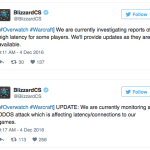 Miscreants have struck Blizzard servers again with multiple waves of DDoS attacks over the last 12 hours. Warcraft and Overwatch, two massively popular games, have been facing latency, login and disconnection issues even while Blizzard has been working on fixing the problem. The company first acknowledged the problem in a tweet Sunday evening. Since then, Blizzard claimed to have regained control over matters at its end, only to announce twice the DDoS attacks had restarted. Its last update, at 11:42 p.m. EST Sunday, came three hours after the last wave of DDoS attacks. On Twitter, a group calling itself Phantom Squad claimed responsibility for the attack Blizzard also provided a link to a support page on its website that may help some users troubleshoot their connection problems. As always, social media was abuzz with users venting their frustration at the gaming servers being affected. This is at least the fifth such instance in the last few months. The company also has a scheduled maintenance coming up Tuesday. Source: http://www.ibtimes.com/warcraft-overwatch-down-blizzard-ddos-attacks-affect-gaming-service-2454782
 Forbes’ Thomas Fox-Brewster recently reported on a DDoS-for-hire tool. For $7500, anyone who wanted to cause a little online mayhem could rent an army of 100,000 bots. Its controllers boasted that the Mirai-based botnet could unleash attacks of 1 Terabit per second or more. Now there’s a new DDoS service that’s powered by four times as many bots. 400,000 of anything sounds like a lot, but how big is that in botnet terms? A security researcher who goes by the handle MalwareTech told Bleeping Computer’s Catalin Cimpanu that this new Mirai botnet is larger than all other the Mirai botnets combined . It’s being actively promoted on the Dark Web, and its handlers are even willing to give free demonstrations of its considerable capabilities to potential customers. You don’t have to rent all 400,000 bots if you don’t want to. A customer can specify how many bots they want to rent for an attack, the duration of the attack, and the length of the “cool-down period” they’re willing to accept so the bots don’t get overtaxed. Prices are adjusted accordingly, a Bitcoin payment is made, and customers are given an Onion URL to access the botnet’s controls so they can launch their attack. Access to a service like this doesn’t come cheap. Cimpanu was quoted $3,000 to $4,000 to utilize 50,000 bots for a two-week attack with 1-hour bursts and a 5-10 minute cool-down. Apart from the massive number of bots this Mirai botnet has at its disposal, Cimpanu notes something else that differentiates it from the others. This botnet has the ability to circumvent certain DDoS mitigation techniques. Its creators have given it the ability to broadcast fake IP addresses, which makes the attacks much more difficult to disrupt. It also has one prominent attack under its belt already: the one last month that targeted a mobile telecom provider’s network in Liberia. Though reports after the fact showed that the whole country was not ever knocked completely offline, this botnet definitely seems to have the capacity to make that happen. Aimed at the right servers, a fraction of its 400,000 bots can cause widespread disruptions. Just look at what a single gamer with money to burn and an axe to grind with the Playstation Network did to Internet users all over the east coast this month. Source: http://www.forbes.com/sites/leemathews/2016/11/29/worlds-biggest-mirai-botnet-is-being-rented-out-for-ddos-attacks/#5a31b930465a