Category Archives: DDoS Criminals

UK nuclear stations on terror alert for cyber attacks

The cyber security industry has been urged to co-operate with government to protect UK critical national infrastructure from cyber attacks. UK security services have reportedly told nuclear power stations to bolster their cyber defences in the face of increased threats. Government officials have warned that terrorists, foreign spies and “hacktivists” are looking to exploit “vulnerabilities” in the nuclear industry’s internet defences, according to the Telegraph. UK energy minister Jesse Norman is quoted as saying that nuclear plants must make sure that they “remain resilient to evolving cyber threats”. However, he said the government is fully committed to defending the UK against cyber threats, and that the Civil Nuclear Cyber Securty Strategypublished in February 2017 sets out ways to ensure that the civil nuclear sector can defend against, recover from and remain resilient to evolving cyber threats. According to the strategy, the volume and complexity of cyber attacks against the UK are growing and the range of actors is widening. “The threat is becoming increasingly global and asymmetric. Both states and non-state actors can use easily-available cyber tools for destructive purposes,” the strategy states. The strategy sets out a voluntary roadmap to enable organisations in the civil nuclear sector to meet the increasing threat from cyber, and will support the development of cyber security capability of the sector, ensuring organisations will be able to comply with current and new regulation as well as being able to recover from compromises. However, for this to be achieved, the strategy said civil nuclear sector needs to work as a partnership between the government, regulator and industry, with clear roles and responsibilities which are understood and agreed. The strategy warns that the nuclear industry has to do more to protect itself, saying current mechanisms for sharing information in relation to vulnerabilities and how compromises have been addressed will need to be strengthened and enhanced to ensure good practice is shared, and continuous improvement can be made. In November 2016, veteran US investigative reporter Ted Koppel said a cyber attack on the US power grid is likely, but preparations for such an event are not up to scratch. “We are our own worst enemies,” he told Intel Security’s annual Focus conference in Las Vegas, saying that despite the risk of a cyber attack blackout, the US is unprepared for the consequences. Peter Carlisle, vice-president for Europe, Middle East and Africa at Thales e-Security believes cyber attacks against critical national infrastructure are set to increase dramatically as criminals develop “increasingly heinous methods” to jeopardise the UK’s national security. “From power stations to the transport network, the risk to the public remains severe, especially if hackers are able to gain access to electronic systems. “To tackle this, the security industry must stand shoulder to shoulder with the government to protect data and critical infrastructure from attack, and ensure hostile forces never have the opportunity to do us harm,” he said. Malcolm Murphy, technology director at network management firm Infoblox said attacks against IT networks are becoming increasingly common, and, if carried out against critical national infrastructure, can represent a significant threat to national security. “In addition to the damage caused to the networks themselves, a DDoS [distributed denial of service] attack on an organisation’s domain name system [DNS] can be used to prevent communication of and around the attacks, causing confusion and panic as seen in the attack on the Ukraine power grid in 2015,” he said. “The DNS is a mission-critical piece of network infrastructure used by all organisations without which networks cannot function. Often inadequately protected by traditional security solutions, it remains a vulnerable network component frequently used as an attack vector by cyber-criminals. “With botnets available for hire for relatively small sums of money online, DNS-based DDoS attacks are becoming increasingly easy for cyber criminals to carry out, and in their efforts to defend the country against the growing cyber threat, organisations responsible for the security of critical infrastructure should be making DNS protection a top priority,” he said. Most UK businesses have little visibility or control over their DNS servers and services, even though they are a key component of businesses’ infrastructure and security profile, a report published in March 2017 revealed. Only 8% of companies polled claim to have full visibility across all areas of DNS, including frequency of dropped requests, cache poisoning, latency and overall load on DNS infrastructure, rendering it impossible to ensure a consistent service to internal and external internet users. Source: http://www.computerweekly.com/news/450416097/UK-nuclear-stations-on-terror-alert-for-cyber-attacks

See the article here:
UK nuclear stations on terror alert for cyber attacks
Korean foreign ministry gets several DDoS attacks from China

The website of South Korea’s Ministry of Foreign Affairs has come under several cyberattacks originating from China but little damage has been reported so far, the ministry said Tuesday. “Several on-and-off DDoS attack attempts originating from China have taken place on websites including that of the Ministry of Foreign Affairs,” ministry spokesman Cho June-hyuck said in a press briefing. Defensive measures were immediately taken against the cyberattacks and no damage has been sustained, he said. The latest hacking attempts came as bilateral tensions remain high over the deployment of a US missile defense system in South Korea. Since the attempts, the foreign ministry has launched a special response team and distributed a response manual among the South Korean diplomatic missions in China, the spokesman noted. The spokesman did not elaborate on exactly who is behind the DDoS, or distributed denial of service, attacks, but they are the latest in a recent series of Chinese retaliations on South Korean industries and entities. A month earlier, the Chinese-language website of South Korean retail giant Lotte as well as its duty-free branch’s Chinese and Japanese-language websites sustained similar DDoS assaults, incurring heavy revenue losses. The attacks came as China stepped up its retaliatory actions over Seoul’s on-going deployment of the US missile interception system, Terminal High Altitude Area Defense. China vehemently protests the deployment which it said would compromise its security interests. “Our government pays attention to the Chinese government’s (past) expression of its consistent stance that it opposes any kind of cyberattack,” the ministry spokesman noted. “The government is expecting that (China) will continuously take responsible steps in accordance with the stance.” South Korea has also recently lodged a protest with the Chinese government after South Korean national flags were found destroyed in China, Cho said. “A national flag is a symbol of a nation’s dignity and the government takes very seriously the cases of destroyed Taegeukgi that took place in certain Chinese areas,” he said. “The government has officially lodged complaints with China on many occasions and demanded China take steps to address them immediately.” “In any case, the people-to-people exchange which is the foundation of the bilateral relationship should come under a man-made obstacle,” the spokesman said, adding that the South Korean government is trying to proactively react to China’s unjust measures in order to minimize any impact on South Korean companies. Referring to a media report alleging North Korean involvement in hacking attempts at a Poland bank and other international financial institutions, Cho also said that North Korea is likely to be using illegal cyber activities for a source of foreign currency earnings. “Given the international community’s concerns over the possibility that illegal income could be used for the development of weapons of mass destruction, North Korean cyber threats are emerging as new international threats along with its nuclear, missile and WMD threats.” (Yonhap) Source: http://www.koreaherald.com/view.php?ud=20170328000862

Follow this link:
Korean foreign ministry gets several DDoS attacks from China

Criminal benefits: profit margin of a DDoS attack can reach 95%

Kaspersky Lab’s researchers have discovered the full extent of the profit margins benefiting criminals from DDoS services that are available on the black market. Kaspersky Lab’s experts have studied the DDoS services available on the black market and determined just how far this illegal business has advanced, as well as the extent of its popularity and profitability. The worrying news is that arranging an attack costs as little as $7 an hour, while the targeted company can end up losing thousands, if not millions, of dollars. The level of service involved when arranging a DDoS attack on the black market is not very different from that of a legal business. The only difference is that there’s no direct contact between the provider and the customer. The ‘service providers’ offer a convenient site where customers, after registering, can select the service they need, pay for it, and receive a report about the attacks. In some cases, there is even a customer loyalty program, with clients receiving rewards or bonus points for each attack. There are a number of factors that affect the cost for the customer. One is the type of attack and its source: for example, a botnet made up of popular IoT devices is cheaper than a botnet of servers. However, not all those providing attack services are ready to specify such details. Another factor is the duration of the attack (measured in seconds, hours and days), and the client’s location. DDoS attacks on English-language websites, for example, are usually more expensive than similar attacks on Russian-language sites. Another big factor affecting the cost is the type of victim. Attacks on government websites and resources protected by dedicated anti-DDoS solutions are much more expensive, as the former are high risk, while the latter are more difficult to attack. For instance, on one DDoS-as-a-service website, the cost of an attack on an unprotected website ranges from $50 to $100, while an attack on a protected site costs $400 or more. It means a DDoS attack can cost anything from $5 for a 300-second attack, to $400 for 24 hours. The average price for an attack is around $25 per hour. Kaspersky Lab’s experts were also able to calculate that an attack using a cloud-based botnet of 1000 desktops is likely to cost the providers about $7 per hour. That means the cybercriminals organising DDoS attacks are making a profit of around $18 per hour. There is, however, yet another scenario that offers greater profitability for cybercriminals – it involves the attackers demanding a ransom from a target in return for not launching a DDoS attack, or to call off an ongoing attack. The ransom can be the bitcoin equivalent of thousands of dollars, meaning the profitability of a single attack can exceed 95 per cent. In fact, those carrying out the blackmail don’t even need to have the resources to launch an attack – sometimes the mere threat is enough. “We expect the profitability of DDoS attacks to continue to grow. As a result, will see them increasingly used to extort, disrupt and mask other more intrusive attacks on businesses. Worryingly, small and medium sized businesses are not confident in their knowledge of how to combat these threats effectively. The longest DDoS attack in 2016 lasted 292 hours according to Kaspersky Lab’s research, or about 12 days,” said says Russ Madley, head of B2B at Kaspersky Lab UK. “Most online businesses can ill-afford to have their ‘doors closed’ for even an hour, let alone for 292 hours, as criminals take advantage of their poor defences. Companies that host these online sites are also under attack on a daily basis. The channel has a significant opportunity with our help to identify risks, provide strategic advice and deliver the right solutions to customers to prevent damaging DDoS attacks.” Interestingly, some cybercriminals have no scruples about selling DDoS attacks alongside protection from them. Kaspersky Lab’s experts, however, do not recommend using criminal services. Source: http://www.information-age.com/connected-cities-suffer-catastrophic-blackouts-123465253/

Taken from:
Criminal benefits: profit margin of a DDoS attack can reach 95%

Did you know: Crimelords behind DDoS attacks offer customer loyalty points?

Tweaking business models for greater 404 kerching The DDoS attack business has advanced to the point that running an attack can cost as little as $7 an hour, while the targeted company can end up losing thousands, if not millions of dollars.…

View the original here:
Did you know: Crimelords behind DDoS attacks offer customer loyalty points?

The Short List of Who Protects Companies Against DDoS Attacks

Here’s a question: when was the last time you got something truly useful for free? Like that time it turned out your phone company was giving you mobile data even though it wasn’t included in the plan you selected, or that time you turned up at the car dealership for a major repair, and they informed you the cost was covered because you’re just such a great customer. Oh right: it was never. So why is it that so many companies seem to think somebody else is responsible for protecting them against distributed denial of service (DDoS) attacks? DDoS mitigation is an important and complex service that requires careful expertise, on-demand or always-on deployment, nearly limitless scalability and huge amounts of network bandwidth. If a company hasn’t taken the steps to invest in this kind of protection, they don’t have it. Attack overview A DDoS attack is a distributed denial of service attack, which is a cyberattack that uses a botnet, a network of internet-connected devices that have been hijacked for remote use, to direct large amounts of malicious traffic at a website that has been targeted. This traffic overwhelms the website, its server or its resources to take it offline or render it so frustratingly slow it can’t be used. Distributed denial of service attacks have been a problem for websites and organizations of all sizes for over 15 years, and the problem is becoming a crisis as DDoS for hire services steadily gain popularity, and botnets steadily gain in size due to unsecured Internet of Things devices. For larger organizations, a successful DDoS attack can cost between $20,000 and $100,000 per hour, and while unquantifiable, the loss of user trust or loyalty that can result from such an attack can be even worse. Erroneous assumptions DDoS attacks haven’t exactly been flying under the radar lately. Their frequency, as well as the threat they pose, should be well known to anyone working in online security. Yet a recent survey by Kaspersky uncovered some staggering statistics. Thirty percent of companies surveyed indicated that they haven’t taken action against the threat of DDoS attacks because they believe they won’t be targeted, 40% believe their ISP will provide protection, and a further 30% believe data centers will provide protection. Perhaps most misguided of all, 12% believe a small amount of DDoS-caused downtime would not have a negative impact on the company. Why ISPs won’t provide complete protection While some ISPs do provide complete DDoS protection as an added service that clients pay good money for, most provide only partial protection. Due to the large amounts of bandwidth an ISP has available, they can do well against large volumetric attacks, but craftier application layer attacks are a problem. Also, while ISPs can be good at identifying malicious traffic, they don’t deal with that malicious traffic efficiently, meaning that while it’s struggling to deal with an influx of malicious traffic, legitimate traffic will be caught in the bottleneck with it or even discarded alongside the bad traffic, resulting in users unable to get through to the website. In other words, while a basic DDoS attack could be thwarted by an ISP, the result – users unable to access the website – ends up being the same. Further, some DDoS attacks like the Slowloris are made up of traffic and requests that are seemingly legitimate, making them difficult to detect for even some intrusion detection systems, let alone an ISP. Perhaps the biggest problem with relying on an ISP for protection is that regardless of what type of attack is launched, there isn’t going to be a quick response from an ISP. They aren’t built for the kind of real-time monitoring and deployment that can catch an attack within seconds. Most often, it will be several hours before an ISP begins to deal with an attack. By then, the damage is done. Why data centers won’t provide complete protection either There’s a caveat here: just as with ISPs, some data centers do provide complete protection against distributed denial of service attacks, but again it is an added service that definitely adds to the data center bill. Similar to ISPs, data centers do provide some measure of DDoS protection, but it can generally only protect against basic attacks that can be stopped with rate limiters, or attacks that are not directly aimed at an application service. Large or complex attacks cannot be stopped by basic data center protection. Moreover, not only do ISPs and data centers not provide complete protection against DDoS attacks, but they also put their clients at a bigger risk of second-hand DDoS damage. If an ISP or data center is struggling with a large or complex attack, websites that weren’t targeted will nonetheless suffer the effects. A-Z protection Professional DDoS protection is built to provide the quickest, most proactive and most complete protection against distributed denial of service attacks. Cloud-based protection is especially excellent at protecting against both network-layer and application-layer attacks, and with the use of a scrubbing server, attack traffic will be kept from ever touching the target website while legitimate traffic is let through unfettered. For companies after a more bang-for-their-buck solution, it may be preferable to look into a quality content delivery network (CDN). CDNs are designed to improve site speed and performance, and all CDNs offer some level of DDoS protection due to the built-in load balancing that comes from their multi-server environments. However, CDNs will also offer additional DDoS protection on top of that. High-quality distributed denial of service protection won’t become a freebie or throw-in until the internet reaches a phase where there’s something so much worse and so much more common than DDoS attacks that they become almost after-thoughts for all the malicious cyberattackers out there. So companies can either root for that reality, or take protection into their own hands by investing in solid DDoS protection. Source: http://www.iotevolutionworld.com/iot/articles/430637-short-list-who-protects-companies-against-ddos-attacks.htm

Read More:
The Short List of Who Protects Companies Against DDoS Attacks

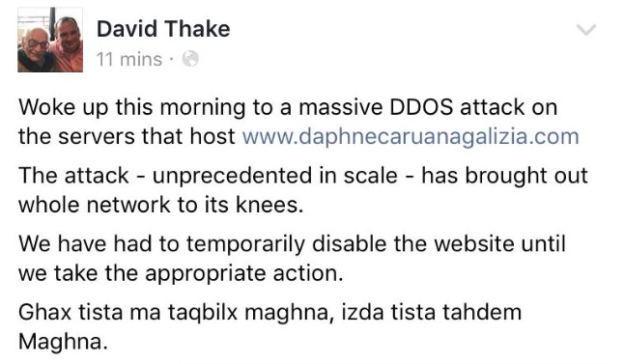
Servers hosting Daphne Caruana Galizia’s website suffer ‘unprecedented’ DDoS attack

The servers hosting Daphne Caruana Galizia’s personal blog have suffered a DDoS attack. A DDos (denial of service) attack occurs when many systems flood the bandwidth of a targeted system, in an attempt to make the online service unavailable. Mrs Caruana Galizia does not yet know who is behind the attack, but did say it is highly likely to be a person of Maltese nationality.. Prior to the DDoS attack on the servers, she said, a fake Gmail account was setup – similar to her personal email address. The person who created the account, then emailed two persons working for the company who handle software support for the website, and tried to acquire information required to hack the site through them. This, however, did not work and the software support personnel realised that it was not Mrs Caruana Galizia’s email address, and also the use of broken English in the email. This, she said, is what led her to believe that the person behind the attack is Maltese. The police were contacted aftewr the DDOS attack occurred later, and an investigation is ongoing. The fake Gmail address used a proxy server, and thus far no culprit has been identified, she said. She explained that aside from the crime involving the DDoS attack, impersonation is also a crime. Vanilla Communications, a server hosting company owned by David Thake, hosts Daphne Caruana Galizia’s personal blog – a service that she pays for each month, she said. In a Facebook post, Mr Thake said that the servers hosting her website suffered a DDoS attack which he called “unprecedented in scale.” Mr Thake, in his post, said the attack brought the network to its knees. Source: http://www.independent.com.mt/articles/2017-03-21/local-news/Servers-hosting-Daphne-Caruana-Galizia-s-website-suffer-unprecedented-DDOS-attack-6736171884

Follow this link:
Servers hosting Daphne Caruana Galizia’s website suffer ‘unprecedented’ DDoS attack

Web smut seekers take resurgent Ramnit malware from behind

? Botnet knocked down, but it gets up again ? Aficionados of salacious smut sites in the UK and Canada are picking up some nasty software that infects systems by using corrupted pop-under adverts.…

Read More:
Web smut seekers take resurgent Ramnit malware from behind

Russian bank Alfa Says it was Under DNS Botnet Attacks

The Russian banking giant Alfa announced, in a press statement, that hackers targeted its cyber infrastructure in a large-scale DNS Botnet attack. The purpose appears to have been to make it seem as though the bank had been communicating with the Trump Organization. The bank is now asking U.S. to assist it to uncover the culprits. On Friday, the bank revealed that their servers were under three cyber attacks targeting the domain name server (DNS) since mid-February. It is unclear who was behind these attacks; the details show unknown hackers allegedly used Amazon and Google servers to send requests to a Trump Organization server posing to look like they came from Alfa Bank, pushing the Trump server to respond back to the bank. An Alfa Bank spokesperson said: “The cyber attacks are an attempt by unknown parties to manufacture the illusion of contact between Alfa Bank’s DNS servers and ’Trump servers’’. Furthermore, Alfa Bank revealed that it is ready to work with the U.S. law enforcement agency to identify the individuals involved in the campaign. The bank has already hired Stroz Friedberg, a US-based cyber security firm to get into the depth of the matter. “The cyber attacks are an attempt by unknown parties to manufacture the illusion of contact between Alfa Bank’s DNS servers and ‘Trump servers,” an Alfa Bank representative said in a statement. “We have gone to the U.S. Justice Department and offered our complete cooperation to get to the bottom of this sham and fraud.” On February 18, 2017, the bank claims it experienced suspicious cyber activity from an unidentified third-party. Specifically, the unidentified third-party repeatedly sent suspicious DNS queries from servers in the U.S. to a Trump Organization server. The unidentified individuals made it look as though these queries originated from variants of MOSCow.ALFAintRa.nET. The use of upper and lower case indicated the human intervention in the process. Moreover, Alfa Bank says it received more than 1,340 DNS responses containing mail.trump-email.com.moscow.alfaintra.net. Last week, CNN reported that the FBI’s counterintelligence team was investigating if there was a computer server connection between the Trump Organization and Alfa Bank during the U.S. election, according to sources close to the investigation. The bank has now denied that there was ever a conversation between both parties. Mark McArdle, CTO at cyber security company eSentire commented on the issue and said that: “A botnet is typically associated with an attack that leverages scale, as it can employ thousands (potentially millions with IoT devices) of devices and use them to coordinate an attack on a target. We’ve seen this with some big DDoS attacks. We also see botnets being used as platforms for large-scale spamming. However, the number of DNS connections reported in the Alfa Bank attacks (1,340 in once case) don’t indicate massive scale. A botnet, however, can be used to add another layer of obfuscation between you and your attacker. Following the breadcrumbs back could bring you to a PVR that has been hacked and is now part of a botnet. I suspect in this case, the botnet is being used more for obfuscation of identity than scale. The attackers may be using a botnet to send spoofed DNS requests to a legitimate Trump server using a spoofed “reply-to” address inside Alfa-Bank’s infrastructure. Spoofing DNS lookups is not very difficult since DNS is not authenticated, and the ability to spoof source addresses is unfortunately still available – all you need is a system to launch your attack from that is connected to the Internet via an ISP that doesn’t filter out spoofed source addresses. While this type of attack has been around for a while, what’s new in this case is that someone is using it to try and contrive evidence of a relationship where neither party sought one. Additionally, there is also reference in Alfa Bank’s statement about Spam messages from marketing@trumphotels.com. It’s also possible to spoof email (spammers do this all the time). A spoofed email could include a reference to a legitimate Trump Org server and a real connection would be established if a user clicked on it (or selected “show images” in the email). Again, this does not mean the email came from Trump Org, just that it was sent in order to attempt to solicit “a connection” between Trump Org and Alfa-Bank.” Either way, identity is difficult to determine unless cryptographic certificates are used, and ultimate hack attribution is even more difficult. This is not the first time that allegations surrounding Trump’s relations with Russia have emerged. Some believe Russia hacked the US election to give Trump a way to win the presidency while some believe that Russian media was involved in spreading fake news against Trump’s opponent Hillary Clinton. Either way, nothing has been proven yet. Source: https://www.hackread.com/russia-alfa-bank-target-with-dns-botnet-attacks/

More:
Russian bank Alfa Says it was Under DNS Botnet Attacks

Standards and Security: The Great DDoS Challenge

Whether or not you work in IT security, distributed denial of service (DDoS) attacks are becoming more visible by the day. In the last three months of 2016 alone, DDoS attacks greater than 100Gbps increased by 140% year-on-year, according to a recent report. This growth isn’t expected to decelerate any time soon. The damage inflicted by DDoS attacks in the past year has been seen across various aspects of the online world. We often hear of news sites and political campaigns being taken offline, but this is now moving towards more mission critical operations in hospitals, banks and universities. The most significant example in recent months is the DDoS attack against Domain Name Service (DNS) provider Dyn. Let’s take a look at this case and determine the potential impact that conformance to existing standards could have had on the incident. IoT and the DDoS dilemma The Dyn attack in October 2016 impacted a whole host of major websites including Amazon, Netflix, Twitter, Spotify and Github, and was widely reported as the largest of its kind ever recorded. Its substantial impact was down to the huge number of connected devices used in the attack – not just laptops and PCs but routers, printers and baby monitors that make up the so-called Internet of Things (IoT). These devices were deliberately infected with the Mirai malware in order to create a botnet to carry out the momentous attack. It’s important to be clear on the mechanisms of the Mirai malware if we’re to consider the potential impact of standards on the attack. By using known passwords, it is able to search for susceptible IoT devices before infecting them with the malware. As a result, the device becomes part of a botnet which is capable of launching DDoS attacks from all of its infected devices. Seven out of 12 DDoS attacks in Q4 2016 were down to the Mirai botnet. In the Dyn case, it was estimated that the attack involved 100,000 malicious endpoints. The botnet sent around 1 TB of traffic per second to the company’s servers, meaning legitimate requests were denied. Mitigating DDoS attacks This attack was fundamentally a consequence of the devices involved still retaining their default password. There are two arguments as to where culpability lies in this instance. Some blame the users for not changing the default passwords once they were connected. Others feel more responsibility should fall on the manufacturers to ensure operators understand the importance of changing default passwords. In fact, in some cases manufacturers were distributing products with well-known default passwords and no option to change the password without purchasing a new product. In any case, these devices were vulnerable and open to attack. Standards: the silver bullet? DDoS attacks are becoming far more sophisticated so it’s essential that hardware and software manufacturers start to seriously consider standards to address the potential security risks in the growing Internet of Things. One key standard is the Open Trusted Technology Provider Standard, or O-TTPS, which addresses these issues around supply chain security and product integrity. Recently approved as ISO/IEC 20243, this set of best practices can be applied from design to disposal, throughout the supply chain and the entire product life cycle. Standards like the O-TTPS aim to reduce the risk of tainted (e.g., malware-enabled and malware-capable) and counterfeit hardware and software components from entering the supply chains and making their way into products that connect to the internet. This specific standard also has a conformance program that identifies Open Trusted Technology Providers who conform. The vendors involved in the Dyn incident could have followed the O-TTPS’ requirements for vulnerability analysis and notification of newly discovered and exploitable product weaknesses. If they had done so from the outset, the vulnerability that allowed the Mirai botnet to grow would have been caught early. The attack vector would have subsequently been blocked and the impact on businesses and consumers significantly reduced. Securing Information and Communication Technology (ICT) on which our business enterprises and critical infrastructures depend is a serious problem that becomes even more daunting and complex as we extend those environments to IoT devices. ICT and IoT devices are developed, manufactured, and assembled in multiple countries around the world. They are then distributed and connected globally. Providing international standards like the O-TTPS (ISO/IEC 20243) that all IT providers and their technology partners (e.g., component suppliers, manufacturers, value-add resellers) in their supply chains can adopt, regardless of locale, is one significant way to increase cyber and supply chain security. Standards can’t categorically prevent the inception of DDoS attacks, but what they can do is mitigate their effectiveness and limit their economic damage. The adoption of a universal product integrity and supply chain security standard is a major first step in the continued battle to secure ICT products and IoT devices and their associated end users. Further steps need to be taken in the form of collaboration, whereby we reach a point where we can recognise which technology and technology providers can be trusted and which cannot. But adhering to global standards provides a powerful tool for technology providers and component suppliers around the world to combat current and future DDoS attacks. Source: https://www.infosecurity-magazine.com/opinions/standards-security-great-ddos/

See more here:
Standards and Security: The Great DDoS Challenge