
Category Archives: DDoS Criminals

Taiwan high-tech industry hardest hit by DDoS attacks in last 30 days

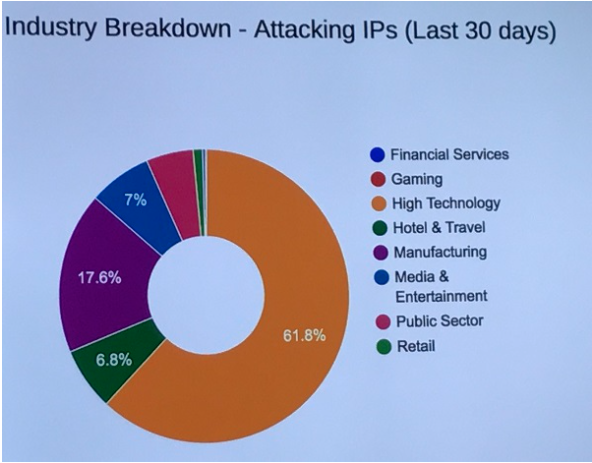
TAIPEI (Taiwan News)—Most denial-of-service (DDoS) attacks launched by hackers from Feb. 15 to March 14, 2017 in Taiwan targeted the high-tech industry, according to statistics compiled by leading global content delivery network provider Akamai Technologies. Industries in Taiwan that were most severely attacked by hackers were the high technology industry (61.8 percent), manufacturing industry (17.6 percent) and the financial services industry (7 percent), according to statistics compiled by Akamai’s intelligent platform that delivers 30 percent of the global Internet traffic. Industries in Taiwan under DDoS attacks from February 15 to March 14, 2017. (Taiwan News) The majority of the hacks were launched from IP addresses in Taiwan, followed by Alabama in the U.S., and Brazil. “It is often a misconception that most attacks are launched from abroad,” said Akamai’s Security Business Unit director Amol Mathur. “Attacks are coming both domestic and outside.” The premium CDN provider works customizes solutions for clients from different industries in Taiwan, including hospitality, banking, travel and airline services. Taiwan’s financial institutes are still recovering from a cybersecurity scare last month, in which 15 banks received threats from an anonymous hacker group to shell out 10 Bitcoins each (equivalent to US$10,466), or brace themselves for DDoS attacks that would compromise their server systems. DDoS attacks launched by hackers often compromise institute’s servers data processing capacity by delivering a sudden deluge of data that overtakes bandwidth resources, for instance if the company server bandwidth only allows 10 Gigabyte per second (Gbps) of capacity it can be paralyzed by a 100 Gbps attack. Hackers might use DDoS as a distraction to conceal other malign operations, such as stealing personal information or credential theft, added Mathur. Industries affected by hacker attacks vary monthly, depending on whether there is a major geopolitical event, said Mathur. For instance global hacker group Anonymous took down the London Stock Exchange system for two hours as part of its campaign against global central banks in June 2016. Mathur advised banks should not heed hacker demands to pay ransom. “In real life you would not pay ransom, so why would you pay hackers,” he said. The cybersecurity expert noted a rise in DDoS attacks globally during the fourth quarter of 2016, and pointed out DDoS attacks data size was increasing exponentially every quarter. Globally, attacks over 100 Gbps jumped 140 percent year-on-year during 4Q16, with the largest-size attack recorded reaching 517 Gbps, according to the Akamai “Fourth quarter 2016 State of the Internet/Security Report.” Mathur noted the cause of increased DDoS attacks was partly due to easy access for people to rent bots online, for as cheap as US$10 by going to a site and simply keying in the website address. Hackers can generate a monthly income of US$180,000 to US$200,000 from bot rentals. It remains extremely difficult for law enforcement agencies from a single country to track down hackers that spread the attacks launched by rented bots around the globe, and hide behind the protection of anonymity offered by the dark web. Additionally, the preferred Bitcoin currency used for business transactions by hackers is hard to trace to an IP address, explained Mathur. Introduction of mobile devices, mobile payment, IP surveillance cameras and emerging Internet of Things (IoT) trends introduce new cybersecurity vulnerabilities as hackers can utilize attacks through large number of connected devices. The Mirai bot for instance exposed vulnerabilities in the default user administrator name and passwords used by thousands of connected IP surveillance cameras and their DVR worldwide, said Mathur. He urged the IoT industry to form a joint standard, and for countries to start implementing regulations that set cybersecurity standards for connected devices. Hackers are also finding ways to target vulnerabilities in smartphone application programming interface (API) to obtain credentials, and data from mobile transactions. Apple Pay and some other mobile payment technologies periodically publish white papers announcing how it is securing data, but are mostly for tech savvy readers, said Mathur. One way consumers can safeguard credit card transactions is to check if the online shopping sites or App they use have The Payment Card Industry Data Security Standard (PCI DSS), noted Mathur. The proprietary information security standard launched nearly a decade ago by major credit card companies Visa, MasterCard, American Express, JCB and others follows a stringent standard and heavily fines companies that do not follow its compliance. Source: http://www.taiwannews.com.tw/en/news/3117326

Originally posted here:
Taiwan high-tech industry hardest hit by DDoS attacks in last 30 days

Oops! 185,000-plus Wi-Fi cameras on the web with insecure admin panels

Just unplug them now before someone writes a botnet, okay? Get ready for the next camera-botnet: a Chinese generic wireless webcam sold under more than 1,200 brands from 354 vendors has a buggy and exploitable embedded web server.…

Read More:
Oops! 185,000-plus Wi-Fi cameras on the web with insecure admin panels

How Homeland Security plans to end the scourge of DDoS attacks

The agency is working on a multimillion dollar effort to protect the country’s most critical systems from distributed denial of service attacks, which are among the simplest digital assaults to carry out and the toughest to fight. MARCH 8, 2017 —In late October, in Surprise, Ariz., more than 100 phone calls bombarded the police department’s emergency dispatch line. Calls also overwhelmed the nearby city of Peoria’s 911 system and departments across California and Texas. But each time a dispatcher picked up, no one was on the line – and there was no emergency. The Arizona district attorney’s office says the calls clogging 911 lines resulted from a digital prank, which triggered a distributed denial of service, or DDoS, attack on critical emergency communication systems. The prosecutor’s office tracked the torrent of calls to 18-year-old hacker Meetkumar Hiteshbhai Desai. Now, he’s facing four counts of felony computer tampering. While Mr. Desai said he didn’t intend to cause any harm, according to the Maricopa County Sheriff’s Office, he did surface a potentially devastating glitch in smartphone software that could exact damage on any number of sensitive and critical targets. Whenever anyone clicked a certain link on his webpage via a mobile device, their phone automatically dialed 911. While this kind of DDoS targeting 911 systems is unprecedented, it’s exactly the type of attack that national law enforcement officials have been concerned about for years. In fact, the Homeland Security Department (DHS) has been working on technology to protect 911 centers from DDoS and telephone-based, or TDoS, attacks for three years. The Arizona incident proved someone can “cause a large number of phones or a large number of computers or a large number of whatever connected device to start generating these calls,” says Dan Massey, program manager in the cybersecurity division of the DHS Science and Technology Directorate. “It went from how much damage can I do from my phone” to a situation where, with just a handful of people, “if all of our phones started calling some victim, whether that’s 911 or a bank or a hospital, that can get very fast and very big.” DDoS attacks are both among the simplest forms of cyberattacks to carry out and the most difficult to defend against. They are designed to direct an overwhelming amount of digital traffic – whether from robocalls or web traffic – at targets to overwhelm them so they can’t handle legitimate business. Writ large, there has been an exponential increase in the intensity and frequency of DDoS attacks over the past six months and critical infrastructure components are possible future targets, according to DHS. For a sense of the scale of today’s DDoS attacks, compare the 100 megabits per second Internet speed at a typical company to the more than 1 million megabits (1 terabit) per second speed of a DDoS attack against Web hosting company Dyn in October. The attack, which drew power from insecure webcams and other internet-connected devices, knocked out widely used online services like Netflix, Twitter, and Spotify for hours. Such massive web DDoS assaults may also become a problem for 911, as the country moves toward a next generation 911 system that uses mapping services to locate callers and can support voice, text, data, and video communication. “What you’re seeing is a convergence of the traditional internet with the phone system and next generation 911 is a great example of that,” says Massey. “DDoS attacks and/or TDoS attacks kind of blend together a little bit there.” To help combat the problem, the department has given out $14 million in grants for DDoS prevention studies, including phone-based attacks. Some of that funding is piloting initiatives to stop phone-based attacks at 911 centers in Miami/Dade County and the City of Houston, as well as at a large bank that the department wouldn’t identify. So far, DHS efforts have yielded, among other things, a DDoS early warning system to flag organizations that an attack may be coming, and alerting them to adjust internet network settings to defend against an onslaught of traffic. Additionally, DHS-funded research from tech firm SecureLogix produced a prototype that can thwart phony telephone calls sent to a 911 system or other critical phone operation. The model attempts to detect bogus calls by monitoring for clues that indicate an incoming call is fake. “As we have seen, it is simple to flood a 911 center, enterprise contact center, hospital, or other critical voice system with TDoS calls,” says Mark Collier, SecureLogix chief technology officer. “The research is essential to get ahead” because the assailants “are generating more attacks, the attacks are more sophisticated, and the magnitude of the attacks is increasing. “ To be sure, the race to keep digital adversaries out of the country’s 911 system faces obstacles, some of which are outside the jurisdiction of Homeland Security and dispatch centers. The DHS DDoS defense program is “a good start,” but one “challenge in defending certain types of critical infrastructure is the fact that emergency services like 911 must serve anyone – immediately,” per Federal Communications Commission rules, “due to their life saving nature,” said Mordechai Guri, research and development head at Israel’s Ben-Gurion University Cyber-Security Research Center. “The approach of blocking the DDoS originators must be backed by a change in the laws and regulations.” Before the October attacks on the Arizona 911 systems, he and fellow Ben-Gurion researchers warned that DDoS attacks launched from cellphones could pose a significant threat to emergency services. During one experiment, it took fewer than 6,000 hacked phones to clog emergency services in a simulated US state, the academics wrote in a September 2016 paper. Such an attack can potentially last for days. The very nature of the 911 system makes shutting out any callers potentially dangerous, and some alternatives, like requiring a person in distress to authenticate themselves for assistance, are not viable, says Massey of DHS. “We really need to make sure that we’re not missing a critical 911 call,” he says. “So that’s a challenge for the project to make sure that we’re not misclassifying people.” Source: http://www.csmonitor.com/World/Passcode/2017/0308/How-Homeland-Security-plans-to-end-the-scourge-of-DDoS-attacks

See more here:
How Homeland Security plans to end the scourge of DDoS attacks

7 Security Steps To Defend Your Company Fram A DDoS Attack

Of all the cybersecurity threats today’s businesses face, distributed denial-of-service (DDoS) attacks are among the most complex and devastating. This type of breach involves multiple compromised systems that work in conjunction to shut down service. Although security technology is becoming more sophisticated, so are hackers, and you don’t want to be caught unprepared if (or more likely, when) your company’s data gets compromised. Below, a few members of Forbes Technology Council each offer one important prevention measure to help your IT department defend against a DDoS attack. 1. Continue To Add Layers Of Defense Remain vigilant, continuing to add layers of security as they become available. Also provide your department with signs to look for so they have a better idea of potential threats. This provides for a much more proactive approach to security. – Chalmers Brown, Due 2. Practice Your Response Plan Have a plan on what to do and who should do it, then do a dry run against it a few times a year. Go further than just your IT team – involve your vendors, executive team, etc. and ask for feedback on what would help them help you in the face of a DDoS attack. Update your plan each time. This practice helps your team execute fast and has the added benefit of showing those around you that you’re prepared. – Brian Fritton, Patch of Land 3. Use A Web Application Firewall (WAF) A Web Application Firewall (WAF) is your best line of defense against a DDoS attack. It acts like an antivirus that blocks all malicious attacks on your website. It sits above your application at the network level to provide protection before the attacks reach your server. Using a WAF not only protects you against DDoS attacks, but also improves application performance and enhances user experience. – Thomas Griffin, OptinMonster 4. Leverage Cloud Services And Educate Yourself Continually Cloud providers will handle security better than you can do in-house — especially if you’re a target. Even the U.S. government leverages cloud providers to consult and augment security. Amazon has DDoS mitigation services, and their DNS is both inexpensive and secure. Educate yourself to stay aware of the potential threats and mitigation services that are available to you. – Tim Maliyil, AlertBoot 5. Help Employees Educate Each Other Since our inception, we’ve had a personal ‘buddy’ assigned to any new team member. They are responsible for teaching the new person all of the dos and don’ts of the department, and also get them more culturally aligned with the team/company. – Pin Chen, ONTRAPORT 6. Get Senior Management Involved In Security Planning It is critical for companies to include senior management in DDoS prevention planning. Most attacks are due to poor ongoing security practices or setups. Ransomware attacks alone cost over $1B in 2017. Companies should consider cloud solutions that offer cost-effective managed security solutions, with ongoing security and maintenance updates, so that they can focus on building their core business. – Cristina Dolan, Trading Screen 7. Segment Your IoT Devices Behind A Firewall While DDoS attacks are difficult to prevent, you can minimize the impact by enabling DDoS and flood protection on your organization’s firewalls. To restore order quickly in the event of an attack, develop a DDoS response plan. To minimize the chance of your IoT infrastructure being used in a DDoS attack, make sure all IoT devices are segmented on a dedicated safe zone behind a firewall. – Bill Conner, SonicWall Source: https://www.forbes.com/sites/forbestechcouncil/2017/03/07/7-security-steps-to-defend-your-company-fram-a-ddos-attack/#4a04a540408

Read more here:
7 Security Steps To Defend Your Company Fram A DDoS Attack

The power of Big Data for security, operations and DDoS protection

DDoS atacks are costly to your reputation and your bottom line. In this podcast recorded at RSA Conference 2017, Avi Freedman, CEO at Kentik, discusses how to recognize attacks quickly and accurately, then shut them down with situation-appropriate mitigation. Here’s a transcript of the podcast for your convenience. I’m Avi Freedman, CEO of a startup called Kentik Technologies, I’m here today, on this podcast, to talk about the power of Big Data for security, operations, … More ?

More:
The power of Big Data for security, operations and DDoS protection

Luxembourg government servers forced offline by DDoS attack

Authorities in Luxembourg have said that government servers had come under a DDoS attack on Monday. According to reports from the Luxemburger Wort, the attack started at 9.30 am, forcing the web servers of many state authorities offline or difficult to reach. Just over an hour later, the state-owned IT operator “Centre des Techniques de l’information de l’Etat” (CTIE) sent a message via Twitter, to confirm that the network was the victim of a DDoS attack. Reports by Luxemburg publication Paperjam said that over a hundred servers had been affected by the attack and that the attack impacted servers for more than 24 hours. Gilles Feith, chief of the CTIE government IT centre, said that this was the first-time Luxembourg authorities had been targeted to such an extent but could not confirm the origin of the attack. “Before it gets back to normal, it may take some time to wait,” said Feith, adding it may take “a few hours or even days.” Stephanie Weagle, VP, Corero Network Security, told SC Media UK that DDoS attacks have become many things over the last decade; weapons of cyberwarfare, security breach diversions and service impacting strategies. “The motivations for these attack campaigns are endless – financial, political, nation-state, extortion and everything in between,” she said. Weagle added: “Continuing to rely on traditional IT security solutions, and or human intervention to deal with the growing DDoS epidemic will continue to prove devastating to businesses. As recent events have confirmed once again, proactive, automated protection is required to keep the Internet connected business available in the face of DDoS attacks.” Pascal Geenens, Radware EMEA security evangelist, told SC Magazine that these days anyone has access to booter or stresser services or DDoS-for-hire. “Services are available on the Darknet as well as on the Clearnet and for just a couple of Euros one can launch a DDoS attack by a click of the mouse,” he said. Geenens added the release of the Mirai source code last October was a turning point. “We saw a huge rise in the number of botnets leveraging IoT devices (mostly IP cams and residential routers) and attacks grew in size. A 1Tbps attack should not come as a surprise today, the potential certainly is there.” He said the motivation behind DDoS attacks can be many things, combined with the user-friendly experience and low price provided by the services to perform them, the spectrum of motivations is only widening. “The main drive of most cyber-crime is still money, we have witnessed countless cyber-ransoms leveraging DDoS. This attack could be precursor of a larger RDoS. Attackers typically provide some proof they have the ability to interrupt the service, which is typically followed by a message with a demand for ransom and if the victim does not pay there will be an ultimatum followed by a much larger and longer attack.” Geenens said the number and size of DDoS attacks is growing and we do not predict this trend will slow in the near future. “My advice to any online business or government, it is five past 12, everybody is a potential target. Make DDoS protection a priority. UEBA is another technology that should be part of the strategy for organisations that carry important or sensitive information.” Source: https://www.scmagazineuk.com/luxembourg-government-servers-forced-offline-by-ddos-attack/article/641003/

View post:
Luxembourg government servers forced offline by DDoS attack

Advanced Windows botnet spreads Mirai malware

Kaspersky Lab experts are analyzing the first Windows-based spreader for the Mirai malware as part of a concerted effort to close down Mirai botnets in the wild. The Windows bot appears to have been created by a developer with more advanced skills than the attackers who unleashed the massive Mirai-powered DDoS attacks in late 2016, a fact that has worrying implications for the future use and targets of Mirai-based attacks. The malware author is likely … More ?

Read More:
Advanced Windows botnet spreads Mirai malware

74 Percent of Companies that Suffer a Data Breach Don’t Know How It Happened

And just two thirds of IT pros say their current IT security budget is sufficient, a recent survey found. According to the results of a recent survey [PDF] of 250 IT professionals, 34 percent of companies in the U.S. were breached in the past year, and 74 percent of the victims don’t know how it happened. The survey, conducted by iSense Solutions for Bitdefender, also found that two thirds of companies would pay an average of $124,000 to avoid public shaming after a breach, while 14 percent would pay more than $500,000. One third of CIOs say their job has become more important in their company’s hierarchy, and another third say their job has been completely transformed in the past few years. And while nine in 10 IT decision makers see IT security as a top priority for their companies, only two thirds say their IT security budget is suifficient — the remainder say they would need an increase of 34 percent on average to deliver efficient security policies. Cloud security spending increased in the past year at 48 percent of companies, while the budget for other security activities remained the same. On average, respondents say only 64 percent of cyber attacks can be stopped, detected or prevented with their current resources. Separately, a survey of 403 IT security professionals in the U.S., U.K., Canada and Europe found that only three percent of organizations have the technology in place and only 10 percent have the skills in place to address today’s leading attack types. The survey, conducted by Dimensional Research and sponsored by Tripwire, also found that just 44 percent of organizations have the skills, and 43 percent have the technology, to address ransomware attacks effectively. “Most organizations can reasonably handle one or two key threats, but the reality is they need to be able to defend against them all,” Tripwire senior director of IT security and risk strategy Tim Erlin said in a statement. “As part of the study, we asked respondents which attack types have the potential to do the greatest amount of damage to their organization. While ransomware was cited as the top threat, all organizations were extremely concerned about phishing, insider threats, vulnerability exploitation and DDoS attacks.” Respondents felt most confident in their skills to handle phishing (68 percent) and DDoS attacks (60 percent), but less confident in their abilities to deal with insider threats (48 percent) and vulnerability exploitations (45 percent). Similarly, respondents felt more confident in the technology they have in place to address phishing (56 percent) and DDoS attacks (63 percent), but less confident in the technology to address insider threats (41 percent) and vulnerabilities (40 percent). A separate survey of 5,000 U.S. consumers by Kaspersky Lab and HackerOne found that 22 percent of respondents are more likely to make a purchase if they know a company hired hackers to help boost security. Knowing what they do about their own company’s cyber security practices, just 36 percent of respondents said they would choose to be a customer of their own employer. Almost two in five U.S. adults don’t expect companies to pay a ransom if hit by ransomware. When asked what types of data they would expect a company to pay a ransom for, 43 percent expect companies to do so for employee Social Security numbers, followed by customer banking details (40 percent) and employee banking details (39 percent). Source: http://www.esecurityplanet.com/network-security/74-percent-of-companies-that-suffer-a-data-breach-dont-know-how-it-happened.html

Read this article:
74 Percent of Companies that Suffer a Data Breach Don’t Know How It Happened

Blame the US, not China, for the recent surge in massive cyberattacks

The internet’s new scourge is hugely damaging global attacks that harness armies of routers, cameras, and other connected gadgets—the so-called Internet of Things (IoT)—to direct floods of traffic that can take down swaths of the network. The blame so far has largely fallen on the Chinese manufacturers who churn out devices with shoddy security on the cheap. But all those devices have to be plugged in somewhere for them to used maliciously. And American consumers are increasingly the ones plugging them in. Nearly a quarter of the internet addresses behind these distributed denial-of-service, or DDoS, attacks are located in the United States, newresearch from network services firm Akamai has found. Some 180,000 US IP addresses took part in DDoS attacks in the last quarter of 2016, it found—more than four times as many as addresses originating in China. Akamai’s findings are particularly notable because the armies of hacked devices that carry out DDoS attacks—such as those controlled by the Mirai malware—don’t bother covering their tracks. That means the IP addresses are far more likely to genuinely correspond to a location within a certain country, the report’s authors write. The findings also end an era of Chinese dominance in DDoS attacks. Over the previous year, China has accounted for the highest proportion of IP addresses taking part in such attacks globally. Now the US is the clear leader, accounting for 24% of such addresses. The UK and Germany are a distant second and third. (To be clear, though, wherever the attacking devices’ IP addresses are, the person controlling them could be located anywhere.) The huge number of devices taking part in DDoS attacks in the US means regulation there, and in Europe, could stem the flood of damaging traffic. Of course, IoT regulation is a thorny issue—essentially, no US federal agency really wants to take the problem on—and there remain technical questions over how to actually go about blocking the attacks. Still, it’s a lot clearer now that simply pointing the finger at China isn’t enough. Source: https://qz.com/912419/akamai-akam-report-a-quarter-of-ddos-ip-addresses-are-now-from-the-us/

View article:
Blame the US, not China, for the recent surge in massive cyberattacks

Majority of DDoS Attacks in October-December 2016 Conducted From Germany, UK, US

According to reports, United States, the United Kingdom and Germany became the top three source countries for DDoS attacks in October-December 2016. MOSCOW (Sputnik) – The United States, the United Kingdom and Germany became the top three source countries for DDoS attacks in October-December 2016, an Internet company dubbed Akamai said in report Wednesday, adding that the overall number of attacks in 2016 increased by 4 percent compared to previous year. “The top three source countries for DDoS attacks were the U.S. (24%), the U.K. (10%), and Germany (7%). In the past year, China dominated the top 10 list of source countries. In Q4 2016, China dropped to the fourth position overall, with 6% of traffic,” the State of the Internet / Security Report said. Russia became the fifth country in the list, with 4.4 percent of attacks. “The average number of DDoS attacks remained steady this quarter [October-December 2016] at 30 per target, indicating that after the first attack, an organization has a high likelihood of experiencing another,” the report said. The study notes that the number of IP addresses, used for DDoS attacks, significantly increased in the last quarter of 2016. The report also provides data regarding attacks in January- September 2016, with China, the United States, Turkey and the United Kingdom being the top source countries for attacks. Source: https://sputniknews.com/world/201702151050711562-ddos-atacks-internet/

Visit link:
Majority of DDoS Attacks in October-December 2016 Conducted From Germany, UK, US