Category Archives: DDoS Vendors

What’s business continuity management and why does your business need it?

Reality check: Modern businesses rely on their digital capabilities now more than ever. Downtime has become a terrifying thing to even utter, let alone consider. This is why an effective business continuity plan has become a cornerstone in every business, with IT-centric businesses being no exception. Business Continuity is all about identifying what your key products are and what you can do to ensure that business continues as usual even in the case of disruptions or catastrophes, no matter the size or cause. In truth, business continuity planning is not such an alien concept even to regular consumers. Ever planned a holiday? Whenever planning a holiday, we think of the worst case scenarios and how we can come out of them unscathed, without ruining our well-earned trip. We set up plans in case something goes wrong with our ‘core services’ and we’re prepared for it. We search for additional taxi services in the area despite having booked a cab already, or we check for alternate routes should we rent a car. It’s never a good idea to go on a vacation unprepared for something to go wrong, and a business should be no different. Being the largest multi-site data centre provider in Malta, we are experienced in the business of keeping our customers’ systems online at all costs. The ideal IT services provider should strive to deliver a redundant solution in every component within their setup. At BMIT, we take great care in adopting this approach, from upgrading our core infrastructure services all the way to training our technical team to adopt best-practice methods for optimal business continuity management. Improving redundancy should always be the utmost priority when it comes to introducing new products within an IT Services provider’s portfolio. Business continuity planning is not such an alien concept even to regular consumers Studies show that the average total cost of unplanned application downtime per year is €1 billion to €2.5 billion for the Fortune 1000 companies. An hour of infrastructure failure costs an average of €100,000 with the number jumping fivefold to €500,000 to €1m in the case of a critical application failure; certainly not numbers to scoff at. The digital world undergoes changes every day and it is imperative to constantly keep working to ensure that the systems are up-to-date and relevant to the present realities. The introduction of new ranges of systems and services that protect customers against common business continuity pitfalls always helps to cement the provider’s commitment to ensure the clients’ uptime. With the world fast approaching an almost completely digitally-dependent era, the dangers of the dark side of the internet become an ever-present reality for the modern digital business. In recent years Distributed Denial of Service attacks, otherwise known as DDoS attacks, have emerged as one of the most disruptive ways in which a business can be brought down to its knees. DDoS attacks are weapons of mass disruption aimed at paralysing internet systems including networks, websites and servers, resulting in lost revenues, compromised site performance and tarnished reputations. BMIT has had to take these dangers into consideration, especially since even ISPs can be targeted, which would put us at a risk of not being able to provide a connection for our customers. In recent years, we’ve launched a multi-tiered DDoS protection and mitigation system to protect our customers from even the most vicious of DDoS attacks. From our experience in the industry, we learnt that best-practice is for our private network’s bandwidth needs to be sourced from multiple providers and delivered across multiple redundant links in order to eliminate the risks of our customers going offline through an outage. This setup ensures that our clients are hosted on a reliable and certified ISO27001 network which does not rely on a singular connection. At BMIT we offer clients various features which help ensure continuity for their business. We now have a multi-tiered DDoS protection and mitigation system protecting our redundant 40gbps private international network. This network consists of multiple geographically-separated links, each of which can take over traffic load should there be any faults in the other links. Moreover, we have multiple data centres and international points of presence which form a key part of business continuity plans for our customers. Geo-redundancy is a critical aspect of business continuity for international customers, and our presence across countries addresses this. For example, some clients mirror their servers from one data centre to another. In addition, we also offer several backup options as well as managed services options to help our clients achieve a robust business continuity plan. As part of our portfolio, our customers can also tap into several tools to manage their systems, including advanced firewall solutions as well as virtual load-balancing services. Ultimately, each of our redundant service offerings is a step forward in our customers’ pursuit to ensuring their business stays up. Customers’ feedback is vital and should always be taken into consideration. Good business continuity practices are a top priority for clients and usually the main reason why providers with great core infrastructures for business continuity retain customers. Sources: https://www.timesofmalta.com/articles/view/20170528/business-news/What-s-business-continuity-management-and-why-does-your-business-need.649236

See more here:
What’s business continuity management and why does your business need it?
The dark, dangerous, and insanely profitable world of DDoS attacks

Imagine a business model with a 95 percent profit margin. As wonderful as this sound, this business is certainly not something that most would want to get into. We’re talking, of course, about the criminal enterprise of Distributed Denial of Service (DDoS) attacks. This form of cyber-crime has grown exponentially over the past few years, giving CIOs and digital business leaders sleepless nights about whether they’ll be the next victim. Powerful DDoS attacks have a devastating effect: flooding web servers and hauling companies offline, causing untold financial and reputational damage. “The popularity of DDoS has spawned a criminal underworld, with thousands of service providers hiding out on the so-called ‘Dark Web’,” explains Arbor Network’s territory manager for Sub-Sahara, Bryan Hamman. These nefarious organisations offer to execute DDoS attacks for as little as just a few dollars. One simply chooses the type of attack (do you want to use web servers or connected botnets?), the magnitude, the duration, and indicates the victim that they’re targeting. “These Dark Web services have made it very simple to enlist the resources needed for a DDoS attack. Self-service portals and bitcoin payment systems guarantee one’s anonymity and eliminate the need for direct contact with the service provider,” says Hamman. He adds that reports and status updates are all published via these portals, allowing customers to track the impact of their attacks. In some cases, there are even bonuses for each attack that’s commissioned – so DDoS providers even have a form of loyalty programme. Soft targets Cyber-security company Kaspersky Lab recently found that the most basic attack (sold at about USD25 per hour) resulted in a profit to the service provider of about USD18 per hour. But the second revenue stream emerges with those DDoS attacks that demand a ransom from companies in return for restoring services and bringing the victim back online. In these cases, profit shares from the ransoms can push the overall profit margins to over 95 percent. The intended victims themselves are priced differently – with the likes of government websites, and organisations known to have some form of defence in place, commanding a much higher premium, notes Hamman. “It’s interesting to note the level of awareness and information held by the DDoS service providers, as they distinguish between the soft targets and the more difficult quests. Those organisations with the most advanced DDoS defences are far less likely to be targeted,” he explains. The answer “With such rich pickings available for cyber-criminals, it shows that the scourge of DDoS isn’t likely to slow down anytime soon,” highlights Hamman. Almost all types of organisations today are totally dependent on connectivity to sustain their business. As we rapidly adopt Cloud architectures and new mobility or virtual office solutions, all of our data, applications and services are only available when we’re connected. So it stands to reason that organisations should ensure they have professional and dedicated DDoS prevention solutions in place. “Companies need to have what we term ‘layered protection’ – incorporating broad DDoS attack detection and mitigation, alongside network visibility and actionable security intelligence.” “By remaining on the cusp of the latest DDoS protection tools, it becomes possible to thwart any attacks from the growing legion of DDoS attackers out there,” he adds. And, when these criminal services are so immediately available for hire, with just a few clicks of the mouse, the threat of DDoS is ever-present for all businesses and industries. By Bryan Hamman, Arbor Network’s territory manager for Sub-Sahara Source: http://www.itnewsafrica.com/2017/05/the-dark-dangerous-and-insanely-profitable-world-of-ddos-attacks/

More here:
The dark, dangerous, and insanely profitable world of DDoS attacks

Report: DDoS attacks are less common, but they’re bigger

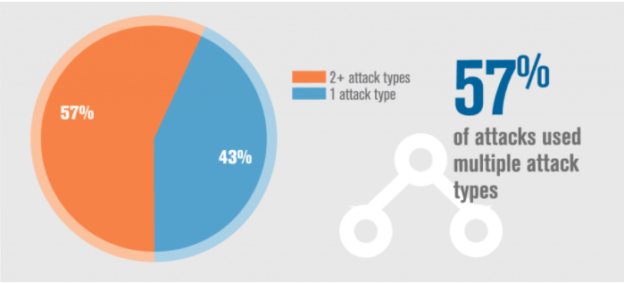
Information security company Verisign just published its Distributed Denial of Trends Report for Q1 2017. This report talks about changes in the frequency, size, and type of DDoS attack that the company has observed over the first few months of this year. The main takeaway is this: The number of DDoS attacks has plunged by 23 percent compared to the previous quarter. That’s good! However, the average peak attack size has increased by almost 26 percent, making them vastly more potent at taking down websites and critical online infrastructure. That’s bad. The report also notes that attacks are sophisticated in nature, and use several different attack types to take down a website. While 43 percent use just one attack vector, 25 percent use two, and six percent use five. This, obviously, makes it much more difficult to mitigate against. Verisign’s report also talks about the largest DDoS attack observed by the company in Q1. This was a multi-vector attack that peaked at 120 Gbps, and with a throughput of 90 Mpps. Per the report: This attack sent a flood of traffic to the targeted network in excess of 60 Gbps for more than 15 hours. The attackers were very persistent in their attempts to disrupt the victim’s network by sending attack traffic on a daily basis for over two weeks. The attack consisted primarily of TCP SYN and TCP RST floods of varying packet sizes and employed one of the signatures associated with the Mirai IoT botnet. The event also included UDP floods and IP fragments which increased the volume of the attack. So, in short. The attackers were using several different attack types, and they were able to sustain the attack over a long period of time. This shows the attacker has resources, either to create or rent a botnet of that size, and to sustain an attack over two weeks. The fact that DDoS attacks have increased in potency is hardly a surprise. They’ve been getting bigger and bigger, as bad actors figure out they can easily rope insecure Internet of Things (IoT) devices into their botnets. The Mirai botnet, for example, which took down Dyn last year, and with it much of the Internet, consisted of hundreds of thousands of insecure IoT products. The main thing you can gleam from the Verisign report is that DDoS attacks are increasingly professional, for lack of a better word. It’s not 2005 anymore. We’ve moved past the halcyon days of teenagers taking down sites with copies of LOIC they’d downloaded off Rapidshare. Now, it’s more potent. More commoditized. And the people operating them aren’t doing it for shits and giggles. Source: https://thenextweb.com/insider/2017/05/24/report-ddos-attacks-are-less-common-but-theyre-bigger/#.tnw_RJHfi1AZ

Originally posted here:
Report: DDoS attacks are less common, but they’re bigger

There’s now a WannaCry decryptor tool for most Windows versions

As the criminals behind the WannaCry ransomware are trying to make it work again, security researchers have created tools for decrypting files encrypted by it. DDoS attacks against the killswitch domains Since researcher Marcus Hutchins (aka MalwareTech) registered a (previously non-existent) killswitch domain for the malware and stopped its onslaught, the domain has been under attack by Mirai-powered botnets. Today’s Sinkhole DDoS Attack pic.twitter.com/wxT2YUrdOF — MalwareTech (@MalwareTechBlog) May 18, 2017 That particular domain has been … More ?

See more here:
There’s now a WannaCry decryptor tool for most Windows versions

6 steps to reduce your risk of a DDoS attack

You’ve seen the splashy headlines about web services getting taken down by DDoS, or Distributed-Denial-of-Service Attacks, but have you ever worried about these attacks taking down your firm’s site? As recently as October 2016, internet traffic company Dyn was the victim of several DDoS attacks, which shut down websites and services across the East Coast. With the increasingly popularity of Internet of Things devices, which includes any everyday device that’s now connected to the web, these DDoS attacks are increasing in frequency. Hackers create armies of these devices, which are infected with malware, that will attack any given service. The attack works by having multiple devices flood the bandwidth of a service or website with so much traffic that the service is no longer available to normal users. Neustar, a global DDoS protection and cybersecurity firm, releases a yearly study about the impacts of DDoS attacks on businesses. Neustar’s first quarter 2017 report, found that the number of attacks doubled between 2017 and 2016. DDoS attacks are only getting larger, the report states, and the 1,010 respondents collectively experienced a minimum revenue risk from the attacks in excess of $2.2 billion during the previous 12 months. On Thursday, during the Arizona Technology Council 2017 Cybersecurity Summit, Mark Goldenberg, security solutions architect at CenturyLink, presented six steps regarding the possibility of a DDoS attack. In 2012, during the Occupy Wall Street movement, many financial institutions were victims of DDoS attacks, Goldenberg said. The attacks prompted the Federal Financial Institutions Examination Council to release these six steps. Goldenberg said these steps can apply to any firm in regards to a DDoS attack. Step 1: Assess information security risk Goldenberg said that a company should understand its online assets by maintaining an ongoing program to assess information security risk. Take time to review which publicly-based Internet assets are critical to your business that could be affected by a DDoS attack, he said. Some firms have services on a website that can be down for a period of time, but there are other parts of the website that are absolutely vital to your firm’s day-to-day operations, Goldenberg said. Understanding what’s vital and what isn’t will help your business make the right decisions in the event of an attack, he said. Step 2: Monitor Internet traffic to your site(s) in order to detect attacks Talk to your team about what sort of visibility your firm has, whether it’s sources of internet traffic or what types of internet traffic parts of your site is getting, Goldenberg said. Knowing your site’s analytics will let you and your team know where to look in the event of a cyberattack, which in turn will let your team know what kind of resources to bring to the table, Goldenberg said. Step 3: Be ready and notify Make sure your team has an incident response plan, which includes alerting service providers, especially internet providers, Goldenberg said. If your firm has multiple internet providers, Goldneberg said it’s important to know how to coordinate between the providers in the event of a DDoS attack. Your internet provider(s) won’t do anything independent of you, Goldenberg said. And be ready to know when and how to notify your customers when you’re under attack. “A communication plan is key,” Goldenberg said. Step 4: Ensure sufficient staffing for the duration of the DDoS attack When your firm is undergoing a DDoS attack, it’s important to have both your security and network team at the table working together. Make sure, though, that your security team is on the alert for potential breaches. “The perpetrators of the attack understand that when they launch an attack, it’s a priority issue for you to get your network back available,” Goldenberg said. If your security team isn’t on the lookout for breaches at the same time, your data could be compromised during the attack. Step 5: Share that information After your attack, you may want to share the information about it to fellow businesses within your industry. Goldenberg said the Arizona Technology Council is the perfect example of a group to share this information with. “If one peer is hit with a DDoS attack today, it could mean that you’re going to be next,” Goldenberg said. Step 6: Evaluate gaps in your response and adjust After the attack, it’s time to come together to find out what kind of gaps your firm may still have and to learn from it, Goldenberg said. “What you do today has to be reviewed with the team on a regular basis and kept up to date. If you’re able to withstand a low level attack today, regroup with the team, understand where your strengths are, where your weaknesses are, so you can plan for the larger attack down the road.” Source: http://azbigmedia.com/ab/6-steps-preparing-ddos-attack

Read More:
6 steps to reduce your risk of a DDoS attack

Bondnet botnet goes after vulnerable Windows servers

A botnet consisting of some 2,000 compromised servers has been mining cryptocurrency for its master for several months now, “earning” him around $1,000 per day. GuardiCore researchers first spotted it in December 2016, and have been mapping it out and following its evolution since then. The’ve dubbed it Bondnet, after the handle its herder uses online (“Bond007.01”). Compromised Windows servers serve different functions Bondnet’s main reason of being is the mining of cryptocurrencies: primarily Monero, … More ?

See more here:
Bondnet botnet goes after vulnerable Windows servers

DDoS attacks could cost enterprises over $2.5 million in revenue

A new report from information services specialist Neustar looks at the frequency and cost of DDoS attacks and what is being done to counter the threat. In terms of revenue loss, three percent of organizations report average revenue loss of at least $250,000 per hour, with 51 percent taking at least three hours to detect an attack and 40 percent taking at least three hours to respond, that means an attack could cost over $2.5 million. Attacks are getting larger too, with 45 percent of DDoS attacks delivered at more than 10 gigabits per second (Gbps), and 15 percent of attacks being at least 50 Gbps, almost double the number reported last year. In total 849 out of 1,010 organizations surveyed were attacked, with no particular industry spared, an increase of 15 percent since 2016. 86 percent of those attacked were also hit more than once. Also customers are often the first to spot a problem, with 40 percent of respondents reporting receiving attack alerts from customers, up from 29 percent in 2016. “Distributed Denial of Service (DDoS) attacks are the zeitgeist of today’s Internet,” says Barrett Lyon, pioneer of the DDoS defense industry and head of research and development at Neustar Security Solutions. “The question organizations must ask now is how they are prepared to manage these highly disruptive events. Are they prepared for the bad day where their customers call and ask why the website is down?” Ransomware now often goes hand in hand with DDoS too, the number of instances of this increased 53 percent since 2016. 51 percent of attacks involved some sort of loss or theft with a 38 percent increase year on year in thefts of customer data, financial and intellectual property. Whilst almost all organizations surveyed have some form of DDoS protection in place, 90 percent say they are investing more than they did a year ago and 36 percent think they should be investing more still. Source: https://betanews.com/2017/05/04/ddos-attack-cost/

Read More:
DDoS attacks could cost enterprises over $2.5 million in revenue

Netflix Incident A Sign Of Increase In Cyber Extortion Campaigns

Attackers using threats of data exposure and DDoS disruptions to try and extort ransoms from organizations The recent leak of 10 unaired episodes from Season 5 of Netflix’ hit series “Orange Is The New Black” shows that ransomware is not the only form of online extortion for which organizations need to be prepared. Increasingly, cyber criminals have begun attempting to extort money from organizations by threatening to leak corporate and customer data, trade secrets, and intellectual property. Instead of encrypting data and seeking a ransom for decrypting it, criminals have begun using doxing as a leverage to try and quietly extort bigger sums from enterprises. “Targeted attacks are the new cybersecurity threat and are on the rise,” says Nir Gaist, CEO and co-founder of security vendor Nyotron. “Organizations, regardless of industry or size, can be targeted with cyber extortion or espionage as the hackers’ goal.” The reason why there isn’t more noise over such incidents is that victims often like to keep quiet about them, he says. “Unless the company is regulated to report the attack, they will keep it quiet to keep brand and reputation intact,” Gaist says. Even in the case of the Netflix leak, for instance, it was the hackers themselves who announced the attack. “There was no monetary loss due to the early release of the ‘Orange is the New Black’ episodes, but there was reputation loss and brand damage,” he says. A malicious hacker or hacking group calling itself TheDarkOverload earlier this week claimed responsibility for publicly posting several episodes of the Netflix series after apparently stealing them from Larson Studio, a small post-production company, back in December. The hackers first tried to extort money from Larson Studio before going after Netflix directly. When Netflix refused to acquiesce to the extortion demand, the hackers released the unaired episodes. The hackers claimed to have stolen several more unaired episodes of TV programs from Netflix, Fox, and National Geographic and have threatened to release them as well. It is not clear if the hackers have made any extortion demands from the various studios. The Netflix incident is an example of the growing threat to organizations from extortion scams, says Moty Cristal the CEO of NEST Negotiation Strategies, a firm that specializes in helping organizations negotiate with online extortionists. Cyber extortion can include the threat of DDoS attacks and data exposure. The goal of attackers is to find a way to threaten targets with the most damage, either financial or from a brand reputation standpoint, Cristal explains. Any decision on whether to pay or not to pay should be based on an assessment of the potential damage, both real and perceived, that the attacker could wreak, and the company’s ability to withstand such damage, Cristal says. In the Netflix incident, the fact that the attackers demanded just around 50 bitcoin for the stolen episodes suggests they were likely motivated more by the need to be recognized and professionally acknowledged than by financial gain, Cristal adds. Surprisingly, targeted extortion attacks do not always have to be sophisticated to be successful, although sometimes they can very sophisticated Gaist says. “In a targeted attack, the hacker will attempt to find a simple vulnerability to get in,” he says. “Unfortunately for most companies, basic security hygiene is simply not attended to properly – leaving them completely vulnerable to a targeted attack.” While attacks that result in potential exposure of customer and corporate data can be scary, there are a couple of good reasons not to pay, security analysts say. One of course is that paying off a ransom or extortion is only likely to inspire more attempts. An organization that shows its willingness to pay to get data back or to prevent something bad from happening will almost certainly be attacked again. The other reason is that not all extortion scams are real. In fact, a lot of times attackers will attempt to scare money out of an organization with false threats. Last year for instance, a malicious hacking group calling itself the Armada Collective sent extortion letters to some 100 companies threatening them with massive distributed denial of service attacks if they did not pay a specific ransom amount. Security vendor CloudFlare, which analyzed the Armada Collective’s activities, estimated that the group netted hundreds of thousands of dollars in ransom payments from victims, without carrying out a single attack. Meg Grady-Troia, web security product marketing manager at Akamai, says paying a ransom doesn’t necessarily guarantee a chosen outcome. “So doing separate analysis of the request for payment and the real threat is critical for any organization.” Akamai’s customers have seen a lot of extortion letters, threatening a DDoS attack if a specified amount of bitcoin is not deposited to an identified wallet by a certain time, she says. These letters have come from a number of groups, including DD4BC, Armada Collective, Lizard Squad, XMR Squad, and others. Often though, there is very little follow-through. “Some of these DDoS extortion letters are merely profit-making schemes, while some are serious operations with the resources to damage a business,” says Grady-Troia. Paying a ransom is no guarantee that your data still won’t be leaked, she says. “Once data has been exfiltrated from your system, the blackmail may or may not continue after the requested payment, or it may still be leaked.” What organizations need to be focusing on is DDoS attack resilience and the operational agility of their systems, particularly access controls, backup procedures, and digital supply chain. “The importance of online extortion depends immensely on the nature of the threat and the enterprise’s risk tolerance,” Grady-Troia says. “Businesses should have a security event or incident response process that can be invoked in the case of any attack, and that process should include subject matter experts for systems and tools, procedures for all kinds of hazards.” Source: http://www.darkreading.com/attacks-breaches/netflix-incident-a-sign-of-increase-in-cyber-extortion-campaigns/d/d-id/1328794

Read the article:
Netflix Incident A Sign Of Increase In Cyber Extortion Campaigns

Malware Hunter: Find C&C servers for botnets

Recorded Future and Shodan released Malware Hunter, a specialized crawler for security researchers that explores the Internet to find computers acting as remote access trojan (RAT) command and control centers. What Malware Hunter does Malware Hunter unearths computers hosting RAT controller software that remotely controls malware-infected computers and instructs them to execute malicious activities such as recording audio, video, and keystrokes on a victim’s machine. Using command and control servers, attackers can launch widescale attacks … More ?

Read more here:
Malware Hunter: Find C&C servers for botnets