Hackers use misconfigured LDAP servers – Connectionless Lightweight Directory Access Protocol (CLDAP) – to provide a means to launch DDoS attacks. More than 400 DDoS attacks taking advantage of misconfigured LDAP servers have been spotted by security researchers. CLDAP DDoS attacks use an amplification technique, which takes advantage of the Connectionless Lightweight Directory Access Protocol (CLDAP): LDAP is one of the most widely used protocols for accessing username and password information in databases like Active Directory, which is integrated in many online servers. When an Active Directory server is incorrectly configured and exposes the CLDAP service to the Internet it is vulnerable to be leveraged to perform DDoS attacks. Since its discovery in October 2016, researchers at Corero Network Security have observed a total of 416 CLDAP DDoS attacks, most of which are hosting and internet service providers. The largest attack volume recorded was 33 Gbps, with an average volume of 10 Gbps. The attacks averaged 14 minutes long in duration. “These powerful short duration attacks are capable of impacting service availability, resulting in outages, or acting as a smoke screen for other types of cyber-attacks, including those intended for breach of personally identifiable data,” said Stephanie Weagle, vice president of marketing at Corero Network Security, in a blog post. Stephen Gates, chief research intelligence analyst from NSFOCUS, told SC Media UK that in the quest to find new means of launching DDoS attacks, hackers have once again found open devices on the Internet running weak protocols that can be exploited for their personal gain. “However, like any other reflective DDoS attack campaign, the number of available reflectors is of critical importance. In addition, the amplification factor those reflectors afford is the second stipulation,” he said. “In this case, the number of open devices on the Internet running CLDAP is relatively small, in comparison to open DNS and NTP reflectors; yet the amplification factor is respectable (~70x). Surely, this attack technique is new, but it is not the worse seen so far. This vector will likely be used in combination with other reflective attack techniques, and rarely used on its own. Until the world’s service providers fully implement BCP-38, similar discoveries and resulting campaigns will continue to plague us all.” Bogdan Botezatu, senior E-Threat analyst at Bitdefender, told SC that a CLDAP attack is designed around third parties: an entity running a misconfigured instance of CLDAP, a victim and an attacker. “The attacker would ask the CLDAP infrastructure to retrieve all the users registered in the Active Directory. Because the attacker makes this query look like it was initiated by the victim by replacing the originating IP address with the victim’s, the CLADP service will actually send the answer to the victim,” he said. “Subsequently, the victim finds itself being bombarded with the information they did not request. If the attacker can harness enough power, the victim’s infrastructure will crash under a load of unsolicited information.” He said that organisations could deploy strong, restrictive firewall policies for inbound traffic. “Load balancing and specialised hardware can also help organisations absorb the impact,” said Botezatu. Source: https://www.scmagazineuk.com/more-than-400-ddos-attacks-identified-using-new-attack-vector–ldap/article/652939/
View original post here:
More than 400 DDos attacks identified using new attack vector – LDAP
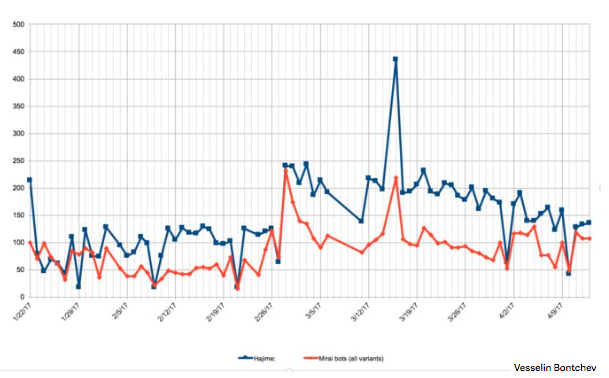
 The Hajime malware is competing with the Mirai malware to enslave some IoT devices Mirai — a notorious malware that’s been enslaving IoT devices — has competition. A rival piece of programming has been infecting some of the same easy-to-hack internet-of-things products, with a resiliency that surpasses Mirai, according to security researchers. “You can almost call it Mirai on steroids,” said Marshal Webb, CTO at BackConnect, a provider of services to protect against distributed denial-of-service (DDoS) attacks. Security researchers have dubbed the rival IoT malware Hajime, and since it was discovered more than six months ago, it’s been spreading unabated and creating a botnet. Webb estimates it’s infected about 100,000 devices across the globe. These botnets, or networks of enslaved computers, can be problematic. They’re often used to launch massive DDoS attacks that can take down websites or even disrupt the internet’s infrastructure. That’s how the Mirai malware grabbed headlines last October. A DDoS attackfrom a Mirai-created botnet targeted DNS provider Dyn, which shut down and slowed internet traffic across the U.S. Hajime was first discovered in the same month, when security researchers at Rapidity Networks were on the lookout for Mirai activity. What they found instead was something similar, but also more tenacious. Like Mirai, Hajime also scans the internet for poorly secured IoT devices like cameras, DVRs, and routers. It compromises them by trying different username and password combinations and then transferring a malicious program. However, Hajime doesn’t take orders from a command-and-control serverlike Mirai-infected devices do. Instead, it communicates over a peer-to-peernetwork built off protocols used in BitTorrent, resulting in a botnet that’s more decentralized — and harder to stop. “Hajime is much, much more advanced than Mirai,” Webb said. “It has a more effective way to do command and control.” Broadband providers have been chipping away at Mirai-created botnets, by blocking internet traffic to the command servers they communicate with. In the meantime, Hajime has continued to grow 24/7, enslaving some of the same devices. Its peer-to-peer nature means many of the infected devices can relay files or instructions to rest of the botnet, making it more resilient against any blocking efforts. Hajime infection attempts (blue) vs Mirai infection attempts (red), according to a honeypot from security researcher Vesselin Bontchev. Who’s behind Hajime? Security researchers aren’t sure. Strangely, they haven’t observed the Hajime botnet launching any DDoS attacks — which is good news. A botnet of Hajime’s scope is probably capable of launching a massive one similar to what Mirai has done. “There’s been no attribution. Nobody has claimed it,” said Pascal Geenens, a security researcher at security vendor Radware. However, Hajime does continue to search the internet for vulnerable devices. Geenens’ own honeypot, a system that tracks botnet activity, has been inundated with infection attempts from Hajime-controlled devices, he said. So the ultimate purpose of this botnet remains unknown. But one scenario is it’ll be used for cybercrime to launch DDoS attacks for extortion purposes or to engage in financial fraud. “It’s a big threat forming,” Geenens said. “At some point, it can be used for something dangerous.” It’s also possible Hajime might be a research project. Or in a possible twist, maybe it’s a vigilante security expert out to disrupt Mirai. So far, Hajime appears to be more widespread than Mirai, said Vesselin Bontchev, a security expert at Bulgaria’s National Laboratory of Computer Virology. However, there’s another key difference between the two malware. Hajime has been found infecting a smaller pool of IoT devices using ARM chip architecture. That contrasts from Mirai, which saw its source code publicly released in late September. Since then, copycat hackers have taken the code and upgraded the malware. Vesselin has found Mirai strains infecting IoT products that use ARM, MIPS, x86, and six other platforms. That means the clash between the two malware doesn’t completely overlap. Nevertheless, Hajime has stifled some of Mirai’s expansion. “There’s definitely an ongoing territorial conflict,” said Allison Nixon, director of security research at Flashpoint. To stop the malware, security researchers say it’s best to tackle the problem at its root, by patching the vulnerable IoT devices. But that will take time and, in other cases, it might not even be possible. Some IoT vendors have released security patches for their products to prevent malware infections, but many others have not, Nixon said. That means Hajime and Mirai will probably stick around for a long time, unless those devices are retired. “It will keep going,” Nixon said. “Even if there’s a power outage, [the malware] will just be back and re-infect the devices. It’s never going to stop.” Source: http://www.itworld.com/article/3190181/security/iot-malware-clashes-in-a-botnet-territory-battle.html