
What do cyber-attacks have in common with hurricanes, tornados and earthquakes? All are realities in our world. No matter how common or uncommon they may be, failing to prepare for any of them will lead to costs that could be unbearable—or worse. These were the thoughts of Nikhil Taneja, MD Radware as he shared the company’s annual Global Application & Network Security Report 2016-17 that identifies major attack trends of 2016, outlines industry preparedness, and offers predictions for in 2017. The report finds that 98% of Organizations Experienced Attacks in 2016, indicating that cyber-attacks became a way of life for nearly every organization in 2016. This trend will continue in 2017, predicts Radware. While understanding some crucial aspects such as The threat landscape—who the attackers are, their motives and tools, what will be the potential impact on businesses, including associated costs of different cyber-attacks, how a company’s preparedness level compares to other organizations etc, the report comes up with some of the key findings: – IoT Botnets Open the 1TBps Floodgates- This exemplifies why preparing for “common” attacks is no longer enough. This event introduced sophisticated vectors, such as GRE floods and DNS water torture. – Cyber-Ransom Proves Easiest, Most Lucrative Tool for Cybercriminals- Almost all ransom events have a different attack vector, technique or angle. There are hundreds of encrypting malware types, many of which were developed and discovered this year as part of the hype. Also, DDoS for ransom groups are professionals who leverage a set of network and application attacks to demonstrate their intentions and power. – Cyber-Attacks Cost Almost Twice What You May Think- Most companies have not come up with a precise calculation of the losses associated with a cyber-attack. Those who have quantified the losses estimate the damage at nearly double the amount compared to those who estimate. – Stateful Devices: #1 Point of Failure- Common IT devices, including firewalls, application delivery controllers and intrusion protection systems, now represent the greatest risk for an outage. Consequently, they require a dedicated attack mitigation solution to protect them. Threat Landscape Trends The report identifies top five trends that dominated 2016 threat landscape and will continue to haunt CISOs in the coming years. These include: – Data Leakage + SLA Impact Are Top Concerns – Data leakage and service level impact often come together, with a DDoS attack serving as a smokescreen that distracts IT teams so data can be infiltrated. – Mirai Rewrites the Rules- As the first IoT open-source botnet, Mirai is changing the rules of real-time mitigation and makes security automation a must. It isn’t just that IoT botnets can facilitate sophisticated L7 attack launches in high volumes. The fact that Mirai is open-source code means hackers can potentially mutate and customize it—resulting in an untold variety of new attack tools that can be detected only through intelligent automation. – Non-Volumetric DoS: Alive and Kicking – Despite astonishing volumes, neither the number of victims nor the frequency of attacks has grown. Most non-volumetric DDoS attacks are in relatively lower volumes, with 70% below 100Mbps. Rate-based security solutions continue to fall short, requiring companies to rethink their security strategy and embrace more sophisticated solutions. Without those upgrades, there is a good chance an organization will experience, yet lack visibility into service degradation. – Increased Attacks against Governmental Institutions- 2016 brought a new level of politically affiliated cyber protests. While the U.S. presidential election was in the spotlight, the media reported on a different breach almost weekly. These incidents happened across the globe, with regimes suffering from cyber-attacks due to alleged corruption or perceived injustices. – SSL-Based Attacks Continue to Grow- Although 39% report suffering an SSL-based attack, only 25% confidently state they can mitigate it. – DDoS Attacks Are Becoming Shorter- Burst attacks are increasing thanks to their effectiveness against most mitigation solutions. Security Strategy Evolves Rather Slowly These trends and findings indicate that while hackers continue to develop new attack tools and techniques, 40% of organizations do not have an incident response plan in place. Seventy percent do not have cyber-insurance. And despite the prevalence of ransomware, only 7% keep Bitcoin on hand. Another interesting finding of the study was three-fourths of companies do not employ hackers in their security teams, and 43% say they could not cope with an attack campaign lasting more than 24 hours. “Combining statistical research and frontline experience, the Radware report identifies trends that can help educate the security community. It draws information from sources such as the information security industry survey, where this year, 598 individual respondents representing a wide variety of organizations around the world participated,” Taneja commented. On average, responding organizations have annual revenue of USD $1.9 billion and about 3,000 employees. Ten percent are large organizations with at least USD 5 billion in annual revenue. Respondents represent more than 12 industries, with the largest number coming from the following: professional services and consulting (15%), high tech products and services (15%), banking and financial services (12%) and education (9%), the study notes. Source: http://www.cxotoday.com/story/cyber-attacks-cost-almost-twice-what-you-may-think/
Continue reading here:
Cyber-Attacks Cost Almost Twice What You May Think
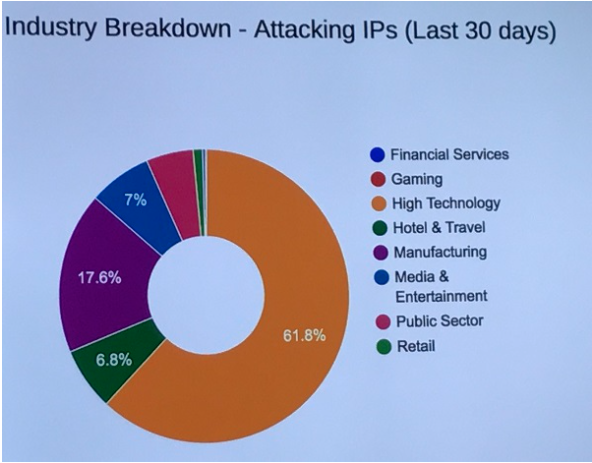
 TAIPEI (Taiwan News)—Most denial-of-service (DDoS) attacks launched by hackers from Feb. 15 to March 14, 2017 in Taiwan targeted the high-tech industry, according to statistics compiled by leading global content delivery network provider Akamai Technologies. Industries in Taiwan that were most severely attacked by hackers were the high technology industry (61.8 percent), manufacturing industry (17.6 percent) and the financial services industry (7 percent), according to statistics compiled by Akamai’s intelligent platform that delivers 30 percent of the global Internet traffic. Industries in Taiwan under DDoS attacks from February 15 to March 14, 2017. (Taiwan News) The majority of the hacks were launched from IP addresses in Taiwan, followed by Alabama in the U.S., and Brazil. “It is often a misconception that most attacks are launched from abroad,” said Akamai’s Security Business Unit director Amol Mathur. “Attacks are coming both domestic and outside.” The premium CDN provider works customizes solutions for clients from different industries in Taiwan, including hospitality, banking, travel and airline services. Taiwan’s financial institutes are still recovering from a cybersecurity scare last month, in which 15 banks received threats from an anonymous hacker group to shell out 10 Bitcoins each (equivalent to US$10,466), or brace themselves for DDoS attacks that would compromise their server systems. DDoS attacks launched by hackers often compromise institute’s servers data processing capacity by delivering a sudden deluge of data that overtakes bandwidth resources, for instance if the company server bandwidth only allows 10 Gigabyte per second (Gbps) of capacity it can be paralyzed by a 100 Gbps attack. Hackers might use DDoS as a distraction to conceal other malign operations, such as stealing personal information or credential theft, added Mathur. Industries affected by hacker attacks vary monthly, depending on whether there is a major geopolitical event, said Mathur. For instance global hacker group Anonymous took down the London Stock Exchange system for two hours as part of its campaign against global central banks in June 2016. Mathur advised banks should not heed hacker demands to pay ransom. “In real life you would not pay ransom, so why would you pay hackers,” he said. The cybersecurity expert noted a rise in DDoS attacks globally during the fourth quarter of 2016, and pointed out DDoS attacks data size was increasing exponentially every quarter. Globally, attacks over 100 Gbps jumped 140 percent year-on-year during 4Q16, with the largest-size attack recorded reaching 517 Gbps, according to the Akamai “Fourth quarter 2016 State of the Internet/Security Report.” Mathur noted the cause of increased DDoS attacks was partly due to easy access for people to rent bots online, for as cheap as US$10 by going to a site and simply keying in the website address. Hackers can generate a monthly income of US$180,000 to US$200,000 from bot rentals. It remains extremely difficult for law enforcement agencies from a single country to track down hackers that spread the attacks launched by rented bots around the globe, and hide behind the protection of anonymity offered by the dark web. Additionally, the preferred Bitcoin currency used for business transactions by hackers is hard to trace to an IP address, explained Mathur. Introduction of mobile devices, mobile payment, IP surveillance cameras and emerging Internet of Things (IoT) trends introduce new cybersecurity vulnerabilities as hackers can utilize attacks through large number of connected devices. The Mirai bot for instance exposed vulnerabilities in the default user administrator name and passwords used by thousands of connected IP surveillance cameras and their DVR worldwide, said Mathur. He urged the IoT industry to form a joint standard, and for countries to start implementing regulations that set cybersecurity standards for connected devices. Hackers are also finding ways to target vulnerabilities in smartphone application programming interface (API) to obtain credentials, and data from mobile transactions. Apple Pay and some other mobile payment technologies periodically publish white papers announcing how it is securing data, but are mostly for tech savvy readers, said Mathur. One way consumers can safeguard credit card transactions is to check if the online shopping sites or App they use have The Payment Card Industry Data Security Standard (PCI DSS), noted Mathur. The proprietary information security standard launched nearly a decade ago by major credit card companies Visa, MasterCard, American Express, JCB and others follows a stringent standard and heavily fines companies that do not follow its compliance. Source: http://www.taiwannews.com.tw/en/news/3117326