Category Archives: DDoS Vendors

Russian hacker, nabbed in Spain, cops 4+ years for Citadel botnet

Should have stayed under the skirt of Mother Russia. Just a thought Dimitry Belorossov – a Russian cyber-criminal who used the Citadel banking trojan – has been sentenced to four years and six months in a US prison after pleading guilty to conspiring to commit computer fraud.…

See the article here:
Russian hacker, nabbed in Spain, cops 4+ years for Citadel botnet

Linux botnet observed launching powerful DDoS attacks

Threat actors are leveraging a botnet made up of infected Linux machines to launch powerful distributed denial-of-service (DDoS) attacks against as many as 20 targets per day, according to Akamai’s Security Intelligence Response Team (SIRT). The botnet is composed of Linux machines infected with a stealthy trojan identified in 2014 as “XOR DDoS.” The threat was observed altering its installation depending on the victim’s Linux environment and running a rootkit to avoid detection. According to an advisory published on Tuesday, Akamai’s SIRT has seen DDoS attacks – SYN and DNS floods were the observed attack vectors – that reached anywhere from a few gigabits per second (Gbps) to nearly 179 Gbps. Although the advisory said that 90 percent of targets are located in Asia, Tsvetelin Choranov, security intelligence response engineer with Akamai’s SIRT, told SCMagazine.com in a Tuesday email correspondence that a very small number of attacks have been launched against entities in the U.S. “The target industries confirmed from our standpoint are online gaming and education,” Choranov said, adding, “We don’t have a defined number of systems infected by this malware. Some of the source IPs that we are seeing actively producing malicious traffic have spoofing capabilities.” The advisory noted that evidence suggests the malware is of Asian origin, but Choranov said that Akamai’s SIRT has not heard of anyone claiming responsibility for the DDoS attacks. He added that there is also no known reason for the attacks, such as extortion. Unlike a lot of malware, XOR DDoS is not spreading via exploitation of vulnerabilities. “Rather, it populates via Secure Shell (SSH) services that are susceptible to brute-force attacks due to weak passwords,” the advisory said. “Once login credentials have been acquired, the attackers [use] root privileges to run a Bash shell script that downloads and executes the malicious binary.” The advisory outlines two methods for detecting the malware. “To detect this botnet in your network, you can look for the communications between a bot and its C2, using the Snort rule shown in [the advisory],” the advisory said. “To detect infection of this malware on your hosts you can use the YARA rule [also in the advisory].” XOR DDoS is persistent, meaning it runs processes that will reinstall deleted files. Removing the threat involves identifying malicious files in two directories, identifying the processes responsible for persistence of the main process, killing those processes, and deleting the malicious files. “XOR DDoS malware is part of a wider trend of which companies must be aware: Attackers are targeting poorly configured and unmaintained Linux systems for use in botnets and DDoS campaigns,” the advisory said. Source: http://www.scmagazine.com/linux-botnet-observed-launching-powerful-ddos-attacks/article/441750/

Originally posted here:
Linux botnet observed launching powerful DDoS attacks

Linux-powered botnet lets rip on victims with 180Gbps network floods

Enormous network of hijacked zombie servers threatens to batter everything in its path Cybercrooks have built a network of compromised Linux servers capable of blowing websites and other systems off the internet with at least 150Gbps of junk traffic.…

More:
Linux-powered botnet lets rip on victims with 180Gbps network floods

XOR DDoS botnet launching attacks from compromised Linux machines

Attackers have developed a botnet capable of 150+ Gbps DDoS attack campaigns using XOR DDoS, a Trojan malware used to hijack Linux systems, according to Akamai. What is XOR DDoS? XOR DDoS is a T…

Read the article:
XOR DDoS botnet launching attacks from compromised Linux machines

New DDoS attack uses smartphone browsers to flood site with 4.5bn requests

Researchers have found that smartphone browsers can deliver a powerful flooding attack. Researchers suspect a mobile advertising network has been used to point hundreds of thousands of smartphone browsers at a website with the aim of knocking it offline. According to distributed denial-of-service protection service CloudFlare, one customer’s site recently came under fire from 4.5 billion page requests during a few hours, mostly from smartphone browsers on Chinese IP addresses. As CloudFlare’s Marek Majkowski notes, browser-based ‘Layer 7? flood attacks have been viewed as a theoretical threat for several years, but haven’t become a reality due to difficulties in efficiently distributing malicious JavaScript to force a large number of browsers to make HTTP requests to a targeted site. Security researchers have previously suggested web ads as an efficient way to distribute malicious JavaScript. Analysing the log files, Majkowski found the smartphone browser attack peaked at over 275,000 HTTP requests per second, with 80 percent coming from mobile devices and 98 percent from a Chinese IP address. The logs also reveal mobile versions of Safari, Chrome, Xiaomi’s MIUI browser, and Tencent’s QQBrowser. “Strings like ‘iThunder’ might indicate the request came from a mobile app. Others like ‘MetaSr’, ‘F1Browser’, ‘QQBrowser’, ‘2345Explorer’, and ‘UCBrowser’ point towards browsers or browser apps popular in China,” Majkowski said. Majkowski speculates that the attack was made possible by an ad network, and believes the reason so many mobile browsers visited the attack page hosting the malicious JavaScript was due to ads shown in iframes, either in mobile apps or mobile browsers. Here’s how the attack works: when a user opens an app or browses the web, they are served an iframe with an ad whose content was requested from an ad network. The ad network then forwards the request to a third-party that successfully bids for that inventory and then forwards the user to an attack page. “The user was served an attack page containing a malicious JavaScript which launched a flood of XHR requests against CloudFlare servers,” explained Majkowski. The attack site itself hosting the malicious JavaScript included instructions to launch an XHR in a loop. Source: http://www.zdnet.com/article/new-ddos-attack-uses-smartphone-browsers-to-flood-site-with-4-5bn-requests/

Read More:
New DDoS attack uses smartphone browsers to flood site with 4.5bn requests

Mobile ad network exploited to launch JavaScript-based DDoS attack

A type of DDoS attack that has until now been mostly theoretical has become reality: CloudFlare engineers have spotted a browser-based Layer 7 flood hitting one of its customers with as many as 275,00…

More here:
Mobile ad network exploited to launch JavaScript-based DDoS attack

Mobile advertising DDoS JavaScript drip serves site with 4.5bn hits

Once-theoretical attack vector appears fully-formed on CloudFlare’s doorstep CloudFlare has turned up an unusual form of denial-of-service attack: mobile advertisements that are pumping out around 275,000 HTTP requests per second.…

Continue reading here:
Mobile advertising DDoS JavaScript drip serves site with 4.5bn hits

Mobile advertising DDoS JavaScript drip serves site with 4.5 billion hits

CloudFlare has turned up an unusual form of denial-of-service attack: mobile advertisements that are pumping out around 275,000 HTTP requests per second.…

More:
Mobile advertising DDoS JavaScript drip serves site with 4.5 billion hits

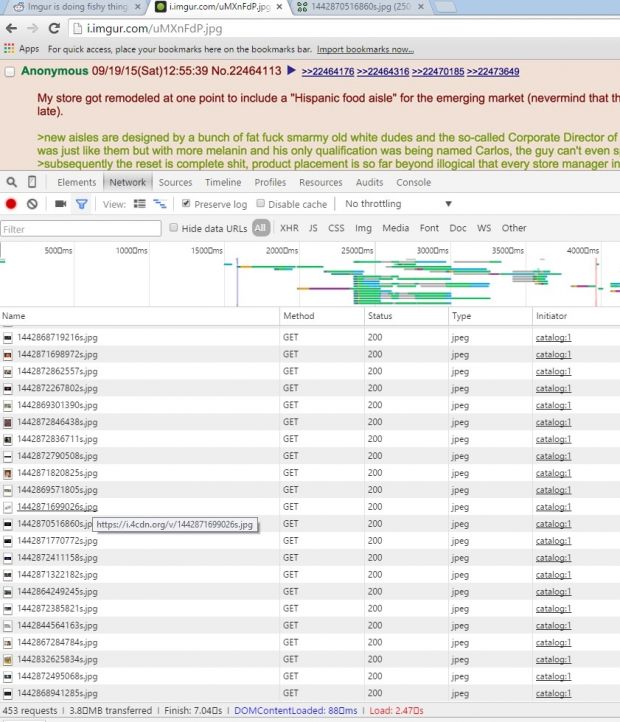
Hackers Used Imgur to Launch DDoS Attacks on 4chan

A Reddit user has uncovered a covert method of carrying DDoS attacks on 4chan’s infrastructure using images hosted on Imgur, via Reddit. According to Reddit user rt4nyp, who discovered the vulnerability, every time an Imgur image was loaded on the /r/4chan sub-reddit, over 500 other images were also loaded in the background, images hosted on 4chan’s CDN. Since traffic on 4chan is quite huge as is, getting some extra connections from Reddit pushed 4chan’s servers over the edge, crashing them several times during the day. Additionally, 8chan, a smaller 4chan spin-off, was also affected and suffered some downtime as well. Malicious code was being loaded with Imgur images Reddit user rt4ny was alerted that something was amiss when he noticed that Imgur images on Reddit were loaded as inlined base64 data. Taking a closer look at the base64 code, he observed that a small piece of JavaScript code was added at the end, which had no business being there. This code secretly stored the “axni” variable in the browser’s localStorage, which was set to load another JavaScript file from “4cdns.org/pm.js.” This is not 4chan’s official CDN, but a domain registered to closely resemble the real deal, which was taken down in the meantime. When refreshing the original image that loaded the “axni” variable, the malicious code would not be loaded again, a measure taken to avoid detection. Additionally, also to avoid detection, the JS file stored on “4cdns.org/pm.js” could not be loaded directly in the browser. Loading 500+ 4chan images inside a hidden iframe Analyzing the pm.js file, rt4ny found that it loaded an iframe outside the user’s view with the help of some clever CSS off-screen positioning tricks, inside which the hundreds of 4chan images were being loaded, along with a 142 KB SWF file. Imgur was contacted about this issue, and fixed it on the same day. “Yesterday a vulnerability was discovered that made it possible to inject malicious code into an image link on Imgur,” said the Imgur team. “From our team’s analysis, it appears the exploit was targeted specifically to users of 4chan and 8chan via images shared to a specific sub-reddit on Reddit.com using Imgur’s image hosting and sharing tools.” It’s a sad day for humanity when we see hackers combine the three best sites on the Internet to find cat GIFs into such wicked and immoral ways. Source: http://news.softpedia.com/news/hackers-used-imgur-to-launch-ddos-attacks-on-4chan-492433.shtml

See the original post:
Hackers Used Imgur to Launch DDoS Attacks on 4chan

The rise of repeated "low and slow" DDoS attacks

There's been a significant change in the nature of DDoS attacks that is leaving businesses exposed to data breaches and malware. Recent research from Neustar shines a light on the changing tactics …

See the original post:
The rise of repeated "low and slow" DDoS attacks