Distributed denial of service (DDoS) attacks are a method attackers favor for disrupting an organization’s operations by flooding the network with traffic, overwhelming available bandwidth, and making network resources unavailable. According to research from the Ponemon Institute, DDoS attacks accounted for 18 percent of data center outages in 2013, up from 2 percent in 2010. They found that such attacks are the most costly data-center attacks to mitigate, costing an average of $822,000 per outage, leading to problems such as business disruption, loss of revenues, and reduced productivity. However, the costs can be even higher for organizations that rely on their websites as their main sales vehicle, since the unavailability of those websites can lead to those organizations losing multiple millions of dollars in sales. According to Forrester Research, the average organization loses $27 million for a 24-hour outage, with business services and financial services institutions faring the worst. Despite the damage that DDoS attacks can do in and of themselves, they are often used as a smoke screen to divert resources into clearing up the disruption, leaving organizations unaware of other attacks happening simultaneously. Often, the real motivations are financial manipulation or a competitive takeout. In other cases, the motivations are ideological, looking to hurt or embarrass organizations. For example, in late 2012 to early 2013, 46 financial institutions in the United States were hit with over 200 coordinated and timed DDoS attacks. It is believed that the motivation for this campaign of attacks was to cause consumers to lose their trust in the retail banking system. However, organizations in any walk of life can be impacted, both in the private and public sector, and such attacks should be considered a top concern by any organization, especially as DDoS attacks are increasingly becoming a weapon of choice. Not only are DDoS attacks growing in number and affecting a wider range of organizations, but more tools are becoming available that make them easier to pull off. Whereas previously an attacker would have had to possess a fair degree of skill and recruit an army of computers into a botnet in order to create enough computing power to launch an attack, new attack methods require considerably fewer resources and less skill. DDoS attack kits are now readily available on the Internet for low prices, making the job of a relatively unskilled hacktivist much easier, and DDoS-as-a-service attacks are an increasingly common phenomenon, whereby attackers hire themselves and their botnets out to those wishing to launch attacks. Another recent development is the use of network time protocol amplification attacks, which use publicly available network time protocol servers, the real purpose of which is to provide clock-synchronization services over public networks. Using this method means that attackers no longer need to go through the effort of putting together a botnet to launch their attacks. Recently, there has also been a dramatic rise in mobile applications used in DDoS attacks, driven by the ease with which mobile apps can be downloaded. These apps allow any mobile user to join a DDoS attack if he or she wishes—for example, for an ideological cause with which he or she sympathizes. It is predicted that such attacks will increase dramatically. The tremendous growth in DDoS attacks in 2013 that continued, if not accelerated, in 2014 means that all organizations should beware of the consequences. Where they do not have the resources in-house to defend themselves, organizations should investigate the use of services that can divert traffic away from their networks while remediation measures are taken. While, on the one hand, there is a trend toward increasing complexity and sophistication of attacks, on the other hand, attacks are becoming easier to pull off by an ever-wider range of criminal actors. The DDoS attack landscape is set to become much more complicated, and many more organizations will become victims. All organizations should beware. Source: https://blogs.rsa.com/ddos-attacks-increasingly-weapon-choice/
More here:
DDoS Attacks: Increasingly the Weapon of Choice

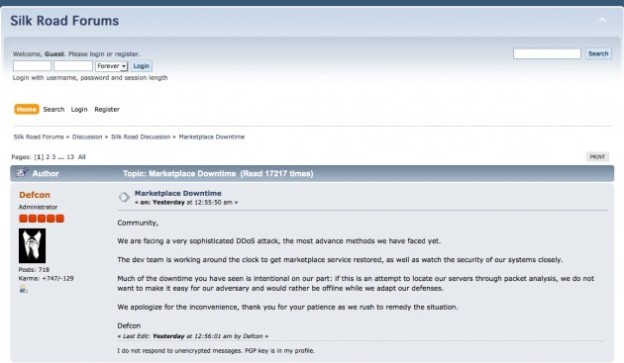
 Online black market Silk Road 2.0 experienced a distributed denial-of-service (DDoS) attack last week, which forced the site’s administrators to temporarily suspend services. News of the attack broke on bitcoin forums hours after it started, with the Silk Road team soon confirming the news via its own forums. For reasons that are less clear, black market Agora has faced outage issues problems of its own in the last few days. Silk Road remains defiant Silk Road 2.0 moderator ‘Defcon’ issued a statement saying that the site was facing a “very sophisticated” DDoS attack using the most advanced methods the site has experienced to date. The moderator said: “The dev team is working around the clock to get marketplace service restored, as well as watch the security of our systems closely. Much of the downtime you have seen is intentional on our part: if this is an attempt to locate our servers through packet analysis, we do not want to make it easy for our adversary and would rather be offline while we adapt our defences.” As the attack continued, Silk Road 2.0 remained offline. Defcon eventually issued a second update, indicating that the team is trying out different approaches to blocking the inbound DDoS. He stressed that the site is still processing withdrawals, although these have been delayed by the attacks. Silk Road 2.0 is aware that cashflow is very important and the site is therefore prioritising delayed withdrawals, the moderator added. Defcon ended the update on a defiant note: “To our adversaries: you cannot stop us. We will overcome every attack.” Questions persist Silk Road 2.0 vendors started reporting problems earlier last week, before the site was finally forced to shut down. Despite official updates, the outage prompted a number vendors to raise questions about the impact of the attack. Silk Road 2.0 was targeted by hackers in the past: last February, the site lost 4,476 BTC to an alleged hack, worth over $2.6m at the time. The attack was blamed on a transaction malleability exploit used by one of the vendors. The site decided to compensate affected customers and, by late May, it said more than 80% of bitcoins stolen in the alleged heist have been repaid to the victims. The source and goal of the latest attack remains unclear. Speculation is mounting that the attack was in fact launched by law enforcement in an attempt to ascertain the location of Silk Road 2.0 servers, while other users believe the attack was launched by criminals or competitors. Following the February hack, Silk Road 2.0 said it would introduce a multi-signature wallet system to replace its previous escrow platform. A multisig system should be less vulnerable to hackers, but has not been fully implemented yet. Online black market Agora faces outage Silk Road 2.0 is not the only black market suffering outage issues. While Silk Road 2.0 was struggling to restore services, which it eventually did late on Friday, competing market Agora went offline. Agora users started reporting intermittent problems on Saturday. The site was out of action over much of the weekend and had still not become available by press time (12:15 BST, Monday). The reason for the outage remains unclear. Earlier this month, Agora confirmed that it was suffering from availability issues on a regular basis. However, the team offered an extensive explanation into the inner workings of the market and the need for security, saying it considers that more important than around-the-clock availability. The Agora team said at the time: “Our primary goal is to stay hidden from law enforcement agencies and secure from hackers. We implement much more security measures than many others, which causes problems with availability.” Source: http://www.coindesk.com/silk-road-2-0-shrugs-sophisticated-ddos-attack/