Distributed Denial of Service (DDoS) attacks are back in the news; it seems that barely a month goes by without media reports of a website or service being brought down by a DDoS attack. Sony’s PlayStation Network again became the victim of such an attack recently, while hacking group Anonymous is on a disabling offensive of extremist websites. DDoS attacks can come in a variety of shapes and sizes. However, the aim of a DDoS attack is always the same: to saturate a server with so many requests that it simply cannot cope, leaving legitimate users unable to connect. Attackers will sometimes use their own network of computers to launch DDoS attacks, but what is now more common is for them to use a network of PCs across the world that have been infected with malware that is capable of joining in a DDoS attack without the owner’s knowledge. We’ve written before about the easy availability of DDoS attack kits, which anyone can download and use to launch their own attacks. DDoS attacks were one of the primary methods used by Anonymous and LulzSec to tackle their victims: the Vatican, the Church of Scientology, the Australian government were all hit, as were Amazon, PayPal, MasterCard and Visa in response to their perceived lack of support for whistleblowing website WikiLeaks. Some of these big name companies could perhaps have predicted a DDoS attack was on its way; taking a stance against Anonymous would often leave a company in its firing line. In fact, Anonymous often warned targets that an attack was imminent. But for many other businesses, predicting a DDoS attack is difficult, and the results can be disastrous: loss of revenue-generating applications as well as reputational damage can negatively impact a business for years. Why would a company be a target for DDoS attacks? Hacktivism is certainly one reason, competition with rival businesses is another. But beyond that, it is tough to establish whether a business is at risk and, if so, from whom? With the exception of the aforementioned Anonymous messages, DDoS attacks can start without warning. So while predicting an attack may be difficult, protecting against one is less so. There are ways a company can keep its applications, services and even its whole network online without stopping legitimate traffic. A sophisticated firewall manager, application security manager and local traffic manager combined provide the protection needed to mitigate DDoS attacks, from blocking attack traffic to re-routing legitimate requests to ensure uptime. Analysis is also key: understanding who is attacking you, as well as how and why, can help prevent an attack from causing too much damage and can help protect against future attacks. Establishing which layer is being attacked (application, network or session, for example) will help a company know where to focus its resources, and intelligent firewall management will be able to inspect all traffic coming into a network and stop traffic that is coming from a DDoS attack. Source: http://memeburn.com/2015/01/ddos-dilemmas-how-far-can-you-predict-attacks-and-what-can-be-done/
Continue reading here:
DDoS dilemmas: how far can you predict attacks, and what can be done?
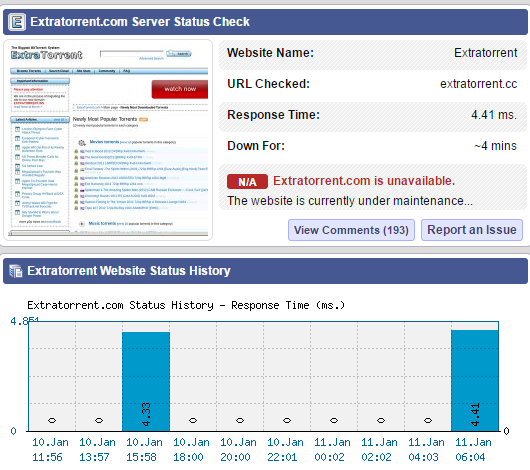
 The worlds number 4 torrent website is down following a massive Distributed Denial of Service (DDoS) attack by unknown hackers. The website seems to have been down for 23 hours and seems to come online for little bit before throwing up a 503 service error. The Extratorrent admin took to Twitter to tell its fans about the DDoS attack ExtraTorrent was one of the more popular torrent websites in 2014. It has grown in size due to more traffic and has moved up again in the top 10, now placed as the 4th most-visited torrent site by torrent ranking websites. This success didn’t go unnoticed by rightsholders groups such as the MPAA who recently called out ExtraTorrent as one of the top pirate sites. The site was forced to trade in its .com domain for .cc this year, after it was suspended by its domain registrar. The Isitdownrightnow says that Extratorrent has been down for past 23 hours (now it says 4 minutes because the website sprang to live for few seconds before going down again While the admin says that its a DDoS attack by unknown hackers, the actual reason may be a takedown by authorities or a revenge DDoS by the music and movie companies. Earlier Sony had allegedly undertaken a similar kind of DoS attacks to stop the torrents sites from sharing the files from the massive hack attack. Reader may note that only two days back around 13 mega Hollywood movie screener versions were leaked and being shared on torrent websites. These movies are considered to be prime Oscar award contenders and it is though that one of the guild members or his/her associates may have leaked these screener versions. Source: http://www.techworm.net/2015/01/extratorrent-down-hackers-launch-ddos-attack.html