
The state’s website was up and down for most of the early afternoon on Friday The state of Indiana is having a bad week. First, Governor Mike Pence signed a controversial “religious freedom” bill into law; earning the state a black eye for taking step backwards on civil rights. Now, twenty-four hours later, the state’s website was knocked offline by a group taking up another person’s protest against Religious Freedom Restoration Act. The group responsible for taking IN.gov offline has targeted 34 other state, local, tribal, and territorial government websites this month. Going by the name @YourVikingdom on Twitter, the group targeted Indiana’s website after another user suggested that a campaign against the state be mounted in response to recently enacted discriminatory law. Senate Bill 101, also known as the Religious Freedom Restoration Act, was surrounded by controversy in the days leading up to its signing. Businesses and organizations on both sides of the debate, including religious groups such as The Christian Church (Disciples of Christ) urged Gov. Pence to veto the bill. The problem most people have with the new law is that it opens the door for business owners to deny services to the LGBT community for religious reasons. The law, said to be nothing short of legalized discrimination, has caused business leaders to react, including Salesforce CEO Marc Benioff, who stated that employees and customers would no longer be sent to Indiana. Salesforce bought ExactTarget, an Indiana-based marketing software company, for $2.5B in 2013. “Today we are canceling all programs that require our customers/employees to travel to Indiana to face discrimination,” Benioff said via Twitter. There’s no way to prove it, but the DDoS attack against Indiana’s primary website might have been avoided. The group responsible has no real purpose. Despite their outlandish claims, the reality is they attack vulnerable infrastructures – or low-hanging fruit as it were – for fun. There is no cause for them to support, just their own amusement. All of their victims, especially the government websites, have little to no anti-DDoS protection. Indiana is no different. Yet, because of the backlash against Indiana over the ‘religious freedom’ law, @YourVikingdom took notice and flooded the website with traffic to the point that it collapsed. The site was able to recover, but the damage had already been done. Then again, the ‘religious freedom’ law might have been nothing more than an excuse. As low-hanging fruit, Indiana’s servers were always a possible target, especially given the established pattern set by @YourVikingdom. Indiana’s website was offline at 2:00p.m. EST, and recovered 45 minutes later, but remained sluggish for another half-hour while the Indiana Office of Technology worked to resolve the issue. Source: http://www.csoonline.com/article/2903314/business-continuity/indianas-website-taken-out-by-ddos-in-response-to-religious-freedom-law.html
Continue reading here:
Indiana’s website taken out by DDoS in response to ‘religious freedom’ law
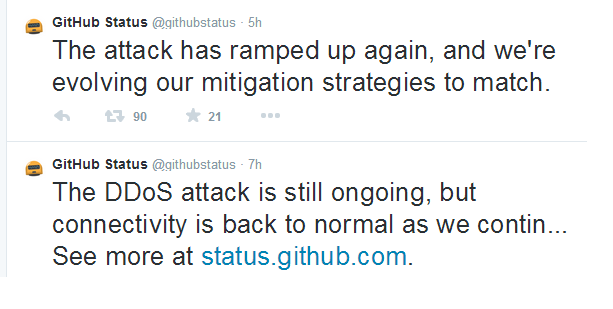
 San Francisco-based GitHub was taken out with a denial of service attack Wednesday. Scripts from the Beijing-based Baidu sent traffic coming to a page operated by GreatFire and a page with Chinese-translations of The New York Times. As is the focus of DDoS attacks, GitHub’s availability was knocked out as a result of the traffic caused. In morning tweets during the attack, GitHub informed followers that the attack was still going and getting worse, but that they were on top of dealing with it. As of two hours ago GitHub states that the DDoS attack is still being worked on. Meanwhile Baidu has said that it had nothing to do with the attack intentionally. The Chinese search engine titan also says that it is working security specialists to find out the cause of things. The company made certain to state that its security hadn’t been compromised during the attack on GitHub. Speculation in tech and security circles say that the attack was a means of strengthening China’s methods of web censorship by taking out sites that could allow for users to get around it. Baidu was simply used as a means of amplifying the attack due to how sizable it is and the amount of traffic it can produce. Source: http://kabirnews.com/github-still-battling-ddos-attack/8495/