Sustained assault took down gov mouthpiece The Netherlands government’s websites were taken offline for around 10 hours on Wednesday following a DDoS attack.…
Continued here:
Dutch government websites KO’d by 10-hour DDoS
Sustained assault took down gov mouthpiece The Netherlands government’s websites were taken offline for around 10 hours on Wednesday following a DDoS attack.…
Continued here:
Dutch government websites KO’d by 10-hour DDoS

Both government and private websites fell victim to a distributed denial of service attack on Tuesday, the Dutch authorities say.
Continued here:
Attack downs Dutch government sites
Many people outside China know about the country’s Great Firewall, but probably assume it will have little, if any, impact on their own online activities. However, a fascinating post on Benjamin Sonntag’s blog explains how one of the servers of La Quadrature du Net, the Paris-based digital freedom association he co-founded, and for which his company provides free hosting, was hit by distributed denial of service attacks (DDOS) caused directly by the Great Firewall’s policies. His blog post provides all the technical details: it turned out that the vast majority of the attacks were coming from Chinese IP addresses. Here’s what seems to have happened: China is censoring its Internet, that’s well known to do this, this country censors (among others) DNS [Domain Name System] queries in its network (and also censoring as a side effect, the rare Japanese, Korean or Taiwanese queries going through China) when it answers a DNS query to a censored website, it answers with “any incorrect IP address” instead. That is, instead of letting Chinese Net users access “forbidden” content, the Great Firewall generally re-directs them to some random, presumably harmless, site. But that wasn’t happening here: we see spikes of requests to websites censored in China coming to IP addresses such as those of La Quadrature du Net. Other people had this same issue : http://furbo.org/2015/01/22/fear-china/ So, the end story is that we just saw censored websites requests coming to La Quadrature du Net’s IP address from China, due to how the Chinese Internet censorship is working! Rather than pushing limited traffic to lots of sites, the Great Firewall was sending lots of traffic to just a few. Among the possible explanations for this new behavior, Sonntag offers two that are equally worrying: Maybe one of the system administrator of the great firewall of China is gaining some small and quick money selling DDOS, selling Internet attacks to the highest bidder (in bitcoin? ) and using that censorship system as a weapon Maybe China chose a precise list of targets to send censored traffic to, adding to this technical “useful” process (the censorship) a “nice” one (putting down foreign opponents’ websites)… La Quadrature du Net, as a digital freedom association, seems to be too nice a target (among others of course). Neither is good news for sites in the West. Whatever the real reason for this DDOS attack on La Quadrature, it certainly shows that the operation of the Great Firewall of China can have very direct effects outside that country. Another reason, perhaps, for those in the West to pay closer attention to China’s increasingly harsh approach to online censorship. Source: https://www.techdirt.com/articles/20150204/09454829910/how-great-firewall-china-caused-ddos-attack-france.shtml
More:
How The Great Firewall Of China Caused A DDoS Attack In France
Xnote.1 – the Swiss Army knife of malware Cybercrooks have cooked up a Linux backdoor boasting multiple malicious functions.…
Read the original post:
ACHTUNG! Scary Linux backdoor turns your box into a DDoS platform
A brute force campaign looking to set up a distributed denial of service (DDoS) botnet using a rare Linux rootkit malware has been launched, emanating from the servers of a Hong Kong-based company called Hee Thai Limited. The malware, known as XOR.DDoS, was first spotted in September by security research firm Malware Must Die. But security firm FireEye says that new variants have been making their way into the wild, as recently as Jan.20. XOR.DDoS is installed on targeted systems via SSH (Secure Shell) brute-force attacks that target both servers and network devices. And these are being carried out using complex attack scripts to serve the malware through a sophisticated distribution scheme that allows the attackers to compile and deliver tailored rootkits on-demand, to infect x86 and mobile ARM systems alike. Once infected, the hosts are enlisted to launch DDoS attacks. “While typical DDoS bots are straightforward in operation and often programmed in a high-level script such as PHP or Perl, the XOR.DDoS family is programming in C/C++ and incorporates multiple persistence mechanisms including a rare Linux rootkit,” FireEye researchers noted in an analysis. What’s notable about the Hee Thai attack is the sheer scale of the operation. Within 24 hours of first sighting back in November, FireEye had observed well over 20,000 SSH login attempts, per server. By the end of January, each server had seen nearly 1 million login attempts. During this time period, traffic from 103.41.124.0/24 accounted for 63% of all observed port 22 traffic. “Someone with a lot of bandwidth and resources really wanted to get into our servers,” FireEye researcher noted. They also said that the campaign has been evolving. At the beginning, each IP address would attempt more than 20,000 passwords before moving on. It then dropped to attempting a few thousand passwords before cycling to the next, and repeat attacks also began to occur. Now, a new stage of the Hee Thai campaign is more chaotic than the previous two. “The attacks now occur en masse and at random, frequently with multiple IPs simultaneously targeting the same server,” FireEye explained. The Hee Thai campaign also features an on-demand malware build system. Using a sophisticated set of build systems, the malware harvests kernel headers and version strings from victims to deliver customized malware that may be compiled on-demand to deliver XOR.DDoS to the target machine. This strategy makes hash signature-based detection systems ineffective for detecting XOR.DDoS. “Brute force attacks are one of the oldest types of attacks,” FireEye researchers said. “Due to its ubiquity, there are numerous solutions available for defending against them. However a great many systems are vulnerable. Even in enterprise settings, network devices and servers in forgotten branch offices could be exposed to this threat.” Source: http://www.infosecurity-magazine.com/news/massive-ddos-bruteforce-targets/
Read the article:
Massive DDoS Brute-Force Campaign Targets Linux Rootkits
While massive retail breaches dominated headlines in 2014, with hacks involving state-sponsored threats coming in a strong second, distributed denial-of-service (DDoS) attacks continued to increase, both in the volume of malicious traffic generated and the size of the organizations falling victim. Recently, both the Sony PlayStation and Xbox Live gaming networks were taken down by Lizard Squad, a hacking group which is adding to the threat landscape by offering for sale a DDoS tool to launch attacks. The Sony and Xbox takedowns proved that no matter how large the entity and network, they can be knocked offline. Even organizations with the proper resources in place to combat these attacks can fall victim. But looking ahead, how large could these attacks become? According to the “Verisign Distributed Denial of Service Trends Report,” covering the third quarter of 2014, the media and entertainment industries were the most targeted during the quarter, and the average attack size was 40 percent larger than those in Q2. A majority of these insidious attacks target the application layer, something the industry should be prepared to see more of in 2015, says Matthew Prince, CEO of CloudFlare, a website performance firm that battled a massive DDoS attack on Spamhaus early last year. Of all the types of DDoS attacks, there’s only one Price describes as the “nastiest.” And, according to the “DNS Security Survey,” commissioned by security firm Cloudmark, more than 75 percent of companies in the U.S. and U.K. experienced at least one DNS attack. Which specific attack leads that category? You guessed it. “What is by far the most evil of the attacks we’ve seen…[are] the rise of massive-scale DNS reflection attacks,” Prince said. By using a DNS infrastructure to attack someone else, these cyber assaults put pressure on DNS resolver networks, which many websites depend on when it comes to their upstream internet service providers (ISP). Believing these attacks are assaults on their own network, many ISPs block sites in order to protect themselves, thus achieving the attacker’s goal, Prince said. By doing so “we effectively balkanize the internet.” As a result, more and more of the resolvers themselves will be provided by large organizations, like Google, OpenDNS or others, says Prince. Source: http://www.scmagazine.com/tidal-waves-of-spoofed-traffic-ddos-attacks/article/393059/
Originally posted here:
Tidal waves of spoofed traffic: DDoS attacks
Dell analysis shows ZeroAccess botnet still slinging out A combined attack on one of the world’s biggest networks of infected PCs has been partially successful: analysis from Dell SecureWorks shows you can’t keep a bad botnet down.…
View post:
We take bots down, but they get up again – you’re never going to keep them down
A DDoS attack on a company’s online resources might cause considerable losses – with average figures ranging from $52,000 to $444,000 depending on the size of the company. For many organizations, thes…
View article:
How much can a DDoS attack cost your organization?
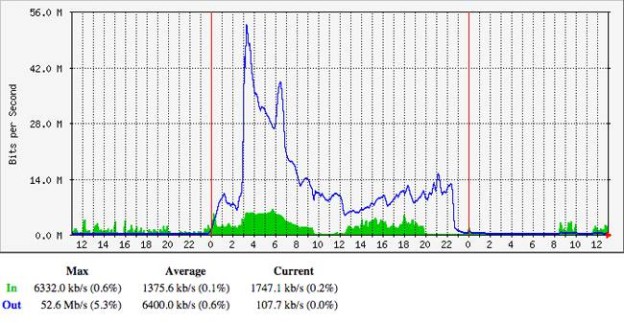
 An upgrade to China’s Great Firewall is having knock-on effects all over the internet, with seemingly random sites experiencing massive traffic spikes. One site owner in North Carolina, Craig Hockenberry, has written up how, after he looked into why his mail server was down, he found 52Mbps of search traffic piling into his system: 13,000 requests per second, or roughly a third of Google’s search traffic. The post goes into some detail over howHockenberry managed to deal with the firehose-blast of requests, all of it coming from China and much of it trying to find Bittorrents or reach Facebook. Short version: he blocked all of China’s IP blocks. Hockenberry is not the only one dealing with a sudden flood of requests, though. There are numerous reports of sysadmins finding that their IP address has appeared in front of the headlights of the Chinese government’s censorship juggernaut, causing them to fall over and forcing them to introduce blocking measures to get back online. After a number of different theories about what was happening, including focussed DDoS attacks and “foreign hackers” – that suggestion courtesy of the Chinese government itself – the overall conclusion of the technical community is that bugs have been introduced into China’s firewall. Particularly, something seems to have gone wrong in how it uses DNS cache poisoning to redirect users away from sites the government doesn’t want them to see. Poison China uses a weak spot of the DNS system to intercept requests coming into and going out of the country. If it spots something it doesn’t like – such as a request for “facebook.com” or “twitter.com” – it redirects that request to a different IP address. For a long while, China simply sent these requests into the ether – i.e. to IP addresses that don’t exist, which has the effect of causing the requests to time out. However, possibly in order to analyze the traffic more, the country has started sending requests to IP addresses used by real servers. Unfortunately, it seems that there have been some configuration mishaps and the wrong IP addresses have been entered. When one wrong number means that a server on the other side of the world suddenly gets hits with the full stream of millions of Chinese users requesting information, well then … that server falls over. The situation has had a broader impact within China. Tens of millions of users weren’t able to access the Web while the government scrambled to fix the problem. According to one Chinese anti-virus vendor, Qihoo 360, two-thirds of Chinese websites were caught up in the mess. China’s DNS infrastructure experts started pointing the finger at unknown assailants outside its system. “The industry needs to give more attention to prevent stronger DNS-related attacks,” said Li Xiaodong, executive director of China’s Internet Network Information Center (CNNIC). Your own medicine The reality, however, is that China has seen the downside to its efforts to reconfigure the basic underpinnings of the domain name system to meet political ends. The network is designed to be widely distributed and route around anything that prevents effective communication. By setting itself up as a bottleneck – and an increasingly huge bottleneck as more and more Chinese users get online – the Chinese government is making itself a single point of failure. The slightest error in its configurations will blast traffic in uncertain directions as well as cut off its own users from the internet. For years, experts have been warning about the “balkanization” of the internet, where governments impose greater and greater constraints within their borders and end up effectively breaking up the global internet. What has not been covered in much detail is the downside to the countries themselves if they try to control their users’ requests, yet make mistakes. Source: http://www.theregister.co.uk/2015/01/26/great_firewall_of_china_ddos_bug/
View article:
Great Firewall of China blasts DDoS attacks at random IP addresses
Airline’s Site Attacked by Group Claiming to Be Aligned With Islamic State Malaysia Airlines had its website hacked by a group that appeared to be trying to settle a score with a U.S. videogame company. Most visitors to MalaysiaAirlines.com for several hours Monday saw a message that said “ISIS WILL PREVAIL” at the top of their browser’s window, and the airline’s ticket booking and other services were unavailable. Instead, a large picture of a Malaysia Airlines Airbus Group NV A380 plane and the messages “404-Plane Not Found,” and “Hacked by Cyber Caliphate,” were displayed. Later, the site displayed a different image: a tuxedo-adorned, pipe-smoking lizard sporting a top hat and monocle. “Hacked by Lizard Squad, Official Cyber Caliphate,” it said, giving the Twitter handle for a group called Lizard Squad. A group calling itself Lizard Squad in December claimed responsibility for a cyberattack on videogame servers of Sony Corp. and Microsoft Corp. Later Monday, the carrier replaced the hacked version of its site with a pared-down version that allowed users to book flights. Both images displayed the Twitter handles for the accounts of what appear to be two men who work for Roxana, Illinois-based U.S. gaming company UMG, which hosts videogame events across the U.S. “We were not involved in any website being hacked in any way,” one of the men, Chris Tuck, told The Wall Street Journal via a direct message on Twitter. “The group who did it is a group of kids who aren’t fond of our company,” he said. “I presume they added our names to either scare us or warn us.” The other man whose handle was shown, UMG Chief Executive Robert Terkla, couldn’t be reached for comment. The Twitter timeline for Lizard Squad revealed recent Tweets directed at the two men about the alleged banning from events of certain gamers. It was unclear whether the gamers allegedly banned were involved with Lizard Squad. The owner or owners of the Lizard Squad Twitter account didn’t immediately respond to a request for comment via Twitter. It was unclear why Malaysia Airlines was targeted. The airline’s loss of two aircraft last year, which left 537 people dead or missing, brought global attention to Malaysia Airlines, which to that point hadn’t been widely known outside the region. In a statement, the company said its web servers are “intact” and customer bookings and data are secure. It said that its domain name system was compromised. Malaysia Airlines said the matter was immediately reported to CyberSecurity Malaysia, a forensics and analysis agency under the Ministry of Science, Technology and Innovation, and the Ministry of Transport. CyberSecurity Malaysia Chief Executive Amirudin Abdul Wahab said its investigation determined that it was a case of domain hijacking. Domain name servers are Internet phone books that translate Web domain names, such as MalaysiaAirlines.com, into numeric addresses computers use to reach individual machines. Tampering with domain names to divert traffic from the intended site would generally require less sophistication than a more complex breach in which a company’s servers are compromised and data is exposed. In December a group called Lizard Squad claimed responsibility for attacking Sony’s PlayStation Network and Microsoft’s Xbox Live videogame services. The group said that attack was a distributed denial of service attack, which disrupts websites by overwhelming them with data traffic. Source: http://www.wsj.com/articles/malaysia-airlines-website-hacked-by-group-calling-itself-cyber-caliphate-1422238358
More here:
Malaysia Airlines Website Hacked by Group Calling Itself ‘Cyber Caliphate’