Category Archives: Security Websies

Anonymous proxies now used in a fifth of DDOS attacks

The number of DDOS attacks using anonymous proxies has increased The number of distributed denial of service attacks using anonymous proxies has increased dramatically over the past year, according to a new research report, as attackers use these proxies to create an instant pseudo-botnet. Ofer Gayer, security researcher at Redwood Shores, CA-based Incapsula Inc., said he first spotted the trend about a year ago. Incapsula was working on creating a database of IP addresses spotted attempting malicious activity, and discovered that attackers were abusing anonymous proxies to turn a regular single-origin denial of service attack into a distributed denial of service attack with traffic flowing through thousands — or tens of thousands — different IP addresses. A year ago, fewer than 5 percent of DDOS attacks came through anonymous proxies. Today, the number is close to 20 percent, Gayer said. “The trend intensified over the past two months,” Gayer said. “Currently, 20 percent of all application-layer attacks are originating from these proxy servers.” Of those, nearly 45 percent came from the TOR network of anonymous routers, and, of those, 60 percent used the TOR Hammer DoS tool. On average, a single attacker would direct traffic from 1,800 different IP addresses, with 540,000 requests per instance. According to Incapsula product evangelist Igal Zeifman, what this means is that an attacker could be sitting at home, on a single computer, and route traffic to a list of anonymous proxies to create an instant botnet-style attack. All it takes is a proxy harvesting script and a publicly-available DOS toolkit. Anonymous proxies, or anonymizers, can serve a useful purpose, preventing identity theft, protecting search histories, avoiding geographical marketing and access restrictions, and allowing activists to bypass Internet censorship of repressive regimes. They also offer several benefits to DDOS attackers. First, they mask the source of an attack and help the attackers evade security measures based on access control lists. They also help the attacker avoid geo-blacklisting, since the attack can be spread among proxies in many different countries. Second, since each proxy is only passing along a small number of messages, it helps the attackers avoid counter-measures based on limiting the number of messages from a single source. Finally, proxies make slight changes to message headers. That helps the attackers avoid signature-based defenses. “You can Google to find several options to generate lists of these servers,” said Zeifman. “And these servers accept requests from anyone.” Each of the anonymous proxies can be used to forward a small amount of traffic, that, together, add up to enough to take down an application. “It’s like a thousand needles, stinging all at the same time,” said Zeifman. Since the attackers are going after application, not much traffic is required. “Very few server operators think about over-provisioning their CPUs,” he said. “Even a small overhead of 100 requests per second is enough to take down a dedicated server environment.” Source: http://www.csoonline.com/article/2903939/application-security/anonymous-proxies-now-used-in-a-fifth-of-ddos-attacks.html

Visit link:
Anonymous proxies now used in a fifth of DDOS attacks
DDoS attack temporarily blocks seattletimes.com

A denial-of-service attack, in which perpetrators flood a targeted website with requests that overwhelm the site’s servers, is believed to have caused Monday morning’s outage. A cyberattack took down The Seattle Times website for about 90 minutes Monday morning. Seattletimes.com was unavailable from about 8 a.m. to 9:30 a.m. as a result of a denial-of-service attack, company spokeswoman Jill Mackie said. “The Seattle Times website experienced technical problems Monday morning due to an external attack that appears to have targeted other sites,” Mackie said in a statement. “We continue to monitor the situation and apologize for any inconvenience this caused readers.” Denial-of-service attacks are designed to flood a website with requests, essentially overwhelming the site’s servers and preventing it from responding to other users. The result is a site that grinds to a halt or runs so slowly that it becomes unusable. Such attacks on their own aren’t designed to damage a target’s computer systems or steal files. The attacks, a fixture of Internet security threats for decades, have been blamed on culprits ranging from political operatives to young, tech-savvy hackers connected by social media. The ease with which such attacks could be orchestrated was illustrated in 2000 when a 15-year-old Canadian boy, working under the alias “Mafiaboy,” was able to temporarily bring down the websites of Yahoo, CNN and Amazon.com, among others. Mackie said The Seattle Times’ information technology staff believes Monday’s attack on the website was carried out by a cyberattack group that calls itself Vikingdom2015. The group is said to have targeted several government and media websites, including those of the Indiana state government and the Bangor (Maine) Daily News, with denial-of-service attacks. IBM security researchers said the group was formed from former members of the Team Cyber Poison hacker group, and began attacking websites this month. Source: http://www.seattletimes.com/business/technology/cyberattack-temporarily-blocks-seattletimescom/

View original post here:
DDoS attack temporarily blocks seattletimes.com

Half of companies under DDoS attack have critical data stolen

Neustar surveyed IT professionals from across EMEA to understand the impact of DDoS attacks. 40 percent of companies estimate hourly losses of over £100,000 at peak times during a DDoS outage,…

Read more here:
Half of companies under DDoS attack have critical data stolen

Botnets inflating Twitch audiences help broadcasters earn money

Most people dream about earning a living by doing something they enjoy. For some gamers, that dream is achievable by using Twitch, the game streaming service that offers gamers with a big-enough follo…

See more here:
Botnets inflating Twitch audiences help broadcasters earn money

GitHub Still Battling DDoS Attack

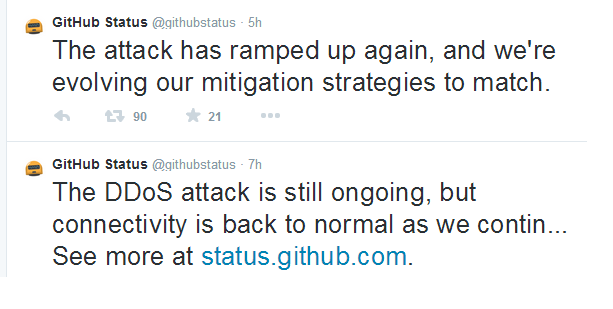
San Francisco-based GitHub was taken out with a denial of service attack Wednesday. Scripts from the Beijing-based Baidu sent traffic coming to a page operated by GreatFire and a page with Chinese-translations of The New York Times. As is the focus of DDoS attacks, GitHub’s availability was knocked out as a result of the traffic caused. In morning tweets during the attack, GitHub informed followers that the attack was still going and getting worse, but that they were on top of dealing with it. As of two hours ago GitHub states that the DDoS attack is still being worked on. Meanwhile Baidu has said that it had nothing to do with the attack intentionally. The Chinese search engine titan also says that it is working security specialists to find out the cause of things. The company made certain to state that its security hadn’t been compromised during the attack on GitHub. Speculation in tech and security circles say that the attack was a means of strengthening China’s methods of web censorship by taking out sites that could allow for users to get around it. Baidu was simply used as a means of amplifying the attack due to how sizable it is and the amount of traffic it can produce. Source: http://kabirnews.com/github-still-battling-ddos-attack/8495/

See more here:
GitHub Still Battling DDoS Attack

Police website target of repeated DDoS attacks

A denial of service attack on Thursday morning to the Finnish Police website was the third attack of its kind this week. The website of the Finnish Police has been the target of repeated denial of service attacks this week, with the latest service disruption on Thursday downing the website for several hours. It marked the third such attack to the poliisi.fi webpage in the last few days. The first attack took place on Tuesday, and downed the website from late morning to 7 pm. Wednesday marked a smaller attack of the same nature. Tomi Moilanen, Chief Information Security Officer with the National Police Board, says the attacks have not led the police to implement any extraordinary measures quite yet. The attacks have also not detrimentally affected the various online services available on the site. The police have filed an investigation request with the National Bureau of Investigation in order to get to the bottom of the cyber attacks. Source: http://yle.fi/uutiset/police_website_target_of_repeated_denial_of_service_attacks/7891226

Read the article:
Police website target of repeated DDoS attacks

DDoS network attacks frustrate Brunswick County School officials

Officials with Brunswick County Schools and the Brunswick County Sheriff’s Office are investigating distributed denial-of-service (DDoS) attacks on the school’s network. According to officials, the attacks have been occurring since county schools reopened in January and have been increasing in frequency that past several weeks. A DDoS attack is usually an outside attack that uses multiple computers or devices to flood a targeted network with so much traffic that it overloads and crashes the system or cripples the ability of legit users from accessing it. School officials say staff members are becoming extremely frustrated at the internet connectivity issues associated with the attacks. The Brunswick County School’s technology department has been working to try and mitigate the impact on the school’s network. Officials say that the county’s network infrastructure is being specifically targeted in the attacks, but the systems have not been compromised. A preliminary investigation has revealed that the individual(s) initiating the attacks have at some point been an authenticated user signed into the school’s network. School officials says this leads them to believe that the responsible party is a current or former student or staff member. Authorities are still investigating. Source: http://www.wect.com/story/28614292/ddos-network-attacks-frustrate-brunswick-county-school-officials

See more here:
DDoS network attacks frustrate Brunswick County School officials

Tengrinews experiences largest DDoS attack in Kazakhstan

Tengrinews news website has experienced an DDoS-attack today, a correspondent of the portal reports. “Today, starting from 9 a.m. Tengrinews.kz website was under a massive DDoS-attack (Distributed Denial of Service) aimed at causing a failure of its server. The log analysis showed that during the attack most of the traffic to the Tengrinews.kz servers were coming from infected computers and servers from around the world, including from Israel, and Western European countries: France, Germany, Italy and Spain. The attack was carried out from infected computers from more than 30 countries around the world. The technical department together with Kazakhtelecom information systems directorate limited access to the site to Kazakhstan IPs only for the duration of the attack,” the technical department of Tengrinews said. DDoS is a type of attack aimed to make an online service unavailable by overwhelming it with traffic from multiple sources, often infected with a Trojan virus. It is virtually impossible to stop such an attack by blocking a single IP address. IT-service of the news website said that the DDoS-attack was carried out from around 700 different IP-addresses simultaneously. “The volume of malicious traffic exceeded 3 gigabits per second,” the department said. After the attack ceased the access to the website was fully restored and the limitations were removed. The website is now operating normally. This is the biggest DDoS-attack on a news resources of Kazakhstan so far. Source: http://en.tengrinews.kz/internet/Tengrinews-experiences-largest-DDoS-attack-in-Kazakhstan-259509/

See original article:
Tengrinews experiences largest DDoS attack in Kazakhstan

‘China censorship’ service GreatFire.org reports DDoS attacks, asks the Internet for help

GreatFire.org, the not-for-profit website designed to highlight online censorship relating to China’s so-called “Great Firewall,” has announced that its mirror websites — set up to circumvent blocks in China — are currently suffering a distributed denial-of-service (DDoS) attacks. A DDoS overwhelms the target — in this case, GreatFire.org’s mirror websites — with a deluge of data, with the intention of causing the network to crash. GreatFire.org is presently reporting 2.6 billion requests per hour — 2,500 times more than its usual traffic — and it says it’s just managing to cope, having switched to faster servers and used other techniques to manage the load. However, it adds that it fears “the attack may be intensified at any time.” China has a long history of blocking online services, and reportedly blocked the whole of Google in the buildup to last year’s 25th anniversary of the Tiananmen Square protests. Back in December, Gmail went dark again too. GreatFire.org basically monitors blocked websites and keywords in China, and has been doing so since 2011. It also offers solutions such as “mirror” websites for circumventing blocks for those located in China. Given GreatFire.org’s core raison d’être , one that would presumably raise the ire of the powers that be in China, it’s surprising to learn that this is in fact the first such attack its sites have undergone in its four-year history. GreatFire.org says the attack began on March 17 and affects all of its mirror websites. Though it asserts that it doesn’t know who or what is behind the attacks, the organization points to a recent story in the Wall Street Journal that reported on how U.S. cloud service providers were facing a backlash from censors in China. The article also talked about how GreatFire.org manages to unblock websites and apps. Notably, GreatFire.org also points to pressure from the Cyberspace Administration of China (CAC) over the past few months. [It] publicly called us “an anti-China website set up by an overseas anti-China organization.” We also know that CAC has put pressure on our IT partners to stop working with us. GreatFire.org is also asking for help — it says that its server costs on Amazon have risen to $30,000 a day (though it doesn’t say what it normally pays). Hinting that it would like Amazon to absorb this cost to support the free-speech cause, the site said: We need companies like Amazon to be on our side and, more importantly, on the side of freedom of speech. We need you to tell Amazon that you think that freedom of speech is an important issue and that Amazon, as a leading global enabler of the internet, plays an important role in access to information. The organization has also asked for anyone with expertise in this realm to get in touch to lend their support. Source: http://venturebeat.com/2015/03/19/china-censorship-website-greatfire-org-suffers-ddos-attack-asks-the-internet-for-help/

Taken from:
‘China censorship’ service GreatFire.org reports DDoS attacks, asks the Internet for help