
 The channel mis-selling firewalls to their customers as protection against DDoS (Distributed Denial of Service) attacks is partly to blame for the escalating number of attacks on enterprises. Dave Larson, CTO of Corero claims that tTraditional security solutions such as firewalls and IPS technology can’t handle the complexity of the modern DDoS attack – and even the more recent next generation firewalls can only provide a marginal benefit in fighting the attacks. Nevertheless, a survey conducted by Corero in 2013 had 40 percent of organisations stating they were relying on firewalls to protect them against DDoS attacks. “We see confusion in the market every day. DDoS protection vendors are fighting for mindshare with the end user community because there is still a vast misunderstanding about what DDoS is all about, and what it takes to eliminate the problem,” says Larson. “The problem is that firewall solutions are not well positioned to show the extent of the problem. Most organisations are shocked at the level and frequency of DDoS activity in their environment once they deploy a targeted in-line DDoS solution that is capable of exposing the threat.” He continues: “Proper DDoS protection is more than a ‘checkbox’ on a traditional security tool . Clicking the’DDoS on’ button on a firewall is not going to protect the business from the sophisticated and adaptive DDoS attacks that are taking down organisations, and distracting security teams from breach activity,” he explains. Larson concedes the channel is not deliberately advising customers to purchase the wrong protection, but “it is a matter of better education around why purpose built in-line appliance-based protection will allow their customers to properly defend against the modern DDoS attack landscape.” “There is no question that firewall technology is a tried and true security solution—a requirement for the majority of businesses. They key here is that that the channel can and should introduce dedicated DDoS protection as an additional layer to their overall security architecture. Implementing first line of defence technology to defeat DDoS at the very edge of the network allows all downstream technology infrastructure , like firewalls and intrusion prevention systems (IPS), to perform as intended. “There is a real opportunity for the channel to gain mind share , and ultimately revenue growth by understanding, and tapping into the DDoS market, this opportunity would complement the selling of traditional security solutions rather than replace them.” Source: http://www.channelpro.co.uk/news/8865/channel-mis-selling-firewalls-leads-to-ddos-attacks
View article:
Channel mis-selling firewalls leads to DDoS attacks
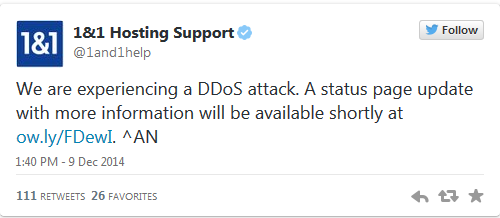
 UK hosting company 1&1 went titsup late on Tuesday night and struggled to recover this morning, after claiming it had been the victim of a Distributed-Denial-of-Service (DDoS) attack. The website collapsed shortly before 10pm yesterday, and it has taken 1&1 a full 12 hours to get its service back up and running. Readers who told the Reg about the outage said that the service had been flaky for several hours before it keeled over. 1&1 blamed the downtime on a DDoS attack in a tweet. However, although the website appeared to be returning to normal, 1&1 had yet to update its customers about the status of its system at time of writing. Customers were still griping about the mysterious outage this morning. Indeed, 1&1 was tight-lipped about the cause of the service disruption on its status page, which made no mention of a system security breach. Last month, Fasthosts blamed a five-hour outage it had suffered on a DDoS attack. Source: http://www.theregister.co.uk/2014/12/10/1_and_1_hosting_firm_claims_ddos_attack_downs_website/