
Kaspersky Lab’s researchers have discovered the full extent of the profit margins benefiting criminals from DDoS services that are available on the black market. Kaspersky Lab’s experts have studied the DDoS services available on the black market and determined just how far this illegal business has advanced, as well as the extent of its popularity and profitability. The worrying news is that arranging an attack costs as little as $7 an hour, while the targeted company can end up losing thousands, if not millions, of dollars. The level of service involved when arranging a DDoS attack on the black market is not very different from that of a legal business. The only difference is that there’s no direct contact between the provider and the customer. The ‘service providers’ offer a convenient site where customers, after registering, can select the service they need, pay for it, and receive a report about the attacks. In some cases, there is even a customer loyalty program, with clients receiving rewards or bonus points for each attack. There are a number of factors that affect the cost for the customer. One is the type of attack and its source: for example, a botnet made up of popular IoT devices is cheaper than a botnet of servers. However, not all those providing attack services are ready to specify such details. Another factor is the duration of the attack (measured in seconds, hours and days), and the client’s location. DDoS attacks on English-language websites, for example, are usually more expensive than similar attacks on Russian-language sites. Another big factor affecting the cost is the type of victim. Attacks on government websites and resources protected by dedicated anti-DDoS solutions are much more expensive, as the former are high risk, while the latter are more difficult to attack. For instance, on one DDoS-as-a-service website, the cost of an attack on an unprotected website ranges from $50 to $100, while an attack on a protected site costs $400 or more. It means a DDoS attack can cost anything from $5 for a 300-second attack, to $400 for 24 hours. The average price for an attack is around $25 per hour. Kaspersky Lab’s experts were also able to calculate that an attack using a cloud-based botnet of 1000 desktops is likely to cost the providers about $7 per hour. That means the cybercriminals organising DDoS attacks are making a profit of around $18 per hour. There is, however, yet another scenario that offers greater profitability for cybercriminals – it involves the attackers demanding a ransom from a target in return for not launching a DDoS attack, or to call off an ongoing attack. The ransom can be the bitcoin equivalent of thousands of dollars, meaning the profitability of a single attack can exceed 95 per cent. In fact, those carrying out the blackmail don’t even need to have the resources to launch an attack – sometimes the mere threat is enough. “We expect the profitability of DDoS attacks to continue to grow. As a result, will see them increasingly used to extort, disrupt and mask other more intrusive attacks on businesses. Worryingly, small and medium sized businesses are not confident in their knowledge of how to combat these threats effectively. The longest DDoS attack in 2016 lasted 292 hours according to Kaspersky Lab’s research, or about 12 days,” said says Russ Madley, head of B2B at Kaspersky Lab UK. “Most online businesses can ill-afford to have their ‘doors closed’ for even an hour, let alone for 292 hours, as criminals take advantage of their poor defences. Companies that host these online sites are also under attack on a daily basis. The channel has a significant opportunity with our help to identify risks, provide strategic advice and deliver the right solutions to customers to prevent damaging DDoS attacks.” Interestingly, some cybercriminals have no scruples about selling DDoS attacks alongside protection from them. Kaspersky Lab’s experts, however, do not recommend using criminal services. Source: http://www.information-age.com/connected-cities-suffer-catastrophic-blackouts-123465253/
Taken from:
Criminal benefits: profit margin of a DDoS attack can reach 95%
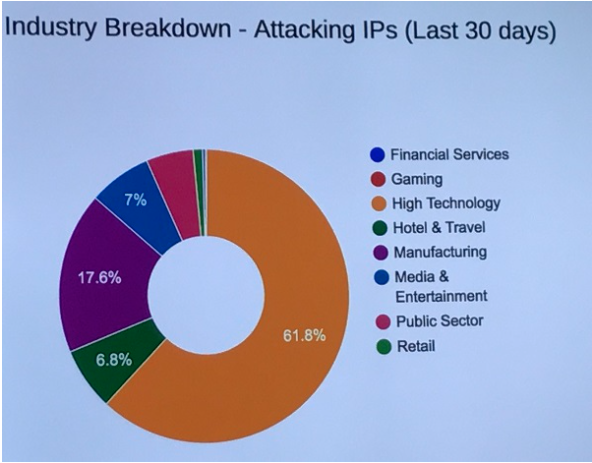
 TAIPEI (Taiwan News)—Most denial-of-service (DDoS) attacks launched by hackers from Feb. 15 to March 14, 2017 in Taiwan targeted the high-tech industry, according to statistics compiled by leading global content delivery network provider Akamai Technologies. Industries in Taiwan that were most severely attacked by hackers were the high technology industry (61.8 percent), manufacturing industry (17.6 percent) and the financial services industry (7 percent), according to statistics compiled by Akamai’s intelligent platform that delivers 30 percent of the global Internet traffic. Industries in Taiwan under DDoS attacks from February 15 to March 14, 2017. (Taiwan News) The majority of the hacks were launched from IP addresses in Taiwan, followed by Alabama in the U.S., and Brazil. “It is often a misconception that most attacks are launched from abroad,” said Akamai’s Security Business Unit director Amol Mathur. “Attacks are coming both domestic and outside.” The premium CDN provider works customizes solutions for clients from different industries in Taiwan, including hospitality, banking, travel and airline services. Taiwan’s financial institutes are still recovering from a cybersecurity scare last month, in which 15 banks received threats from an anonymous hacker group to shell out 10 Bitcoins each (equivalent to US$10,466), or brace themselves for DDoS attacks that would compromise their server systems. DDoS attacks launched by hackers often compromise institute’s servers data processing capacity by delivering a sudden deluge of data that overtakes bandwidth resources, for instance if the company server bandwidth only allows 10 Gigabyte per second (Gbps) of capacity it can be paralyzed by a 100 Gbps attack. Hackers might use DDoS as a distraction to conceal other malign operations, such as stealing personal information or credential theft, added Mathur. Industries affected by hacker attacks vary monthly, depending on whether there is a major geopolitical event, said Mathur. For instance global hacker group Anonymous took down the London Stock Exchange system for two hours as part of its campaign against global central banks in June 2016. Mathur advised banks should not heed hacker demands to pay ransom. “In real life you would not pay ransom, so why would you pay hackers,” he said. The cybersecurity expert noted a rise in DDoS attacks globally during the fourth quarter of 2016, and pointed out DDoS attacks data size was increasing exponentially every quarter. Globally, attacks over 100 Gbps jumped 140 percent year-on-year during 4Q16, with the largest-size attack recorded reaching 517 Gbps, according to the Akamai “Fourth quarter 2016 State of the Internet/Security Report.” Mathur noted the cause of increased DDoS attacks was partly due to easy access for people to rent bots online, for as cheap as US$10 by going to a site and simply keying in the website address. Hackers can generate a monthly income of US$180,000 to US$200,000 from bot rentals. It remains extremely difficult for law enforcement agencies from a single country to track down hackers that spread the attacks launched by rented bots around the globe, and hide behind the protection of anonymity offered by the dark web. Additionally, the preferred Bitcoin currency used for business transactions by hackers is hard to trace to an IP address, explained Mathur. Introduction of mobile devices, mobile payment, IP surveillance cameras and emerging Internet of Things (IoT) trends introduce new cybersecurity vulnerabilities as hackers can utilize attacks through large number of connected devices. The Mirai bot for instance exposed vulnerabilities in the default user administrator name and passwords used by thousands of connected IP surveillance cameras and their DVR worldwide, said Mathur. He urged the IoT industry to form a joint standard, and for countries to start implementing regulations that set cybersecurity standards for connected devices. Hackers are also finding ways to target vulnerabilities in smartphone application programming interface (API) to obtain credentials, and data from mobile transactions. Apple Pay and some other mobile payment technologies periodically publish white papers announcing how it is securing data, but are mostly for tech savvy readers, said Mathur. One way consumers can safeguard credit card transactions is to check if the online shopping sites or App they use have The Payment Card Industry Data Security Standard (PCI DSS), noted Mathur. The proprietary information security standard launched nearly a decade ago by major credit card companies Visa, MasterCard, American Express, JCB and others follows a stringent standard and heavily fines companies that do not follow its compliance. Source: http://www.taiwannews.com.tw/en/news/3117326