Although the web is only a quarter of a century old, it already has a rich history as a platform for worldwide protest. One common tool used by online activists is the distributed denial of service attack, or DDoS: a technologically crude tactic that involves sending so many requests to a target website that it crashes. In recent years, politically motivated DDoS attacks have been launched on the websites of financial giants and local government departments. This year, websites affiliated with the football World Cup were brought down in protest against FIFA. “DDoS has been around as an activist tactic probably since the early 90s,” Molly Sauter, a research affiliate at Harvard University’s Berkman Center for Internet and Society and doctoral student at McGill University, told me. Sauter is the author of the upcoming book The Coming Swarm: DDoS Actions, Hacktivism and Civil Disobedience , which details the history of the DDoS attack from an obscure, insular activity carried out by artists and intellectuals to a hallmark of 21 st century protest. The earliest example of a DDoS attack that Sauter found in her research was implemented by the Strano Network, an Italian collective that launched an attack in 1995 to protest against the French government’s nuclear policy. Back then, DDoS attacks were laborious, manual affairs, requiring participants to constantly remain at their computer. And because having an internet connection was relatively expensive, they couldn’t last for long. The attack in this case only endured for about an hour. The next major milestone was the use of DDoS by the Electronic Disturbance Theater (EDT). Originating in the 90s, and attracting the attention of the media by the end of the decade, the hacktivist group described DDoS as akin to a “virtual sit-in.” One thing that separated them from their predecessors was their use of tools developed in-house, which allowed anyone outside of the organisation to join in. Their kit, called FloodNet, directed a user’s traffic to a target predetermined by the EDT, which included the websites of politicians and the White House. Those wishing to join the “sit-in” simply selected their target from a drop down menu, clicked attack, and relaxed while FloodNet automatically bombarded the offending server. The well-known hacker collective Anonymous took this idea of crowd-sourced activism further, and popularised the idea of voluntary botnets. Often used by criminals, a botnet is a large number of systems, all linked together, which give whoever is in charge of them a whole lot of processing power to wield. DDoS is incredibly simplistic, at a purely technological level. By using the hacker-designed software Low Orbit Ion Cannon, and its subsequent upgrades, participants could connect their computer to a vast network and have it donate resources to DDoS attacks. And that pretty much brings us up to today. “DDoS is incredibly simplistic, at a purely technological level,” Sauter said. “While there might be individual innovations in ways of masking or multiplying traffic, it’s not actually going to get much more advanced than that.” But it’s not just the technical details of DDoS that have mutated over the years. The scale of attacks using the device has developed, too. “Groups have become better at attracting, acknowledging and manipulating media coverage in order to attract more participants,” Sauter explained. While earlier groups just did their own thing, Anonymous managed to engage those outside of their immediate cohort more readily. With their iconic imagery, popular Twitter accounts and evocative videos, the media had a lot of material to work with. The press lacked any sort of official spokesperson of Anonymous to talk to—“So they just tended to reproduce these artifacts in media coverage, which did the work of recruitment for Anonymous,” Sauter observed. “Anonymous didn’t have to do a lot of ‘active’ outreach. That was being done for them.” What actually constitutes a ‘successful’ DDoS attack has also changed. “In the 90s, you could sit in front of your computer with your friends, go to whitehouse.gov, click refresh a bunch of times, and you had a significant chance of the website crashing,” said Sauter. An industry has since emerged to offer protection from DDoS attacks, so crashing a major service today is rarer, though still possible with some serious fire-power. But there’s another way to measure the success of DDoS actions than just website down time. Sauter explained that, when it comes to activism in general, “The logic of change is that you have an action, you get covered in the press, then politicians and the public react to the press coverage, not so much the action itself.” This overall impact is perhaps more important than how long a specific website is technically inaccessible. As Sauter said, “The question of what success means is fairly up in the air.” Some argue that DDoS as a protest tool should be formally recognised as political speech, and enjoy the same free-speech protections as street marches, for example. Jay Leiderman, a criminal defense lawyer, has argued that DDoS is a first amendment issue in defence of the “PayPal 14,” a group of WikiLeaks supporters involved in a DDoS attack against the e-commerce business. Attorney Stanley Cohen, who represented one of the accused, described the act as an “electronic sit in,” and members of Anonymous also created a petition, pushing for politically motivated DDoS to be legalised. CIVIL DISOBEDIENCE AND OTHER TYPES OF ORGANISED LAW BREAKING ONLINE ARE STILL CONSIDERED VERY MUCH FRINGE ACTIVITIES. But DDoS can of course also be used for much less sympathetic purposes. “The biggest problem that activist DDoS faces in terms of its fight for legitimacy is criminal DDoS,” said Sauter. “DDoS is a very popular tactic in terms of harassment, extortion and other criminality.” For example, botnets for DDoSing purposes are reportedly already being created to exploit the Shell Shock bug, a recently revealed weakness in Linux and Unix operating systems. Furthermore, Sauter suggested that online activism in general still isn’t really accepted because it remains an alien concept to many people. “Civil disobedience and other types of organised law breaking online are still considered very much fringe activities because there isn’t an understanding that civil disobedience is something that you can do on the internet,” Sauter said. “That I hope is something that will change, but it will take a legal challenge.” But Sauter feels that political DDoS will continue to gain popularity when it comes to activism, and that it might even have something more to give. Whether it’s the Electronic Disturbance Theater protesting against neoliberalism, or Anonymous rising up to fight what they see as injustices, DDoS actions do not exist in a vacuum. Today, politically motivated DDoS is often part of a broader activist culture in the information age. Sauter suggested it could therefore introduce activists to other ideas, “such as information exfiltration, and leaking, and the construction of alternative infrastructures to replace the corporate-dominated and government-surveilled that are currently the main ways of socialising and communicating online.” In short, DDoS attacks in activist circles can be about more than just crashing a few servers. Source: http://motherboard.vice.com/en_uk/read/history-of-the-ddos-attack
Visit link:
The History of DDoS Attacks as a Tool of Protest
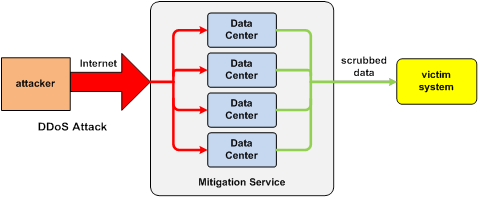
 Various defense strategies can be invoked to defend against DDoS attacks. Many of these depend upon the intensity of the attack. We discuss some of these in this article. Mitigation Strategies Some protection from DDoS attacks can be provided by firewalls and intrusion-prevention systems (systems that monitor for malicious activity). When a DDoS attack begins, it is important to determine the method or methods that the attacker is using. The web site’s front-end networking devices and the server’s processing flow may be able to be reconfigured to stop the attack. UDP Attacks UDP (User Datagram Protocol) attacks send a mass of UDP requests to a victim system, which must respond to each request. One example is a ping attack. It is an enormous influx of ping requests from an attacker that requires the victim server to respond with ping responses. Another example of a UDP attack is when the Internet Control Message Protocol (ICMP) must be used by the server to return error messages. The messages may indicate that a requested service is unavailable or that a host or router cannot be reached. An attacker may send UDP messages to random ports on the victim server, and the server must respond with a “port unreachable” ICMP message. Mitigation Strategy In the case of a UDP attack, the firewall could be configured to reject all UDP messages. True, this would prevent legitimate use of UDP messages, such as pings sent by monitoring services to measure the uptimes and response times of the web site. However, to be shown as failed by a monitoring service is much better than actually being down. SYN Attacks In a SYN attack, a mass of connection requests are sent to the victim server via SYN messages. Typically, the victim server will assign connection resources and will respond with SYN ACK messages. The server expects the requesting client to complete the connections with ACK messages. However, the attacker never completes the connections; and the server soon runs out of resources to handle further connection requests. Mitigation Strategy In this case, the server connection facility could be reconfigured so that it did not assign connection resources until it received the ACK from the client. This would slightly extend the time required to establish a connection but would protect the server from being overwhelmed by this sort of an attack. DNS Reflection Attack A DNS reflection attack allows an attacker to send a massive amount of malicious traffic to a victim server by generating a relatively small amount of traffic. DNS requests with a spoofed victim address are sent to multiple DNS systems to resolve a URL. The DNS servers respond to the victim system with DNS responses. What makes this sort of attack so efficient is that the DNS response is about 100 times as large as the DNS request. Therefore, the attacker only needs to generate 1% of the traffic that will be sent to the victim system. DNS reflection attacks depend upon DNS open resolvers that will accept requests from anywhere on the Internet. DNS open resolvers were supposed to have been removed from the Internet, but 27 million still remain. Mitigation Strategy A defense against DNS reflection attacks is to allow only DNS responses from the domain of the victim server to be passed to the server. Mitigation Services Given a sufficiently large DDoSattack, even the steps mentioned here may not protect a system. If nothing else, the attack can overwhelm the bandwidth of the victim’s connection to the Internet. In such cases, the next step is to use the services of a DDoS mitigation company with large data centers that can spread the attack volume over multiple data centers and can scrub the traffic to separate bad traffic from legitimate traffic. Prolexic, Tata Communications, AT&T, Verisign, CloudFare, and others are examples of DDoS mitigation providers. These services will also monitor the nature of the attack and will adjust their defenses to be effective in the face of an attacker that modifies its strategies as the attack progresses. Legality DDoS attacks are specifically outlawed by many countries. Violators in the U.K. can serve up to ten years in prison. The U.S. has similar penalties, as do most major countries. However, there are many countries from which DDoS attacks can be launched without penalty. With respect to the Spamhaus attack described in Part 1, the CEO of CyberBunker, a Dutch company, was arrested in Spain and was returned to the Netherlands for prosecution. Summary Companies must prepare for the likelihood of losing their public-facing web services and must make plans for how they will continue in operation if these services are taken down. This should be a major topic in their Business Continuity Plans. For instance, in the case of the bank attacks described in Part 1, many banks made plans to significantly increase their call center capabilities to handle customer services should their web sites be taken down by a DDoS attack. DDoS attacks are here to stay. They are motivated by too many factors – retaliation, political statements, aggressive competitors, ransom – and are fairly easy to launch. Botnets can be rented inexpensively. There are even sophisticated tools available on the darknet to launch significant attacks. The defenses against DDoS attacks are at best limited. The ultimate defense is to subscribe to a DDoS mitigation service that can be called upon when needed. Source: http://www.techproessentials.com/ddos-attacks-can-take-down-your-online-services-part-3-defending-against-ddos-attacks/