
“Follow the money” is a popular catchphrase attributed to the 1976 movie All The President’s Men suggesting a money trail or corruption scheme within high (often political) office. Cybercriminal actors are certainly following the advice. The Deloitte Global Cyber Executive Briefing on E-Commerce & Online payments suggests that as retailers discover the financial rewards of having an e-commerce website, criminals are not far behind. But while robbing a brick and mortar store is wrought with risk of getting caught, the cyber world is proving much more lucrative relative to the effort and investments needed to execute a digital heist. For every e-commerce site that goes up, the potential target expands to include merchant, payment service provider, card company, suppliers, banks and buying customer. That is because e-commerce websites are directly connected both to the internet and to the business’ back-end systems for data processing and supply management. This makes e-commerce website a prime attack point for gaining access to crucial information assets within the organization according to Deloitte. The fourth Neustar annual Worldwide DDoS Attacks and Cyber Insights Research Report reveals that attacks against the financial services and retail industries are on the rise. Industry respondents confirm that it is getting much longer for organizations to detect and respond as cyberattacks grow in volume, complexity and frequency. Financial services institutions (FSIs) under attack There is recognition among industry players that they remain at high risk of malware and data theft (44% in 2017 versus 37% in 2016). Ransomware appears to be on the rapid rise in financial services industry as respondents to the survey indicate an increase in reported attacks from 17% in 2016 to 28% a year later. Financial institutions are also investing against Distributed Denial of Service (DDoS) attacks with 91% of organizations putting in more resources in 2017 compared to 79% in 2016. FSIs continue to be one of the favored targets of hackers as 86% of surveyed respondents confirm being under attack in 2017, up 10% from the previous year. More worrisome is that 88% reported being under attack more than once. Retailers under attack Eighty percent of respondents said they were under attack in 2017, up 7% from 2016. Respondents to the survey also noted that it took longer for them to detect and respond to the attacks in 2017 compared to 2016 suggesting that attack are getting sophisticated. Retailers responding to the survey Industry confirmed that they are spending more for security in 2017 (87%) compared to 2016 (76%). Respondents also report that ransomware attacks have increased from 13% in 2016 to 21% in 2017. Asia Pacific under attack Among respondents in Asia Pacific, 33% reported average revenue loss of at least US$250,000 with 49% reporting ransomware and DDoS attacks occurring in concert. Time to detect for 49% of respondents in the region stood at about three hours while 42% said it was taking them at least three hours to respond following discovery of the attack. In response to escalating frequency, complexity and severity of malware and DDoS attacks, Robin Schmitt, general manager, APAC at Neustar recommended that IT and business leaders need to evaluate the effectiveness of existing security strategies. “The research shows that simply identifying an attack and depending on basic defenses is not enough. Organizations in the region need to adopt stronger defenses and innovative solutions to more quickly and effectively mitigate the growing risk and likely impact of a major DDoS attack,” he said. According to Neustar the data from the research suggests that 2017 will be another challenging one from a DDoS threat landscape perspective. Generic Routing Encapsulation (GRE) based flood attacks and Connectionless Lightweight Directory Access Protocol (CLDAP) reflection attacks are emerging as the new hot attack trends for 2017, suggesting that attackers are constantly eyeing new ways to turn legitimate infrastructure elements against their owners. Source: https://www.enterpriseinnovation.net/article/expect-increase-ransomware-and-ddos-attack-combos-2017-145803210
Original post:
Expect an increase in ransomware and DDoS attack combos in 2017
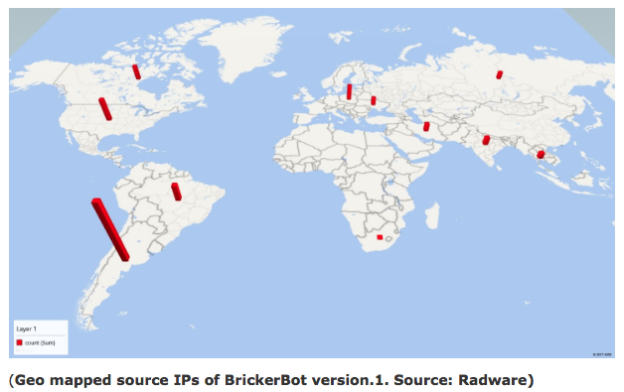
 Canada is among the countries that have been stung by a mysterious botnet infecting Internet-connected devices using the Linux and BusyBox operating systems that essentially trashes the hardware, according to a security vendor. Called a Permanent Denial of Service attack (PDoS) – also called “plashing” by some – the attack exploits security flaws or misconfiguration and goes on to destroy device firmware and/or basic functions of a system, Radware said in a blog released last week. The first of two versions has rendered IoT devices affected into bricks, which presumably is why the attack has been dubbed the BrickerBot. A second version goes after IoT devices and Linux servers. “Over a four-day period, Radware’s honeypot recorded 1,895 PDoS attempts performed from several locations around the world,” the company said in the blog. “Its sole purpose was to compromise IoT devices and corrupt their storage.” After accessing a device by brute force attacks on the Telnet login, the malware issues a series of Linux commands that will lead to corrupted storage, followed by commands to disrupt Internet connectivity, device performance, and the wiping of all files on the device. Vulnerable devices have their Telnet port open. Devices tricked into spreading the attack — mainly equipment from Ubiquiti Networks Inc. including wireless access points and bridges with beam directivity — ran an older version of the Dropbear secure shell (SSH) server. Radware estimates there are over 20 million devices with Dropbear connected to the Internet now which could be leveraged for attacks. Targets include digital video cameras and recorders, which have also been victimized by the Mirai or similar IoT botnets. According to Radware, the PDoS attempts it detected came from a limited number of IP addresses in Argentina, the U.S., Canada, Russia, Iran, India, South Africa and other countries. Two versions of the bot were found starting March 20: Version one, which was short-lived and aimed at BusyBox devices, and version two, which continues and has a wider number of targets. While the IP addresses of servers used to launch the first attack can be mapped, the more random addresses of servers used in the second attack have been obscured by Tor egress nodes. The second version is not only going after IoT devices but also Unix and Linux servers by adding new commands. What makes this botnet mysterious is that it wipes out devices, rather than try to assemble them into a large dagger that can knock out web sites – like Mirai. “BrickerBot 2 is still ongoing,” Pascal Geenens, a Radware security evangelist based in Belgium, said in a phone interview this morning. “We still don’t have an idea who it is because it’s still hiding behind the Tor network.” “We still have a lot of questions like where was it originating from, what is the motivation? One of them could be someone who’s angry at IoT manufacturers for not solving that [security] problem, maybe somebody who suffered a DDoS attack and wants to get back at manufacturers by bricking the devices. That way it solves the IoT problem and gets back at manufacturers. “Another idea that I have is maybe its a hacker that is running Windows-based botnets, which are more costly to maintain.” It’s easy to inspect and compromise an IoT device through a Telnet command, he explained, so IoT botnet are easy to assemble. That lowers the cost for a botnet-for-hire. By comparison Windows devices have to be compromised through phishing campaigns that trick end users into downloading binaries that evade anti-virus software. It’s complex. So Geenens wonders if a hacker’s goal here is to get into IoT botnets and destroy the devices, which then raises the value of his Windows botnet. Another theory is the attacker is searching for Linux-based honeypots — traps set by infosec pros — with default passwords. He also pointed out Unix or Linux-based servers with default credentials are vulnerable to the BrickerBot 2 attack. However, he added, there wouldn’t be many of those because during installation process Linux ask for creation of a root password, so there isn’t a default credential. The exception, he added, is a pre-installed image downloaded from the Internet. Administrators who have these devices on their networks are urged to change factory default credentials and disable Telnet access. Network and user behavior analysis can detect anomalies in traffic, says Radware. Source: http://www.itworldcanada.com/article/canada-one-of-sources-for-destructive-iot-botnet/392242