
Attackers using threats of data exposure and DDoS disruptions to try and extort ransoms from organizations The recent leak of 10 unaired episodes from Season 5 of Netflix’ hit series “Orange Is The New Black” shows that ransomware is not the only form of online extortion for which organizations need to be prepared. Increasingly, cyber criminals have begun attempting to extort money from organizations by threatening to leak corporate and customer data, trade secrets, and intellectual property. Instead of encrypting data and seeking a ransom for decrypting it, criminals have begun using doxing as a leverage to try and quietly extort bigger sums from enterprises. “Targeted attacks are the new cybersecurity threat and are on the rise,” says Nir Gaist, CEO and co-founder of security vendor Nyotron. “Organizations, regardless of industry or size, can be targeted with cyber extortion or espionage as the hackers’ goal.” The reason why there isn’t more noise over such incidents is that victims often like to keep quiet about them, he says. “Unless the company is regulated to report the attack, they will keep it quiet to keep brand and reputation intact,” Gaist says. Even in the case of the Netflix leak, for instance, it was the hackers themselves who announced the attack. “There was no monetary loss due to the early release of the ‘Orange is the New Black’ episodes, but there was reputation loss and brand damage,” he says. A malicious hacker or hacking group calling itself TheDarkOverload earlier this week claimed responsibility for publicly posting several episodes of the Netflix series after apparently stealing them from Larson Studio, a small post-production company, back in December. The hackers first tried to extort money from Larson Studio before going after Netflix directly. When Netflix refused to acquiesce to the extortion demand, the hackers released the unaired episodes. The hackers claimed to have stolen several more unaired episodes of TV programs from Netflix, Fox, and National Geographic and have threatened to release them as well. It is not clear if the hackers have made any extortion demands from the various studios. The Netflix incident is an example of the growing threat to organizations from extortion scams, says Moty Cristal the CEO of NEST Negotiation Strategies, a firm that specializes in helping organizations negotiate with online extortionists. Cyber extortion can include the threat of DDoS attacks and data exposure. The goal of attackers is to find a way to threaten targets with the most damage, either financial or from a brand reputation standpoint, Cristal explains. Any decision on whether to pay or not to pay should be based on an assessment of the potential damage, both real and perceived, that the attacker could wreak, and the company’s ability to withstand such damage, Cristal says. In the Netflix incident, the fact that the attackers demanded just around 50 bitcoin for the stolen episodes suggests they were likely motivated more by the need to be recognized and professionally acknowledged than by financial gain, Cristal adds. Surprisingly, targeted extortion attacks do not always have to be sophisticated to be successful, although sometimes they can very sophisticated Gaist says. “In a targeted attack, the hacker will attempt to find a simple vulnerability to get in,” he says. “Unfortunately for most companies, basic security hygiene is simply not attended to properly – leaving them completely vulnerable to a targeted attack.” While attacks that result in potential exposure of customer and corporate data can be scary, there are a couple of good reasons not to pay, security analysts say. One of course is that paying off a ransom or extortion is only likely to inspire more attempts. An organization that shows its willingness to pay to get data back or to prevent something bad from happening will almost certainly be attacked again. The other reason is that not all extortion scams are real. In fact, a lot of times attackers will attempt to scare money out of an organization with false threats. Last year for instance, a malicious hacking group calling itself the Armada Collective sent extortion letters to some 100 companies threatening them with massive distributed denial of service attacks if they did not pay a specific ransom amount. Security vendor CloudFlare, which analyzed the Armada Collective’s activities, estimated that the group netted hundreds of thousands of dollars in ransom payments from victims, without carrying out a single attack. Meg Grady-Troia, web security product marketing manager at Akamai, says paying a ransom doesn’t necessarily guarantee a chosen outcome. “So doing separate analysis of the request for payment and the real threat is critical for any organization.” Akamai’s customers have seen a lot of extortion letters, threatening a DDoS attack if a specified amount of bitcoin is not deposited to an identified wallet by a certain time, she says. These letters have come from a number of groups, including DD4BC, Armada Collective, Lizard Squad, XMR Squad, and others. Often though, there is very little follow-through. “Some of these DDoS extortion letters are merely profit-making schemes, while some are serious operations with the resources to damage a business,” says Grady-Troia. Paying a ransom is no guarantee that your data still won’t be leaked, she says. “Once data has been exfiltrated from your system, the blackmail may or may not continue after the requested payment, or it may still be leaked.” What organizations need to be focusing on is DDoS attack resilience and the operational agility of their systems, particularly access controls, backup procedures, and digital supply chain. “The importance of online extortion depends immensely on the nature of the threat and the enterprise’s risk tolerance,” Grady-Troia says. “Businesses should have a security event or incident response process that can be invoked in the case of any attack, and that process should include subject matter experts for systems and tools, procedures for all kinds of hazards.” Source: http://www.darkreading.com/attacks-breaches/netflix-incident-a-sign-of-increase-in-cyber-extortion-campaigns/d/d-id/1328794
Read the article:
Netflix Incident A Sign Of Increase In Cyber Extortion Campaigns
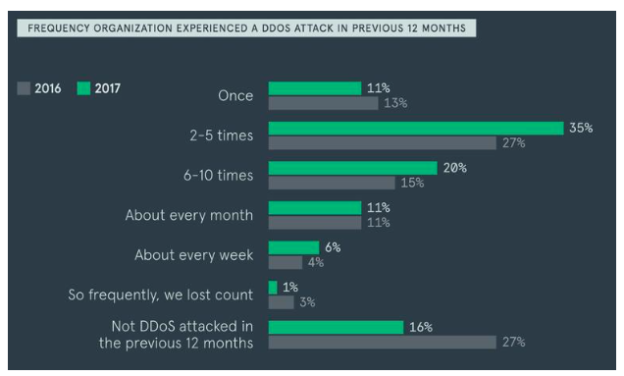
 Neustar says that the enterprise is finding it more difficult than ever to stem the financial cost of DDoS campaigns. DDoS campaigns are on the rise and the enterprise can now expect a bill of at least $2.5 million every time they become a victim. The mere threat of a distributed denial-of-service (DDoS) attack can cause businesses to sweat, and in some cases, cybercriminals earn big moneyjust by threatening a company with a future attack unless they pay protection fees. However, while some threat actors may just pretend, others use DDoS attacks to disrupt businesses by flooding a domain with illegitimate traffic. This kind of attack may also be used make a political statement or as a means of censorship. Whatever the reason, DDoS attack rates are increasing and businesses are being forced to pay out for damage control and repair, as they are losing more revenue through online service disruption than ever before. According to web analytics firm Neustar’s latest DDoS attack trends report, in addition to a survey conducted by Neustar and Harris Interactive of over 1,000 executives from enterprise firms, while the first quarter of the year is generally considered “pre-season” for these attacks, the company is already seeing “significant increases in average attack size and variety of attack vectors.” To date this year, 849 out of 1,010 enterprise companies — 84 percent — included in the research have experienced at least one DDoS attack in the last 12 months, up from 73 percent in 2016. In total, 86 percent of these businesses were struck with multiple DDoS attacks over the past 12 months, of which 63 percent said the loss of revenue at peak times caused by DDoS disruption can sometimes reach beyond $100,000 an hour. This is a significant increase from 50 percent of companies which said so much revenue was at stake in 2016, but to make matters worse, 43 percent of respondents admitted the financial loss per hour is closer to $250,000. Neustar says that the respondents to the survey have collectively lost over $2.2 billion dollars during the past 12 months, which is a minimum of $2.5 million each on average across 849 organizations. According to Neustar’s internal security data, 45 percent of DDoS attacks were of an attack strength of over 10 Gbps per second, and 15 percent of attacks reached at least 50 Gbps which is almost double the rate reported in 2016. Threat actors are utilizing a number of new techniques to disrupt businesses, including Generic Routing Encapsulation (GRE) based flood attacks and Connectionless Lightweight Directory Access Protocol (CLDAP) reflection techniques. The matter is made worse by the increased use of Internet of Things (IoT) connected devices in the enterprise, which when left unsecured, can act as pathways to penetrate business network defenses as well as become slave nodes themselves which are included in the DDoS traffic stream. Mitigating DDoS attacks is not just a challenge for businesses, but public figures and speakers, too. Back in 2016, prominent security researcher Brian Krebs found himself to be the target of a massive DDoS attack — powered by the Mirai botnet — which was close to disrupting service to his website. Web provider Akamai was able to fend off the attack, but due to the size and cost, was unable to protect him again. As a result, Google’s Project Shield, a free DDoS protection service, offered to shelter the websiteagainst future attacks. Alongside the report’s release, Neustar has revealed plans to increase the firm’s global DDoS mitigation service capacity to 3 Tbps and hopes to extend this capacity to 10 Tbps by early 2018. Source: http://www.zdnet.com/article/the-average-ddos-attack-cost-for-businesses-rises-to-over-2-5m/