
DDoS attacks have increased by over 200% in the last year, according to new research from Imperva. The uptick in attacks has been attributed to DDoS-for-hire services, the company said. DDoS attacks are now among the most common cyber threats businesses can face, according to Imperva. Between April 1, 2015 and March 31, 2016 it recorded an average of 445 attacks targeting its customers per week. More than 40% of customers affected were targeted more than once, and 16% were hit more than five times. The majority of attacks noted by Imperva targeted the application layer, making up 60% of all DDoS attacks. The remainder targeted the network layer. However, Imperva noted that the number of application layer attacks are trending downwards, dropping by 5% year over year. If that trend continues, network layer attacks could be just as common as application layer ones before too long. The most recent quarter covered by this report shows a big jump in the size of network layer attacks. The biggest recorded attack was 470 Gbps, while many others exceeded 200 Gbps. Imperva now says attacks of this size are a “regular occurrence.” These increases in DDoS attacks have been attributed to DDoS-for-hire services, where anyone can pay as little as $5 to launch a minute-long DDoS attack on a target of their choice. This means attacks can be launched by just about anyone—whether it’s because of a grudge against a particular company or just boredom. These now account for 93% of DDoS attacks, up from 63.8% in Q2 2015. Imperva says this has directly led to the increase in overall DDoS numbers. Another clue to an increase in DDoS-for-hire services and what Imperva calls “casual offenders” is a decrease in attack complexity. Starting in Q2 2015 the company recorded a decrease in multi-vector attacks; attacks using multiple vectors and payloads indicate a more sophisticated, complex attack. However, Q1 2016 saw an increase in the volume of assaults using five or more payloads. “This countertrend reminds us that—in parallel with the increased “hobbyist” activity—more capable cyber-criminals continue to improve their methods. As per the first rule of the DDoS mitigation industry, attacks continue to get larger and more sophisticated on the high-end of the scale,” the report said . The report also examined where DDoS attacks generally emerge from. Once again, China tops the list, with a sharp increase recorded in South Korea. The excellent broadband infrastructure in the country enables attacks to easily launch effective attacks, Imperva said. The UK is now the world’s second most-attacked country, after the United States of America. Most attacks targeted small and medium businesses, but some bigger institutions, including the BBC and HSBC , were hit as well. Source: http://www.infosecurity-magazine.com/news/ddos-attacks-increase-200/
More:
DDoS Attacks Increase 200%; UK Now Second Most Targeted Nation
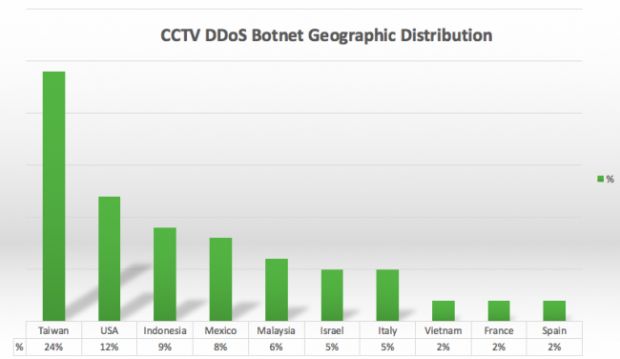
 All clues lead back to Chinese DVR vendor TVT A botnet of over 25,000 bots lies at the heart of recent DDoS attacks that are ferociously targeting business around the world. More exactly, we’re talking about massive Layer 7 DDoS attacks that are overwhelming Web servers, occupying their resources and eventually crashing websites. US-based security vendor Sucuri discovered this botnet, very active in the last few weeks, and they say it’s mainly composed of compromised CCTV systems from around the world. Their first meeting with the botnet came when a jewelry shop that was facing a prolonged DDoS attack opted to move their website behind Sucuri’s main product, its WAF (Web Application Firewall). Botnet can crank out attacks of 50,000 HTTP requests per second Sucuri thought they had this one covered, just as other cases where companies that move their sites behind their WAF block the attacks, and eventually the attacker moves on to other targets. Instead, they were in for a surprise. While the initial attack was a Layer 7 DDoS with over 35,000 HTTP requests per second hitting the server and occupying its memory with garbage traffic, as soon as the attackers saw the company upgrade their website, they quickly ramped up the attack to 50,000 requests. For Layer 7 attacks, this is an extraordinarily large number, enough to drive any server into the ground. But this wasn’t it. The attackers continued their assault at this high level for days. Botnet’s nature allowed attacks to carry out attacks at higher volumes Usually, DDoS attacks flutter as the bots come online or go offline. The fact that attackers sustained this high level meant their bots were always active, always online. Sucuri’s research into the incident discovered over 25,513 unique IP addresses from where the attacks came. Some of these were IPv6 addresses. The IPs were spread all over the world, and they weren’t originating from malware-infected PCs, but from CCTV systems. Taiwan accounted for a quarter of all compromised IPs, followed by the US, Indonesia, Mexico, and Malaysia. In total, the compromised CCTV systems were located in 105 countries. Top 10 locations of botnet’s IPs The unpatched TVT firmware comes back to haunt us all Of these IPs, 46 percent were assigned to CCTV systems running on the obscure and generic H.264 DVR brand. Other compromised systems were ProvisionISR, Qsee, QuesTek, TechnoMate, LCT CCTV, Capture CCTV, Elvox, Novus, or MagTec CCTV. Sucuri says that all these devices might be linked to Rotem Kerner’s investigation, which discovered a backdoor in the firmware of 70 different CCTV DVR vendors . These companies had bought unbranded DVRs from Chinese firm TVT. When informed of the firmware issues, TVT ignored the researcher, and the issues were never fixed, leading to crooks creating this huge botnet. This is not the first CCTV-based botnet used for DDoS attacks. Incapsula detected a similar botnet last October. The botnet they discovered was far smaller, made up of only 900 bots . Source: http://news.softpedia.com/news/a-massive-botnet-of-cctv-cameras-involved-in-ferocious-ddos-attacks-505722.shtml#ixzz4CsbxFc4A