Attack on NS1 sends 50 million to 60 million lookup packets per second. Unknown attackers have been directing an ever-changing army of bots in a distributed denial of service (DDoS) attack against NS1, a major DNS and traffic management provider, for over a week. While the company has essentially shunted off much of the attack traffic, NS1 experienced some interruptions in service early last week. And the attackers have also gone after partners of NS1, interrupting service to the company’s website and other services not tied to the DNS and traffic-management platform. While it’s clear that the attack is targeting NS1 in particular and not one of the company’s customers, there’s no indication of who is behind the attacks or why they are being carried out. NS1 CEO Kris Beevers told Ars that the attacks were yet another escalation of a trend that has been plaguing DNS and content delivery network providers since February of this year. “This varies from the painful-but-boring DDoS attacks we’ve seen,” he said in a phone interview. “We’d seen reflection attacks [also known as DNS amplification attacks] increasing in volumes, as had a few content delivery networks we’ve talked to, some of whom are our customers.” In February and March, Beevers said, “we saw an alarming rise in the scale and frequency of these attacks—the norm was to get them in the sub-10 gigabit-per-second range, but we started to see five to six per week in the 20 gigabit range. We also started to see in our network—and other friends in the CDN space saw as well—a lot of probing activity,” attacks testing for weak spots in NS1’s infrastructure in different regions. But the new attacks have been entirely different. The sources of the attacks shifted over the week, cycling between bots (likely running on compromised systems) in eastern Europe, Russia, China, and the United States. And the volume of the attacks increased to the 30Gbps to 50Gbps range. While the attacks rank in the “medium” range in total volume, and are not nearly as large as previous huge amplification attacks, they were tailored specifically to degrading the response of NS1’s DNS structure. Rather than dumping raw data on NS1’s servers with amplification attacks—where an attacker sends spoofed DNS requests to open DNS servers that will result in large blocks of data being sent in the direction of the target—the attackers sent programmatically generated DNS lookup requests to NS1’s name servers, sometimes at rates of 50 million to 60 million packets per second. The packets looked superficially like genuine requests, but they were for resolution of host names that don’t actually exist on NS1’s customers’ networks. NS1 has shunted off most of the attack traffic by performing upstream filtering of the traffic, using behavior-based rules that differentiate the attacker’s requests from actual DNS lookups. Beevers wouldn’t go into detail about how that was being done out of concern that the attackers would adapt their methods to overcome the filtering. But the attacks have also revealed a problem for customers of the major infrastructure providers in the DNS-based traffic management space. While the DNS specification has largely gone unchanged since it was created from a client perspective, NS1 and other providers have carried out a lot of proprietary modification of how DNS works behind the scenes, making it more difficult to use multiple DNS providers for redundancy. “We’ve moved a bit away from the interoperable nature of DNS,” Beevers said. “You can’t slave one DNS service to another anymore. You’re not seeing DNS zone transfers, because features and functionality of the [DNS provider] networks have diverged so much that you can’t transfer that over the zone transfer mechanism.” To overcome that issue, Beevers said, “people are pulling tools in-house to translate configurations from one provider to another—that did work very well for some of our customers [in shifting DNS during the attack].” NS1, like some of its competitors, also provides a service that allows customers to run the company’s DNS technology on dedicated networks. “so if our network gets hit by a big DDoS attack, they can still have access.” Fixing the interoperability problem will become more urgent as attacks like the most recent one become more commonplace. But Beevers said that it’s not likely that the problem will be solved by a common specification for moving DNS management data. “DNS has not evolved since the ’80s, because there’s a spec,” he said. “But I do believe there’s room for collaboration. DNS is done by mostly four or five companies— this is one of those cases where we have a real opportunity because community is small enough and because the traffic management that everyone uses needs a level of interoperability.” As companies with big online presences push for better ways to build multi-vendor and multi-network DNS systems to protect themselves from outages caused by these kinds of attacks, he said, the DNS and content delivery network community is going to have to respond. Source: http://arstechnica.com/information-technology/2016/05/major-dns-provider-hit-by-mysterious-focused-ddos-attack/
Visit site:
Major DNS provider hit by mysterious, focused DDoS attack
 A combination of Ransomware and DDoS attacks is heralding a new wave of cyber attacks against consumers and enterprises around the world. Security experts are concerned this may become a standard practice going forward; this is not good news by any means. Ransomware And DDoS Is A Potent Mix Over the past few years, ransomware attacks have become the norm rather than an exception. But the people responsible for these attack continue to improve their skills, and infected machines will now start executing distributed denial of service attacks as well. Not only will users not be able to access their files, but the device will also become part of a botnet attacking other computers and networks around the world. KnowBe4 CEO Stu Sjouwerman stated: “ Adding DDoS capabilities to ransomware is one of those ‘evil genius’ ideas. Renting out DDoS botnets on the Dark Web is a very lucrative business, even if prices have gone down in recent years. You can expect [bundling] it to become a fast-growing trend.” One of the first types of ransomware to embrace this new approach is Cerber, a Bitcoin malware strain which has been wreaking havoc for quite some time now. Attacks have been using “weaponized” Office documents to deliver malware to computers, which would then turn into a member of a botnet to DDoS other networks. While some people see this change as a logical evolution of ransomware attacks, this is a worrying trend, to say the least. Assailants can come up with new ways to monetize their ransomware attacks, even if the victim decides not to pay the fee. As long as the device is infected, it can be used to execute these DDoS attacks, which is a service worth the money to the right [wrong] people. A recent FireEye report shows how the number of Bitcoin ransomware attacks will exceed 2015 at the rate things are going right now. Now that DDoS capabilities are being added to the mix, it is not unlikely the number of infections will increase exponentially over the next few months. Moreover, removing the ransomware itself is no guarantee computer systems will not be used for DDoS purposes in the future, and only time will tell if both threats can be eliminated at the same time. Source: http://themerkle.com/devices-infected-with-new-ransomware-versions-will-execute-ddos-attacks/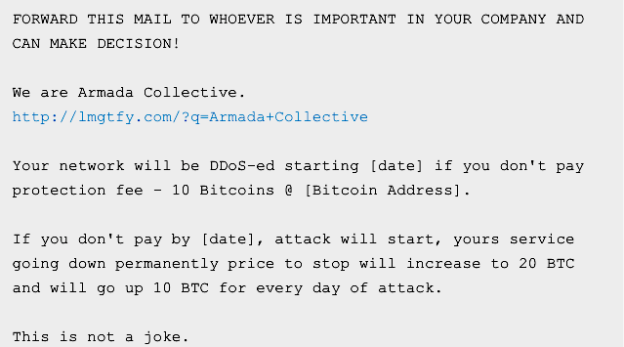
 In less than two months, online businesses have paid more than $100,000 to scammers who set up a fake distributed denial-of-service gang that has yet to launch a single attack. The charlatans sent businesses around the globe extortion e-mails threatening debilitating DDoS attacks unless the recipients paid as much as $23,000 by Bitcoin in protection money, according to a blog post published Monday by CloudFlare, a service that helps protect businesses from such attacks. Stealing the name of an established gang that was well known for waging such extortion rackets, the scammers called themselves the Armada Collective. “If you don’t pay by [date], attack will start, yours service going down permanently price to stop will increase to increase to 20 BTC and will go up 10 BTC for every day of the attack,” the typical demand stated. “This is not a joke.” Except that it was. CloudFlare compared notes with other DDoS mitigation services and none of them could find a single instance of the group acting on its threat. CloudFlare also pointed out that the group asked multiple victims to send precisely the same payment amounts to the same Bitcoin addresses, a lapse that would make it impossible to know which recipients paid the blood money and which ones didn’t. Despite the easily spotted ruse, many businesses appear to have fallen for the scam. According to a security analyst contacted by CloudFlare, Armada Collective Bitcoin addresses have received more than $100,000. “The extortion emails encourage targeted victims to Google for the Armada Collective,” CloudFlare CEO Matthew Prince wrote. “I’m hopeful this article will start appearing near the top of search results and help organizations act more rationally when they receive such a threat.” Source: http://arstechnica.com/security/2016/04/businesses-pay-100000-to-ddos-extortionists-who-never-ddos-anyone/