
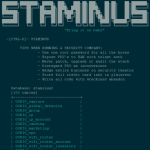
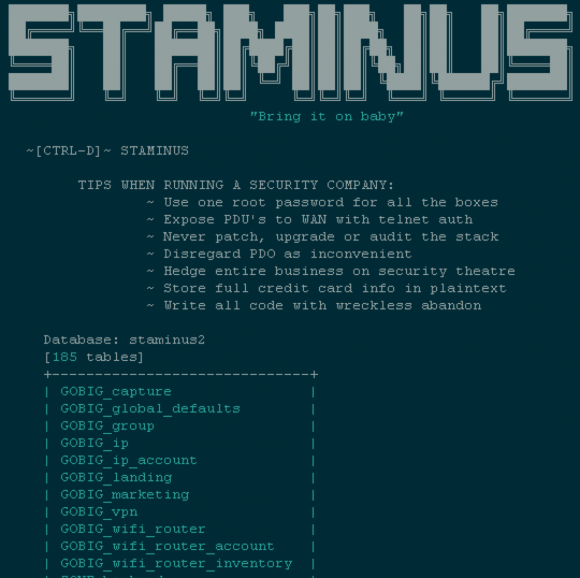
 Staminus Communications Inc ., a California-based Internet hosting provider that specializes in protecting customers from massive “distributed denial of service” (DDoS) attacks aimed at knocking sites offline, has itself apparently been massively hacked. Staminus’s entire network was down for more than 20 hours until Thursday evening, leaving customers to vent their rage on the company’s Facebook and Twitter pages. In the midst of the outage, someone posted online download links for what appear to be Staminus’s customer credentials, support tickets, credit card numbers and other sensitive data. Newport Beach, Calif.-based Staminus first acknowledged an issue on its social media pages because the company’s Web site was unavailable much of Thursday. “Around 5am PST today, a rare event cascaded across multiple routers in a system wide event, making our backbone unavailable,” Staminus wrote to its customers. “Our technicians quickly began working to identify the problem. We understand and share your frustration. We currently have all hands on deck working to restore service but have no ETA for full recovery.” Staminus now says its global services are back online, and that ancillary services are being brought back online. However, the company’s Web site still displays a black page with a short message directing customers to Staminus’s social media pages. Meanwhile, a huge trove of data appeared online Thursday, in a classic “hacker e-zine” format entitled, “Fuck ’em all.” The page includes links to download databases reportedly stolen from Staminus and from Intreppid, another Staminus project that targets customers looking for protection against large DDoS attacks. The authors of this particular e-zine indicated that they seized control over most or all of Staminus’s Internet routers and reset the devices to their factory settings. They also accuse Staminus of “using one root password for all the boxes,” and of storing customer credit card data in plain text, which is violation of payment card industry standards. Staminus so far has not offered any additional details about what may have caused the outage, nor has it acknowledged any kind of intrusion. Several Twitter accounts associated with people who claim to be Staminus customers frustrated by the outage say they have confirmed seeing their own account credentials in the trove of data dumped online. I’ve sent multiple requests for comment to Staminus, which is no doubt busy with more pressing matters at the moment. I’ll update this post in the event I hear back from them. It is not unusual for attackers to target Anti-DDoS providers. After all, they typically host many customers whose content or message might be offensive — even hateful — speech to many. For example, among the company’s many other clients is kkk-dot-com, the official home page of the Ku Klux Klan (KKK) white supremacist group. In addition, Staminus appears to be hosting a large number of internet relay chat (IRC) networks, text-based communities that are often the staging grounds for large-scale DDoS attack services. Source: https://krebsonsecurity.com/2016/03/hackers-target-anti-ddos-firm-staminus/

 Every day hackers attack Norway´s largest news site, VG. But not without risk. VG has both helped the police put hackers behind bars and alerted mothers about what their adventurous sons are up to. VG.no is one of the most successful news sites in the world. Every week 4 million Norwegians – out of a population of 5 million – visit the site for the latest news. But that also makes VG.no a target for hackers. “Whenever there is a new security hole discovered, someone want to try it on VG,” says Audun Ytterdal, head of IT operations in VG. During the Schibsted Tech Polska Winter Event 2016 he presented “War stories from the ops trenches”, describing how the media house protects itself from a continuous flow of DDoS attacks. Under attack every day VG is well prepared for hacker attacks – and is able to deal with lots of traffic without going down. According to Ytterdal the site can handle up to 30 GB per second. “Usually we see around 10.000 http-hits per second. But during the attacks we can experience up to 100.000 http-hits per second,” he explains. Called the hacker´s mum In the presentation he explains some of the technical measures taken to secure the news site from attack. But he also tells entertaining stories about how the IT staff used their technical skills to identify the hackers. And not always the hackers have everything planned out! Take for instance the young hacker who managed to take over the front page of the business site E24.no with photos of himself in a balaclava taken in his mum´s bathroom. However smart he had been breaking into the site, he had forgotten to remove the location info added to the image file when he took the photo with his mobile phone. “So we could see where he lived – and we called his mum informing her that her son was up to activities she may not approve of,” laughs Audun Ytterdal. Sent hackers to jail In another case the hackers bragged about their achievement on Twitter. That gave the IT operations department the opportunity to contact them directly. After a while they also managed to identify two of the hackers. When one of them posted a photo from a town in Southern Norway, VG was able to locate the exact house it had been taken from with use of Google Street View. The information was given to the police – and the two hackers later had to serve time in jail. Entertaining error page For a news room all alarms go off when the main site is down. And Audun Ytterdal believes it will be very hard to avoid never being shut down. So what to do when it happens? Of course identify and fix the problem. But VG also decided to give people a good laugh by designing an entertaining error page. The error page is a fun version of the normal front page of the site. “The last time we used this we had people tweeting that they would rather see the error page of VG than any other news site,” smiles Ytterdal. Source: http://www.schibsted.pl/2016/02/how-norways-biggest-news-site-protects-itself-from-ddos-attacks/