
A group known as New World Hackers says it targeted the websites of Salt Lake City police, Salt Lake International Airport, the Downtown Alliance and First Utah Bank in response to the Feb. 27 officer-involved shooting of teenager Abdullahi Omar Mohamed. The distributed denial of service attacks, first reported Monday by HackRead, appear to have had little impact on the sites’ function. Nick Como, communication and marketing director for the Downtown Alliance, said he heard about the attacks but that the nonprofit’s website analytics were normal. City deputy director of communications Holly Mullen said an attack on the SLCPD site was “unsuccessful.” Airport public relations director Nancy Volmer was unaware of any problems. First Utah Bank CIO Amy Foulks said the bank shut down its website for a few hours Sunday morning after it received an alert, which “allowed ourselves some time to implement a tool that would thwart the denial of service package.” Bank president Brad Baldwin emphasized that the DDoS attacks were not a “hack.” The group did not gain access to the bank’s system or any customer information, he said. A Twitter account associated with the group, @NewWorldHacking, told The Tribune the attacks were in response to the shooting of Mohamed, 17, who was shot and wounded near 250 S. Rio Grande Street after police say he was one of two people attacking a male victim with metal objects. “We want justice for that poor kid who got shot 3 times in the chest for no accurate reason,” it said in a direct message. That the group would target a bank with no apparent role in Mohamed’s shooting is “a mystery to us,” Baldwin said. First Utah reported the attack to authorities, he said. The FBI did not immediately return a request for comment Tuesday. Source: http://www.sltrib.com/news/3665236-155/ddos-attacks-aimed-at-salt-lake
Taken from:
DDoS attacks aimed at Salt Lake City websites in apparent protest of officer-involved shooting
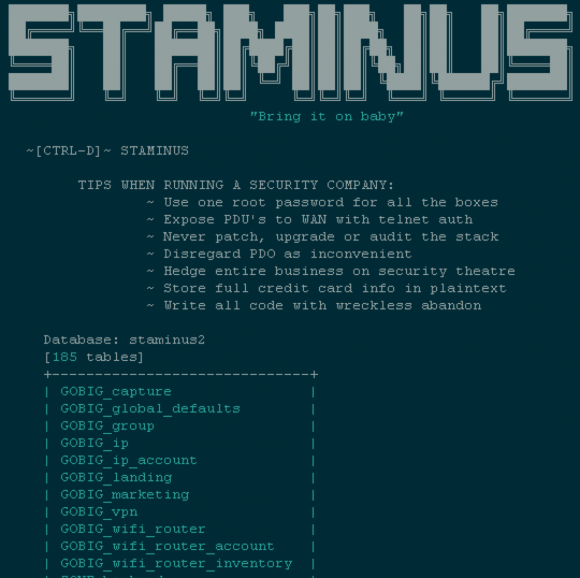
 Staminus Communications Inc ., a California-based Internet hosting provider that specializes in protecting customers from massive “distributed denial of service” (DDoS) attacks aimed at knocking sites offline, has itself apparently been massively hacked. Staminus’s entire network was down for more than 20 hours until Thursday evening, leaving customers to vent their rage on the company’s Facebook and Twitter pages. In the midst of the outage, someone posted online download links for what appear to be Staminus’s customer credentials, support tickets, credit card numbers and other sensitive data. Newport Beach, Calif.-based Staminus first acknowledged an issue on its social media pages because the company’s Web site was unavailable much of Thursday. “Around 5am PST today, a rare event cascaded across multiple routers in a system wide event, making our backbone unavailable,” Staminus wrote to its customers. “Our technicians quickly began working to identify the problem. We understand and share your frustration. We currently have all hands on deck working to restore service but have no ETA for full recovery.” Staminus now says its global services are back online, and that ancillary services are being brought back online. However, the company’s Web site still displays a black page with a short message directing customers to Staminus’s social media pages. Meanwhile, a huge trove of data appeared online Thursday, in a classic “hacker e-zine” format entitled, “Fuck ’em all.” The page includes links to download databases reportedly stolen from Staminus and from Intreppid, another Staminus project that targets customers looking for protection against large DDoS attacks. The authors of this particular e-zine indicated that they seized control over most or all of Staminus’s Internet routers and reset the devices to their factory settings. They also accuse Staminus of “using one root password for all the boxes,” and of storing customer credit card data in plain text, which is violation of payment card industry standards. Staminus so far has not offered any additional details about what may have caused the outage, nor has it acknowledged any kind of intrusion. Several Twitter accounts associated with people who claim to be Staminus customers frustrated by the outage say they have confirmed seeing their own account credentials in the trove of data dumped online. I’ve sent multiple requests for comment to Staminus, which is no doubt busy with more pressing matters at the moment. I’ll update this post in the event I hear back from them. It is not unusual for attackers to target Anti-DDoS providers. After all, they typically host many customers whose content or message might be offensive — even hateful — speech to many. For example, among the company’s many other clients is kkk-dot-com, the official home page of the Ku Klux Klan (KKK) white supremacist group. In addition, Staminus appears to be hosting a large number of internet relay chat (IRC) networks, text-based communities that are often the staging grounds for large-scale DDoS attack services. Source: https://krebsonsecurity.com/2016/03/hackers-target-anti-ddos-firm-staminus/