Category Archives: DDoS Criminals

Greek Banks Hit by DDoS Attacks, Hackers Ask for Bitcoin Ransoms to Stop

Armada Collective, the hackers that launched DDoS attacks on ProtonMail, are back and are targeting several Greek banks, using the same DDoS-for-Bitcoin extortion scheme. Unlike the ProtonMail debacle, when the secure email provider agreed to pay the hackers’ ransom, this time around, bankers contacted local law enforcement, as Greek newspaper Kathimereini is reporting. The attacks started on Thursday, November 26, and continued through this week. Three unnamed Greek banks were targeted, and Armada Collective hackers asked for 20,000 Bitcoin ($7,210,000 / €6,790,000) from each of them. Yanni Koutsomitis, Eurozone analyst and managing director at Imperial Media, said that, on Monday, Greek authorities brought in FBI specialists to help with the investigation and countering the cyber-attack. During the DDoS on ProtonMail, after the initial attacks that convinced ProtonMail management to pay the ransom, subsequent DDoS attacks grew in intensity. Armada Collective denied responsibility for the subsequent attacks, which were many times stronger than the early ones. Many believed the hackers’ explanation and suspected that a state-sponsored actor quietly got on the line and was taking revenge on the secure email provider labeled as “NSA-proof.” The attacks on the Greek banks now confirm that Armada Collective is a serious threat and has the power to cripple an entire nation’s financial institution. Previous Armada Collective targets include Hushmail, Runbox, and a few Internet Service Providers from Switzerland. None of them paid the ransom. Source: http://news.softpedia.com/news/greek-banks-hit-by-ddos-attacks-hackers-ask-for-bitcoin-ransoms-to-stop-496966.shtml

Read this article:
Greek Banks Hit by DDoS Attacks, Hackers Ask for Bitcoin Ransoms to Stop

Tux Machines Again Faces DDoS Attacks

The popular website Tux Machines has evidently fallen victim to a DDoS attack that made the site unavailable for part of the day on Friday. The announcement of the attack was initially made in a blog notice posted on the site late Friday morning GMT which opened with the line “Tux Machines has been mostly offline this morning.” According to the blog post, the attack was at first thought to have been initiated by the Chinese web services company Baidu, but a later update indicated that turned out not to be the case. “…Baidu was [not] at fault but botmasters who used ‘Baidu’ to masquerade themselves, hiding among some real and legitimate requests from Baidu (with Baidu-owned IP addresses).” At this time, it’s not known who’s behind the attack. Roy Schestowitz, who with his wife Rianne publishes both Tux Machines and the politically oriented FOSS blog site Techrights, told FOSS Force, “We’ve suspected EPO seeking revenge, which makes sense for Techrights, not Tux Machines.” EPO refers to the European Patent Office which recently threatened Schestowitz with civil action over an article which claimed the EPO purposefully gives priority to patent applications from large corporations. This isn’t the first time the outspoken Schestowitz’s sites have come under DDoS attacks. In September and October of 2014, both sites came under a crippling attack that lasted for several weeks and which left both sites unreachable for long stretches of time. Indications are that this current attack isn’t nearly as damaging, although Schestowitz said that he and his wife had been working to keep Tux Machines functional throughout the weekend. Many websites use the services of a content delivery network (CDN), in part as protection against all but the most robust DDOS attacks. Schestowitz told us that no CDN is used by either of his sites. “I wrote a lot about this before,” he said. “Performance, Tor, privacy issues, JavaScript and so on. So no, CDNs are out of the question.” We sent Tux Machines an email this morning to determine the current status but have not received a reply. However, at the time of publication the site was responsive, as was Techrights. Source: http://fossforce.com/2015/11/tux-machines-again-face-ddos-attacks/

More:
Tux Machines Again Faces DDoS Attacks

Anonymous vs ISIS, Australian attorney general, NTP and DDoS exploits

Anonymous vs ISIS Naturally, even cybersecurity news in this past week has centred around ISIS in the wake of the Paris attacks. The main headline has come from Anonymous, who have again but more formally waged ‘war’ on ISIS themselves. So far their efforts seem to have focused on communication; deleting thousands of Twitter accounts they believe are associated with the terrorist group. One notable aspect of how ISIS recruit supporters is through social media such as Twitter and Facebook, with an estimated 46,000 affiliated Twitter accounts. The move by Anonymous was announced immediately after ISIS dubbed the group ‘idiots’ and began circulating some useless cybersecurity advice to its followers via messaging app Telegram. Anonymous’s efforts, dubbed #OpParis are likely to irritate the group and possibly damage their recruitment opportunities. Australian attorney general warns terrorism means privacy will suffer Australian Attorney General George Brandis has said that Australians should expect ‘greater impediments to personal privacy’ in the wake of the Paris attacks. Measures have already become more strict under his tenure, with legislation passed to collect call records, IP addresses, location and billing information but it remains to be seen what further changes might be made. He also said during the interview by Nine Network that the situation with ISIS was tantamount to war. UK warns terrorists are targeting hospitals, power stations and air traffic control In an address at GCHQ (Government Communication Headquarters, a branch of British intelligence), chancellor George Osborne warned that terrorists will also be making efforts to target national infrastructure in order to carry out attacks. He also said that the government intend to double cybersecurity spending over the next five years. While we know such attacks are possible, we are yet to see terrorist groups like ISIS leverage this type of capability. NTP being made more secure to avoid DDoS exploits A new beta version of the Network Time Protocol (NTPsec) has been released, in efforts to avoid exploitation in DDoS attacks. Currently only available for open source use and feedback, the protocols codebase has been greatly streamlined; reduced from 30,000 lines of code to just 884. One of the project’s lead developers Eric S Raymond said: ‘The most important change you can’t see is that the code has been very seriously security-hardened, not only by plugging all publicly disclosed holes but by internal preventive measures to close off entire classes of vulnerabilities.’ Hackers offer 200,000 Comcast user passwords for sale Hackers have offered 200,000 Comcast user passwords for sale on the dark web, leading to a mass password reset from the company. What’s interesting in this case is that this was not a breach, but the result of users being duped into revealing their passwords themselves. Fortunately, Comcast’s own security officer discovered the passwords up for sale and initiated the mass reset before any accounts were known to be exploited. A reminder to be more careful with our password management! Vodafone reveal breach as further arrests made in TalkTalk case In the wake of the large TalkTalk breach and as a third man was arrested in the case, Vodafone announced their own breach. Affecting just 1827 users, who have all since been informed, Vodafone have not revealed how the attack was carried out. The number of customers affected by the TalkTalk breach has now been revised; originally given as 4 million, the number is now down to 1.2 million. In addition to usernames, emails and passwords 21,000 of these included bank account details and 28,000 credit card details. Source: https://www.acunetix.com/blog/articles/in-the-headlines-anonymous-vs-isis-australian-attorney-general-ntp-and-ddos-exploits/

Follow this link:
Anonymous vs ISIS, Australian attorney general, NTP and DDoS exploits

Bloggers Put Bounty on DDoS Extortionists

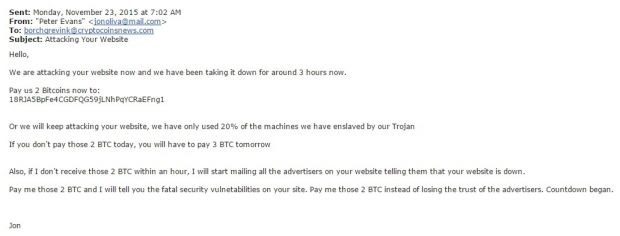
Two sister blogs, Hacked (Security & Tech) and CryptoCoinsNews, have decided to go the Mel Gibson route (“Ransom” movie reference for the uncool kids) and put out a bounty on DDoS attackers instead of paying the money they were asking for. It all started earlier this morning, when both sites saw a serious DDoS attack being carried out against their server infrastructure. Three hours after the attack began, the two received emails from a man named Jon. The attacker claimed to own a botnet that he intended to use for DDoS attacks. He said that currently he was using only 20% of the botnet’s capabilities against the two sites. Jon was asking for a 2 Bitcoin ransom, which would become 3 Bitcoin by tomorrow if unpaid. Instead of giving in and being intimidated by the attacker, the two sites ramped up their DDoS mitigation and decided to put out a 5 Bitcoin ransom on the attacker, which is about $1,600 or €1,500 in today’s exchange rate. Turning the table on DDoS extortionists “If you can help us identify the extortionists in a way that leads to a successful police report, you will receive five bitcoins, with gratitude,” says Samburaj Das of CCN and Hacked. The bloggers are looking for data like real names, addresses, and attacks carried out on other sites that would allow investigators to track their DDoS campaign. Details should be sent to crypto@cryptocoinsnews.com. Only last month something similar happened to ProtonMail, a crypto email service. The site was under a massive DDoS attack, which also expanded to its ISP. Due to peer pressure from other affected services, ProtonMail paid the ransom , but the attacks never stopped, with other groups also taking aim at their infrastructure. Many people skewered ProtonMail’s owners for paying the attackers, saying it was a bad idea and did nothing but encourage such types of groups to carry on with their DDoS-for-Bitcoin extortion campaigns . We’ll just have to wait and see how Hacked/CCN’s countermove goes through. Source: http://news.softpedia.com/news/bloggers-put-bounty-on-ddos-extortionists-496586.shtml

See the article here:
Bloggers Put Bounty on DDoS Extortionists

To the IT Security Rescue: DARPA and the Extreme DDoS Defence Program

IT security is a big deal – especially today with concerns that the government may be compromising some private networks. We know that the agency has compromised Google and Yahoo! in the past. Today, the Defence Advanced Research Projects Agency (DARPA) is working to fight against certain kinds of security breaches. On the surface of it, it seems contradictory, since DARPA is a branch of the U.S. Department of Defence. But, here’s a deeper look into the agency, and what they’re doing and why. DDoS Attacks and Why They’re Important A DDoS attack is a special type of DOS attack, commonly called a “Distributed Denial of Service” attack. It’s an attempt to bring down a network using multiple compromised systems, which are usually infected with malware or a virus – usually a trojan. The point of a denial of service attack is to make so many requests from the server that it can’t keep up, and crashes – taking the site or network offline. A distributed attack means that multiple computers are making requests for information or data from the server. And, because they are spread out, it’s very difficult to stop. It’s difficult to distinguish between legitimate users and attackers because, often, innocent computers are hijacked in the attack and made to look like legitimate users. Security companies that specialize in this type of threat know how to deal with them. And, you can visit this website if you want to know more about how detection and analysis works from inside the industry – including the concept of “white hat hacking” or “penetration testing.” Option One: Self-Defence Tactics One option commonly employed by companies and organizations in the past was a homebrew self-defence strategy. This is the simplest way to defend against an attack, but it’s also a method that’s a bit outdated. Usually, a coder or in-house IT employee would write some Python script that would filter out bad traffic. Sometimes, enterprises would use existing firewalls to block malicious traffic. In the early 2000s, this was a simple affair. Today, attacks are fairly complex and, while it’s simple to write a script, it doesn’t work nearly as well as it used to. A firewall will quickly be overloaded under the mildest of today’s DDoS attacks. Option Two: Specialized Equipment Defence Another option is to use specialized equipment to defend your company or organization. It’s a similar approach to the DIY method in that an enterprise is doing all of the work to stop an attack. However, instead of relying on scripts and firewalls, the business buys and deploys dedicated DDoS mitigation hardware. The hardware sits in a company’s data centre in front of the standard servers and routers. It’s made specifically to detect and filter malicious traffic. Companies that use this approach face multiple challenges. First, the hardware is costly. And, if the company isn’t under attack, the devices are just sitting there, collecting dust. They can also be expensive to operate. You need skilled network and security people to run them. They have to be constantly updated by your operations and IT team if you want protection against the latest threats. DDoS tactics change on a daily basis. And, finally, the Achilles heel of the hardware is that they can’t handle volumetric attacks. All an attacker has to do is figure out your maximum bandwidth and exceed it. Option Three: ISP Defence Most companies outsource their DDoS mitigation. Some enterprises use their ISP to provide the service. An ISP can have more bandwidth than a single company would, which helps with large attacks. But, there are still problems with this approach. The most obvious is that ISPs aren’t in the business of threat detection and mitigation. They sell bandwidth. So, their systems might not actually be very good at detecting and defending against a well-orchestrated (or even not-so-well orchestrated) attack. Option Four: Cloud Mitigation Provider This option essentially outsources the problem to a company that specializes in cloud services. Cloud mitigation providers are experts when it comes to providing DDoS mitigation from the cloud. In other words, these companies have built out massive network resources. They have more bandwidth capabilities than your average hosting provider or cloud storage vendor, and they can mitigate the threat of an attack at multiple sites around the Internet. Basically, they redistribute the bad traffic that comes in to lessen its effects. In many cases, there is no effect. They can scrub traffic for you, and send only the “clean” traffic to your data centre. One major reason you’d want to hire these people is for their expertise. They usually have network and security engineers and researchers on staff that are monitoring the latest threats and tactics hackers use so that customers are well-protected. They also have bandwidth – lots of it. They provide more bandwidth than an enterprise could ever hope to provision on its own. This is effective in stopping even the largest of attacks. They have multiple types of DDoS mitigation hardware. Since DDoS attacks are very complex, there’s an inherent need for multiple layers of filtering to keep up with the latest threats. Cloud providers use multiple technologies, including their own proprietary technology to defend against attacks. Source: http://www.theglobaldispatch.com/to-the-it-security-rescue-darpa-and-the-extreme-ddos-defence-program-68380/

More here:
To the IT Security Rescue: DARPA and the Extreme DDoS Defence Program

Hacktivists claim ISIS terrorists linked to Paris attacks had bitcoin funding

Anti-ISIS hackers claimed to have detected indicators of an impending attack on Paris as well bitcoin funding, a wallet with over $3 million, used by ISIS militants. During Dateline coverage after the terrorist attacks on Paris, Lestor Holt asked, “Does this change the game in terms of intelligence?” Andrea Mitchell replied, “It does,” before discussing how intelligence missed any type of communication regarding the coordinated attacks. She added, “There’s such good surveillance on cell phones and there’s such good communications ability by the intelligence gathering in Europe, especially in France, especially in Great Britain and in the United States. So they may have been communicating via social media or through codes. And that’s the kind of thing that is very concerning to U.S. intelligence.” After the Charlie Hebdo massacre, France passed an “intrusive” surveillance bill, granting the government the power “to wiretap communications, install secret surveillance cameras and sweep up metadata.” That didn’t stop the horrific attacks on Paris, aka “Paris’ 9/11,” and more ubiquitous and invasive surveillance is not the answer. Matthew Williams, a researcher of computational criminology at Cardiff University in Wales, told Mic that “picking out singular acts of crime or terror from an indiscriminate pile of civilian noise is all but impossible.” Ghost Security Group detected indicators of attack on Paris Even with all the surveillance, intelligence groups again missed indicators of a credible terrorist attack. Yet in an interview with NewsBTC, a member of the hacktivist group “Ghost Security Group” claims it “did detect several indicators of an attack impending and are currently in the process of collecting valuable evidence for United States government officials.” ISIS and bitcoin funding DW (Deutsche Welle) previously reported that the Islamic State is experimenting with currency, specifically gold and bitcoin. One bitcoin wallet received around $23 million in a month; anti-ISIS hackers from GhostSec followed a chain of transactions to another wallet with over $3 million in bitcoins. Ghost Security Group confirmed to NewsBTC that ISIS is “extensively using bitcoin for funding their operations” and that the group has “managed to uncover several bitcoin addresses used by them.” Furthermore, bitcoin is “their prime form of cryptocurrency.” No evidence was given, such as the bitcoin wallet address, as the hackers “cannot go into more detail at the moment on current investigations.” GhostSec Background GhostSec (Ghost Security), a hacktivist group which is an offshoot of Anonymous, has been attacking thousands of ISIS social media accounts and public websites since early this year. The group is not alone; in February, Anonymous and the Redcult Team called ISIS a virus that it planned to cure during Operation ISIS (#OpISIS). A GhostSec spokesperson claimed that ISIS, ironically, has been using Google and Amazon Web Service to avoid U.S. and international intelligence agencies and to shield itself and its websites from being hacked by Ghost Security Group; the latter has been credited with stopping terrorist attacks. DigitaShadow, executive director of the Ghost Security Group, told IBTimes UK, that the group discovered terrorist threats against Tunisia in July, and also uncovered evidence that foiled a terrorist attack in New York on July 4. The hacktivist group has also been credited with discovering and reporting other credible extremist threats. GhostSec keeps a running tally of Twitter IDs reported, server IPs reported to host extremist content, Facebook, Tumblr, YouTube and other common sites as well as “uncommon sites” that have been reported as being dedicated to extremist causes and “could/should be targeted and brought down.” It also has a way to submit potential terrorism-related content and other tools. The hacking group has targeted and bypassed CloudFlare “to determine the actual website that they need to attack to takedown the actual website.” Ghost Security Group Ghost Security reportedly formed earlier this year after the terrorist attacks against Charlie Hebdo offices in Paris. Earlier this month, Ghost Security Group split (pdf) from “Ghost Security.” Ghost Security Group is a counter terrorism network that combats extremism on the digital front lines of today utilizing the internet and social media as a weapon. Our cyber operations consist of collecting actionable threat data, advanced analytics, offensive strategies, surveillance and providing situational awareness through relentless cyber terrain vigilance. The newly formed Ghost Security Group (GSG) said (pdf) it “needed to address some misapprehensions concerning our group. Much of that stemmed from our uses of menacing graphics which resemble logos used by illicit cyber networks. Perceptions matter and all of that was undermining our abilities to cultivate relationships with officials who now recognize our capabilities to add value to counter terrorism initiatives.” The new group has a new website that has a more corporate-like appearance, while Ghost Security uses the older .org website. Ghost Security Group added (pdf): The group’s new trademarked look discards the hoodies and Guy Fawkes masks so often associated with publicity stunts and distributed denial-of-service (DDoS) attacks on government, religious, and corporate websites in favor of pristine, white graphics devoid of any reference to illegal activities. Part of the transition has included discarding their old brand and website, www.GhostSec.org , which are now used by former group members who have a different philosophy and approach to combating ISIS online. Ghost Security Group has 12 core members, some of whom work “16 hours a day … and 7 days a week nonstop” to identify surface-level and hidden Deep Web sites that are suspected to be related to the Islamic State; the group receives tips from volunteers and part-time helpers. Foreign Policy reported the group receives 500 tips every day. Data-mining, identity stitching, email monitoring, predictive analysis, social media surveillance, terrorism financing and social engineering are but some of the things listed among GSG’s counter surveillance capabilities. Some members of the small group of terrorist hunters have “ex-military or cybersecurity backgrounds.” GSG said it “monitors over 200 known violent extremist websites for actionable threat data and analysis;” it has “identified and terminated over 100,000 extremist social media accounts that were used primarily for recruitment purposes and transmission of threats against life and property.” It is GSG that claims to have detected indicators of the attack on France. Can you believe that? Michael Smith, co-founder of Kronos Advisory and an advisor to U.S. Congress, forwards about 90% of GhostSec’s leads to the FBI. Even retired Gen. David Petraeus, formerly head of the CIA, told Foreign Policy, “[Smith] has shared with me some of the open source data he has provided to various U.S. agency officials, and I can see how that data would be of considerable value to those engaged in counter-terrorism initiatives.” Regarding ISIS and bitcoin funding, one unnamed GSG hacker said, “Most of the Bitcoin funding sites utilized by the Islamic State are on the deep web and we have managed to uncover several and successfully shut them down in order to limit the funding extremists receive through the use of cryptocurrencies.” The feds claim encryption is a terrorist’s tool, so hopefully the horrible attacks on Paris won’t add fuel to their encryption-is-evil claims. In the same way that all encryption is not bad, bitcoin is not used exclusively by terrorists; hopefully the ISIS-bitcoin-funding issue won’t take a twist and lead to the bashing of cryptocurrencies or a push for more surveillance laws. If you like the idea of cyber vigilantes going after ISIS instead of the government, and if you want to help stop ISIS and other extremist groups, GSG said to report “suspicious activities.” Tips go through a “rigorous review process before a website is cleared for termination.” Every potential “target is reviewed by five members – often including a native Arabic speaker – and ranked by level of threat.” When “asked if their destruction of Islamic State websites sets a bad precedent for freedom of speech online,” GSG’s @DigitaShadow answered: “No. Free speech isn’t murder.” Source: http://www.networkworld.com/article/3005308/security/hacktivists-claim-isis-terrorists-linked-to-paris-attacks-had-bitcoin-funding.html  

Continue Reading:
Hacktivists claim ISIS terrorists linked to Paris attacks had bitcoin funding
Security blogger Graham Cluley’s website suffers DDoS attack

A distributed denial-of-service attack (DDoS) is a cheap but effective way to take out your target’s website by flooding it with so much traffic that the web server becomes overwhelmed and the website crashes. There are those who use DDoS attacks as a kind of online protest, such as hacktivist groups like Anonymous. Then there are those who do it to “amuse” themselves, like the Lizard Squad who took out Playstation and Xbox servers on Christmas Day last year. And then there are other DDoS attacks that come from cybercriminals who don’t care about politics or hijinks – they just want money. Recently a cybergang calling itself the Armada Collective has been attempting to extort money from victims by threatening DDoS attacks unless a ransom is paid in bitcoins. One Swiss company, the encrypted webmail provider ProtonMail, recently paid $6000 in bitcoins after receiving a ransom from the Armada Collective, it said. The site was still DDoSed. And now, the latest site to fall victim to a DDoS attack is that of former Naked Security writer Graham Cluley. We don’t know why Graham was targeted, but on Twitter he noted that he didn’t receive a ransom demand, so it must have been “personal.” Unfortunately, it doesn’t take much skill to launch this kind of attack. Anybody with a little bit of money and the will to wreak havoc can launch DDoS attacks with simple DDoS-for-hire web tools that harness armies of zombified computers to bombard your website with thousands or millions of illegitimate web requests. DDoS attacks are simple but destructive – if your website goes down for any period of time, your customers can’t get through and you end up losing new sales, losing customers, or missing out on ad revenue, depending on what your website’s purpose is. In Graham’s article about how ProtonMail initially caved to the extortion demands, but then had a change of heart, Graham wrote something very sensible about how we should treat extortionists, blackmailers and ransom-takers: No-one should ever pay internet extortionists. For those who receive a ransom demand, it might seem like a few thousand dollars is a fair price to pay when your customers are complaining they can’t access your services, and your business is hurting. But if we pay the extortionists’ demands, that will only give them more reason to do it again. Source: http://www.mysec.hu/magazin/kuelfoeldi-hirek/20413-security-blogger-graham-cluley-s-website-suffers-ddos-attack

Continue reading here:
Security blogger Graham Cluley’s website suffers DDoS attack

FastMail the latest victim of a sustained DDoS offensive

FastMail has been subjected to a number of distributed denial of service (DDoS) attacks, the premium email provider has revealed. The Australian-based company said that the cyber offensive first took place in the early hours of November 8th, which took some of its services offline. In response it immediately “enabled mitigation strategies”, which proved successful in bringing the DDoS attack to an end. However, the following day, at around the same time, the cybercriminal once again launched another onslaught. This second-round of attacks came with a ransom demand, which threatened FastMail with more chaos if it didn’t hand over 20 Bitcoins (worth approximately £7,500). The company said that it does not respond to attempts of extortion and will not bow to pressure from the cybercriminal. “Over the last week, several email providers, including Runbox, Zoho, Hushmail and ProtonMail have been hit by large scale DDoS attacks, accompanied by an extortion demand from the attacker to stop,” FastMail outlined. “The goal of the attacker is clearly to extort money in the hope that the services will not be prepared to deal with the disruption. “With one exception, where ProtonMail paid the criminals and was still attacked, we do not believe the extortion attempts have been successful, and we fully intend to stand up to such criminal behaviour ourselves.” The company says that it is actively working to keep its services running as best as possible and that it has utilized knowledge gained from past DDoS attacks to help it react to numerous situations. The attack on ProtonMail is one of the most high-profile cases of 2015, which the encrypted email provider has described as the “largest and most extensive cyberattack in Switzerland”. A DDoS attack is when numerous computers make repeated requests for information to one computer or device. This has the effect of ‘overwhelming’ a computer or device’s ability to deal with the requests, resulting in it slowing down or crashing. Source: http://www.welivesecurity.com/2015/11/12/fastmail-latest-victim-sustained-ddos-offensive/

See original article:
FastMail the latest victim of a sustained DDoS offensive

ProtonMail comes back online, shores up DDoS defenses

ProtonMail, the Switzerland-based encrypted email service, has found its footing again after a wild ride over the past week. The free service has said it was hit by two different groups using distributed denial-of-service attacks (DDoS) that took it offline. Now it has partnered with Radware, which offered its DDoS mitigation service for a “reasonable price,” allowing service to resume, ProtonMail wrote in a blog post on Tuesday. “The attackers hoped to destroy our community, but this attack has only served to bring us all together, united by a common cause and vision for the future,” the company wrote. The first group of attackers, which call themselves the Armada Collective, asked ProtonMail for a ransom in bitcoin before launching attacks early on Nov. 4. The Swiss Governmental Computer Emergency Response Team warned in September about blackmail attempts by the Armada Collective. They tend to launch a demo attack while demanding 10 or 20 bitcoins, and larger attacks follow if the ransom isn’t paid. Controversially, ProtonMail paid the ransom. The company wrote in a blog post that it was under pressure from other companies to pay it in order to stop the attacks. However, ProtonMail later edited the blog post, writing that paying “was clearly a wrong decision so let us be clear to all future attackers – ProtonMail will never pay another ransom.” The second group’s attack on ProtonMail had wide-ranging effects on its service providers and other companies, which also were knocked offline. The 100Gbps-attack brought down ProtonMail’s ISP, including the ISP’s routers and data center. ProtonMail suspected that the second group might be state-sponsored hackers because of the severe damage inflicted. Bizarrely, the Armada Collective told ProtonMail it wasn’t responsible for the second set of attacks. By Sunday, ProtonMail began recovering. An ISP, IP-Max, set up a direct link from ProtonMail’s data center to a major Internet connection point in Zurich in less than a day, it wrote. Level 3 Communications lent a hand with IP transit. An appeal for donations to put in better protections against DDoS has netted $50,000 so far as well. ProtonMail’s service is free, but eventually it plans to introduce paid-for premium options. ProtonMail is now using Radware’s DefensePipe, a cloud-based service. Other companies, ProtonMail said, offered their services but “attempted to charge us exorbitant amounts.” ProtonMail offers a full, end-to-end encrypted email service and has more than 500,000 users. Although it has been possible to encrypt email for decades, interest has increased since documents leaked by former U.S. National Security Agency contractor Edward Snowden showed massive data-collection operations by western spy agencies. Source: http://www.pcworld.com/article/3004157/protonmail-comes-back-online-shores-up-ddos-defenses.html

See original article:
ProtonMail comes back online, shores up DDoS defenses

ProtonMail restores services after epic DDoS attacks

After several days of intense work, Switzerland-based end-to-end encrypted e-mail provider ProtonMail has largely mitigated the DDoS attacks that made it unavailable for hours on end in the last week.

Continued here:
ProtonMail restores services after epic DDoS attacks