Category Archives: DDoS Criminals

Hackers Used Imgur to Launch DDoS Attacks on 4chan

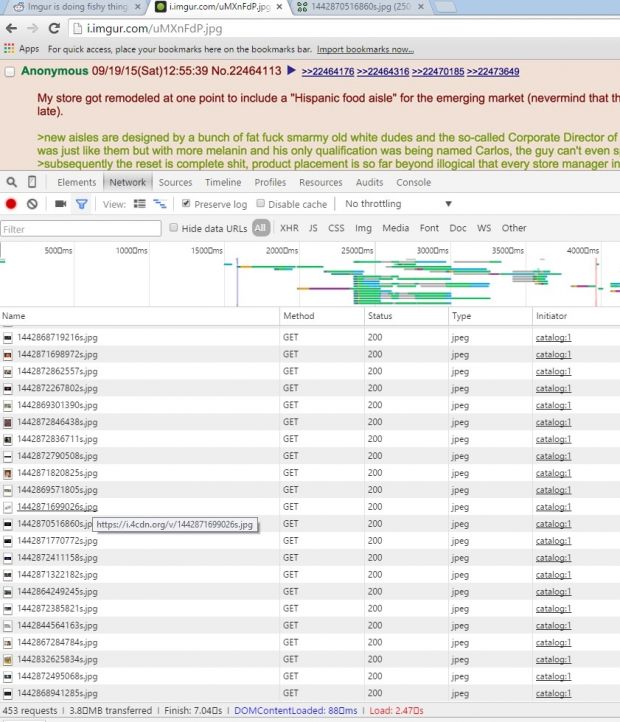
A Reddit user has uncovered a covert method of carrying DDoS attacks on 4chan’s infrastructure using images hosted on Imgur, via Reddit. According to Reddit user rt4nyp, who discovered the vulnerability, every time an Imgur image was loaded on the /r/4chan sub-reddit, over 500 other images were also loaded in the background, images hosted on 4chan’s CDN. Since traffic on 4chan is quite huge as is, getting some extra connections from Reddit pushed 4chan’s servers over the edge, crashing them several times during the day. Additionally, 8chan, a smaller 4chan spin-off, was also affected and suffered some downtime as well. Malicious code was being loaded with Imgur images Reddit user rt4ny was alerted that something was amiss when he noticed that Imgur images on Reddit were loaded as inlined base64 data. Taking a closer look at the base64 code, he observed that a small piece of JavaScript code was added at the end, which had no business being there. This code secretly stored the “axni” variable in the browser’s localStorage, which was set to load another JavaScript file from “4cdns.org/pm.js.” This is not 4chan’s official CDN, but a domain registered to closely resemble the real deal, which was taken down in the meantime. When refreshing the original image that loaded the “axni” variable, the malicious code would not be loaded again, a measure taken to avoid detection. Additionally, also to avoid detection, the JS file stored on “4cdns.org/pm.js” could not be loaded directly in the browser. Loading 500+ 4chan images inside a hidden iframe Analyzing the pm.js file, rt4ny found that it loaded an iframe outside the user’s view with the help of some clever CSS off-screen positioning tricks, inside which the hundreds of 4chan images were being loaded, along with a 142 KB SWF file. Imgur was contacted about this issue, and fixed it on the same day. “Yesterday a vulnerability was discovered that made it possible to inject malicious code into an image link on Imgur,” said the Imgur team. “From our team’s analysis, it appears the exploit was targeted specifically to users of 4chan and 8chan via images shared to a specific sub-reddit on Reddit.com using Imgur’s image hosting and sharing tools.” It’s a sad day for humanity when we see hackers combine the three best sites on the Internet to find cat GIFs into such wicked and immoral ways. Source: http://news.softpedia.com/news/hackers-used-imgur-to-launch-ddos-attacks-on-4chan-492433.shtml

See the original post:
Hackers Used Imgur to Launch DDoS Attacks on 4chan

The rise of repeated "low and slow" DDoS attacks

There's been a significant change in the nature of DDoS attacks that is leaving businesses exposed to data breaches and malware. Recent research from Neustar shines a light on the changing tactics …

See the original post:
The rise of repeated "low and slow" DDoS attacks

Aggressive tactics from DD4BC extortionist group revealed

Akamai shared details of an increase in DDoS attacks from the Bitcoin extortionist group DD4BC, based on observation of attack traffic targeted at customers from September 2014 through August 2015. …

Continued here:
Aggressive tactics from DD4BC extortionist group revealed

3l33t haxxors don’t need no botnet, they just pinch passwords

Crooks can thrive by ‘living off the land’ rather than forging elaborate schemes Half of all breaches Dell’s SecureWorks outfit has responded to over the last year have been a result of attackers using legitimate admin tools and stolen credentials.…

Link:
3l33t haxxors don’t need no botnet, they just pinch passwords

NBN vaults Australia into global top-10 … DDoS attack sources

Or not, if you look at the numbers Australia has won the dubious honour of being named in the global top-10 DDoS sources, and in its quarterly State of the Internet report, Akamai reckons our tiny number of high-speed fibre broadband users are the cause.…

Visit link:
NBN vaults Australia into global top-10 … DDoS attack sources

NCA arrests six Lizard Squad users after gaming firms, retailers targeted

Officers also visiting 50 addresses for a quiet word The National Crime Agency has arrested six users of a Lizard Squad DDoS attack tool, which had been used against a national newspaper, a school, gaming companies, and a number of online retailers.…

Continue reading here:
NCA arrests six Lizard Squad users after gaming firms, retailers targeted

Spooks, plod and security industry join to chase bank hacker

Perp known as ‘DD4BC’ has some serious heat on his or her tail, with worse to come A group of security boffins have joined police and intelligence spooks in a clandestine mission to identify those behind distributed denial of service (DDoS) extortion attacks against major banks.…

More:
Spooks, plod and security industry join to chase bank hacker

81% of healthcare organizations have been compromised

Eighty-one percent of health care executives say that their organizations have been compromised by at least one malware, botnet, or other cyber-attack during the past two years, and only half feel tha…

Excerpt from:
81% of healthcare organizations have been compromised

The UK’s 12 worst DDoS attacks Summarized – hacktivism, extortion and plain malice

DDoS attacks are often seen as a global phenomenon that affects ISPs and large datacentres. But the daily damage is done by much smaller attacks on vulnerable, sometimes poorly defended resources such as websites belonging to well-known organisations. The UK has had more than its fair share of such attacks with hacktivism and occasionally extortion the main motivations. Here we chart some of the worst attacks that have affected UK organisations in recent years. DoS attack on CMP Media (UBM) – 1998 Proof that simple denial of service (DoS) attacks (if not DDoS) are far from new, a disgruntled magazine subscriber decided to barrage the email server and fax machines of the UK tech publisher CMP Media (later sold to UBM) with enough traffic to cut the company off from the world for most of two days. The ISP identified the likely culprit but in 1998 denial of service attacks were a civil rather than criminal matter and remained so until 2006. LulzSec ‘”Tango down” DDoS attacks – 2011 The group that gave the Anonymous movement its UK brand, the small collection of mainly British youths that hid behind the LulzSec moniker loved their DDoS. Several big UK organisations were targeted but the attack that downed the Serious Organised Crime Agency (SOCA) website in June 2011 was probably the last straw. Alleged UK GCHQ DoS attack on Anonymous – 2011 In 2014 Britain hater and anti-NSA campaigning journalist Glenn Greenwald alleged that GCHQ Joint Threat Research Intelligence Group (JTRIG) unit launched DDoS attacks to disrupt chatrooms used by hacktivists from Anonymous and LulzSec. It was pointed out that this was really a targeted DoS attack and not an indiscriminate DDoS. Attack on the BBC by Iran – 2012 Downplayed at the time but what hit the Beeb on 2 March 2012 was anything but for those on the receiving end. Downed the BBC’s email server for a while, disrupted its Persian Service (hence the blame being attributed to Iran, which hates the Service’s output) and even overloaded its exchange with large numbers of phone calls. DDoS attack on Oxford and Cambridge universities – 2012 A single 20-year old individual – later imprisoned for a range of cybercrimes – was blamed for the DDoS attacks on Oxford and Cambridge University that disrupted their websites for a period of days in 2011 and 2012. It was never clear why the named man attacked the universities but the ease with which one person could cause so much trouble for large institutions was noted at the time. DDoS on 123-reg domain registrar – 2012 A sign that DDoS attacks could take on even big Internet-facing businesses, in May 2012 the UK’s largest domain registrar was hit with enough traffic to take its site down for a reported 15 minutes with further problems throughout the day. Rivals were also targeted as crybercriminals tested their latest techniques against well-defended businesses. Spamhaus 325Gbps super-DDoS – 2012 The massive 325Gbps DDoS attack on UK anti-spam organisation Spamhaus remains probably the second or third largest of all time and was even ridiculously said to have ‘slowed the Internet’. Later blamed on Dutch national Sven Kamphuis, the Spamhaus attack was the first to use a technique called DNS amplification to such sensational effect. Julian Assange hacktivists turn on MI5 – 2012 Wikileaks’ founder Julian Assange was briefly a focus for anti-corporate rage, and his pursuit by the UK, the US and Sweden over rape allegations promoted a series of hacktivist DDoS attacks in late 2012. Predictable they might have been but also surprisingly successful – MI5’s public website was put out of action for several hours. Manchester casino extortion attack – 2013 A rare publicised example of DDoS in the service of extortion, the attack on a Manchester-based online casino came after the business refused to pay the owner refused to hand over half the business to Polish nationals Piotr Smirnow and Patryk Surmacki. The pair were eventually arrested at Heathrow Airport tying to leave the country and later jailed. Raspberry Pi Foundation DDoS – 2013 Not everyone likes the Raspberry Pi people it seems including a “lone sociopath” with issues. The individual concerned launched a flurry of bizarre grudge DDoS attacks on its website, with some success. The attacker even targeted a group of teens working on a 48-hour Python hackathon using RaspBerry Pis. The Foundation beat the attacks with the help of an understanding ISP. Carphone Warehouse data breach DDoS – 2015 In July 2015, major UK smartphone retailer Carphone Warehouse suffered a serious data breach which, it later transpired, might have been aided using a DDoS ‘distraction’ attack. Up to one in five DDoS incidents are later found to be part of a data theft snatch in which IT staff are occupied fending off the DDoS, giving attackers more opportunity to sneak in and out. Mumsnet DDoS attack by @DadSecurity – 2015 Who would attack a site as apparently innocuous as Mumsnet? In what must rank as the oddest ideological attack of recent times, a campaign group called ‘@DadSecurity’ is suspected of doing just that as part of a wider campaign of nuisance that included having an armed police team dispatched to the house of founder Justine Roberts. Came after earlier data breach in 2014. Source: http://www.techworld.com/picture-gallery/security/uks-12-worst-ddos-attacks-hacktivism-extortion-plain-malice-3623767/#12

Continue reading here:
The UK’s 12 worst DDoS attacks Summarized – hacktivism, extortion and plain malice

Teen nabbed after attacks on UK government and FBI sites

His lawyers claim that their client was only on the “periphery” of a conspiracy to take down UK government and FBI sites, but a UK teen who didn’t mind boasting online about those crimes now faces the possibility of jail time. Charlton Floate, 19, of Solihull, England, already admitted to three counts of computer misuse under the Computer Misuse Act and three counts of possessing prohibited images at Birmingham Crown Court. The attacks took place in January 2013, when Floate and a team of other cyber criminals crippled government sites with deluges of digital traffic sent from malware-infected computers. Such computers are often called zombie computers, and they’re widely used in botnets to gang up on sites with what’s known as a distributed denial of service (DDoS) attack. The gang managed to knock out the UK’s Home Office site – a heavily used site that provides information on passports and immigration among other things – for 83 minutes. The group also took down an FBI site – that allowed users to report crime – for over five hours. The prosecutor, Kevin Barry, reportedly said that in November 2012, Floate carried out two test runs, remotely attacking the computers of two men in the US. Floate uploaded a sexually explicit video to YouTube to “mock and shame” one of his victims, and he “taunted” the other victim about having control of his computer. Modest, he was not – Floate also reportedly bragged about the government site attacks on Twitter and on a forum frequented by hackers. Judicial officer John Steel QC rejected Floate’s legal team’s contention that he was on the “periphery” of the cyber gang, saying that evidence pointed to his actually being central to the crimes, including organizing the attacks. He said Floate was “clearly a highly intelligent young man”, who had become an expert in computer marketing, had written a book on the subject, and succeeded in taking down an FBI.gov website – what he called the “Holy Grail” of computer crime: A successful attack on the FBI.gov website is regarded by hackers as the Holy Grail of hacking. It was this which he attempted and, indeed, achieved. He was the person who instituted such attacks and assembled the tools and personnel for doing so. The Holy Grail it may be but in this case I beg to differ about how successful Floate was in getting his hands on it. A DDoS attack isn’t a form of sophisticated lock picking, it’s just a noisy way to board the door shut from the outside. Floate may well be bright but he stumbled once, and that’s all that investigators needed. Namely, he used his own IP address – he worked out of his mother’s home – to check up on how the attacks had gone. Police traced the address to Floate’s mother’s home, where they seized Floate’s computer and mobile phone. They also found evidence that he’d tried to recruit others into the gang and that he’d discussed possible weaknesses in certain websites as well as potential future targets – including the CIA and The White House. Sentencing was adjourned until 16 October, pending a psychiatric report. Floate is currently remanded on conditional bail. Steel said he hadn’t yet made up his mind about sentencing but added there’s “clearly potential for an immediate custodial sentence” and that Floate “should be mentally prepared for it.’ Source: https://nakedsecurity.sophos.com/2015/08/24/teen-nabbed-after-attacks-on-uk-government-and-fbi-sites/

Read more here:
Teen nabbed after attacks on UK government and FBI sites