
Some 20 per cent of DDoS attacks have lasting damage that can see them taking a site down for 24 hours or more, according to research by Kaspersky. In fact, almost a tenth of the companies surveyed said their systems were down for several weeks or longer, while less than a third said they had disruption lasting less than an hour. The investigation revealed that the majority of attacks (65 per cent) caused severe delays or complete disruption, while only a third caused no disruption at all. Evgeny Vigovsky, head of Kaspersky DDoS Protection, said: “For companies, losing a service completely for a short time, or suffering constant delays in accessing it over several days, can be equally serious problems. “Both situations can impact customer satisfaction and their willingness to use the same service in the future. Using reliable security solutions to protect against DDoS attacks enables companies to give their customers uninterrupted access to online services, regardless of whether they are facing a powerful short-term assault or a weaker but persistent long-running campaign.” The company highlighted an attack on Github at the end of March when Chinese hackers brought the site down. That attack lasted 118 hours and demonstrated that even large communities are at risk. Last month, another study by Kaspersky revealed that only 37 per cent of companies were prepared for a DDoS attack, despite 26 per cent of them being concerned the problems caused by such attacks were long-term, meaning they could lose current or prospective clients as a result. Source: http://www.itpro.co.uk/security/24514/one-fifth-of-ddos-attacks-last-over-a-day
Category Archives: DDoS News
High volume DDoS attacks still persistent
Arbor Networks released global DDoS attack data that shows a continuation of extremely high volume attacks. In Q1 2015, there were 25 attacks larger than 100Gbps globally. In the past year, Arbor h…
Read the original post:
High volume DDoS attacks still persistent
DDoSsers use reflection amplification to crank up the volume to 100Gbps+
Ne’er-do-wells: ‘Hey.’ Dumb servers: ‘WHAT?’ Targets: ‘AAARGH’ DDoS attacks have grown in volume yet again with 25 attacks larger than 100Gbps globally in Q1 2015, according to the latest stats from DDoS mitigation firm Arbor Networks.…
See the original article here:
DDoSsers use reflection amplification to crank up the volume to 100Gbps+
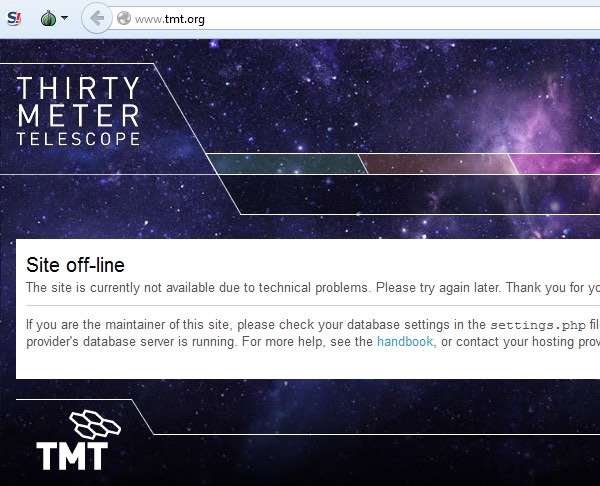
Thirty Meter Telescope website falls over in hacktivist DDoS attack
 Hacktivists have launched a distributed denial-of-service attack against the website of TMT (Thirty Meter Telescope), which is planned to be the Northern hemisphere’s largest, most advanced optical telescope. For at least two hours yesterday, the TMT website at www.tmt.org was inaccessible to internet users. Sandra Dawson, a spokesperson for the TMT project, confirmed to the Associated Press that the site had come under attack: “TMT today was the victim of an unscrupulous denial of service attack, apparently launched by Anonymous. The incident is being investigated.” You might think that a website about a telescope is a strange target for hackers wielding the blunt weapon of a DDoS attack, who might typically be more interested in attacking government websites for political reasons or taking down an unpopular multinational corporation. Why would hackers want to launch such a disruptive attack against a telescope website? Surely the only people who don’t like telescopes are the aliens in outer space who might be having their laundry peeped at from Earth? It turns out there’s a simple reason why the Thirty Meter Telescope is stirring emotions so strongly: it hasn’t been built yet. The construction of the proposed TMT is controversial because it is planned to be be constructed on Mauna Kea, a dormant 13,796 foot-high volcano in Hawaii. This has incurred the wrath of environmentalists and native Hawaiians who consider the land to be sacred. There has been considerable opposition to the building of the telescope on Mauna Kea, as this news report from last year makes clear. Now it appears the protest about TMT has spilt over onto the internet in the form of a denial-of-service attack. Operation Green Rights, an Anonymous-affiliated group which also campaigns against controversial corporations such as Monsanto, claimed on its Twitter account and website that it was responsible for the DDoS attack. The hacktivists additionally claimed credit for taking down Aloha State’s official website. It is clear that denial-of-service attacks are being deployed more and more, as perpetrators attempt to use the anonymity of the internet to hide their identity and stage the digital version of a “sit down protest” or blockade to disrupt organisations. Tempting as it may be to participate in a DDoS attack, it’s important that everyone remembers that if the authorities determine you were involved you can end up going to jail as a result. Peaceful, law-abiding protests are always preferable. Source: http://www.welivesecurity.com/2015/04/27/tmt-website-ddos/
Continue Reading:
Thirty Meter Telescope website falls over in hacktivist DDoS attack
DDoS attack brings down TRAI’s website
Indian telecom regulator TRAI’s official website was on Monday brought down by a hacker group called Anonymous India following the public release of email IDs from which the government body received responses regarding net neutrality. The group also warned TRAI of being hacked soon. “TRAI down! Fuck you http://trai.gov.in for releasing email IDs publicly and helping spammers. You will be hacked soon,” AnonOpsIndia tweeted. The group claimed to launch a DDoS (distributed denial-of-service) attack on the website to make it inaccessible. Slamming the government portal, the group posted: “#TRAI is so incompetent lol They have any clue how to tackle a DDoS?” “But just an alarm for whole #India. You trust incompetent #TRAI who don’t know how to deal with DDoS? Seriously sorry guys. Goodluck!,” it added. Taking a dig at the personnel at TRAI, it tweeted: “Somebody call ‘brilliant minds’ at TRAI and tell them to stop eating samosas and get back to work coz DDoS attack has stopped from here.” In a response to a Twitter user about the attack, Anonymous India said it was “just preventing spammers from accessing those Email IDs posted by Trai publicly.” It said that TRAI is incompetent in dealing with internet. “So those who still think that #TRAi can “handle” the Internet, we just proved you wrong.They just got trolled by bunch of kids.#Incompetence,” the hacker group tweeted. Following tweets suggesting the hacker group to stop their actions, Anonymous India did same. However, the group compalined that no action was taken on those email ids which were revealed. “Guys http://trai.gov.in is back online and they still haven’t done anything about those Email IDs. You guys told us to stop. We did,” it tweeted. “So if you guys still think you can have a chat with incompetent #TRAi, go ahead. But WE ARE WATCHING!,” the group posted. Source: http://indiablooms.com/ibns_new/news-details/N/10099/hacker-group-brings-down-trai-s-website.html
View article:
DDoS attack brings down TRAI’s website
DDoS threat recognized by all members of the C-suite
The increasing number and size of DDoS attacks and their costly and devastating effects on brand perception have not passed unnoticed by North American businesses, most of which have heightened their …
Read More:
DDoS threat recognized by all members of the C-suite
Banks Lose Up to $100K/Hour to Shorter, More Intense DDoS Attacks
Distributed denial of service attacks have morphed from a nuisance to something more sinister. In a DDoS attack, heavy volumes of traffic are hurled at a website to halt normal activity or inflict damage, typically freezing up the site for several hours. Such exploits achieved notoriety in the fall of 2012 when large banks were hit by a cyberterrorist group. But the Operation Ababil attacks were simply meant to stop banks’ websites from functioning. They caused a great deal of consternation among bank customers and the press, but little serious harm. Since then, the attacks have become more nuanced and targeted, several recent reports show. “DDoS is a growing problem, the types of attack are getting more sophisticated, and the market is attracting new entrants,” said Rik Turner, a senior analyst at Ovum, a research and consulting firm. For example, “we’re seeing lots of small attacks with intervals that allow the attackers to determine how efficiently the victims’ mitigation infrastructure is and how quickly it is kicking in,” he said. This goes for banks as much as for nonbanking entities. Verisign’s report on DDoS attacks carried out in the fourth quarter of 2014 found that the number of attacks against the financial industry doubled to account for 15% of all offensives. DDoS activity historically increases during the holiday season each year. “Cybercriminals typically target financial institutions during the fourth quarter because it’s a peak revenue and customer interaction season,” said Ramakant Pandrangi, vice president of technology at Verisign. “As hackers have become more aware of this, we anticipate the financial industry will continue to see an increase in the number of DDoS activity during the holiday season year over year.” In a related trend, bank victims are getting hit repeatedly. “If you have an organization that’s getting hit multiple times, often that’s an indicator of a very targeted attack,” said Margee Abrams, director of security services at Neustar, an information services company. According to a report Neustar commissioned and released this week, in the financial services industry, 43% of bank targets were hit more than six times during 2014. Neustar worked with a survey sampling company that gathered responses from 510 IT directors in the financial services, retail and IT services, with strong representation in financial services. (The respondents are not Neustar customers.) The average bandwidth consumed by a DDoS attack increased to 7.39 gigabits per second, according to Verisign’s analysis of DDoS attacks in the fourth quarter of 2014. This is a 245% increase from the last quarter of 2013 and it’s larger than the incoming bandwidth most small and medium-sized businesses, such as community banks, can provision. At the same time, DDoS attacks are shorter, as banks have gotten relatively adept at handling them. Most (88%) detect attacks in less than two hours (versus 77% for companies in general), according to Neustar’s research. And 72% of banks respond to attacks in that timeframe. Some recent DDoS attacks on banks have been politically motivated. Last year, a hacker group called the European Cyber Army claimed responsibility for DDoS attacks against websites run by Bank of America, JPMorgan Chase, and Fidelity Bank. Little is known about the group, but it has aligned itself with Anonymous on some attacks and seems interested in undermining U.S. institutions, including the court system as well as large banks. But while attacks from nation-states and hacktivists tend to grab headlines, it’s the stealthy, unannounced DDoS attacks, such as those against Web applications, that are more likely to gum up the works for bank websites for short periods and are in fact more numerous, Turner noted. They’re meant to test the strength of defenses or to distract the target from another type of attack. For example, a DDoS attack may be used as smokescreen for online banking fraud or some other type of financially motivated fraud. In Neustar’s study, 30% of U.S. financial services industry respondents said they suffered malware or virus installation and theft as a result of a DDoS attack. “What I hear from our clients is that DDoS is sometimes used as a method to divert security staff so that financial fraud can get through,” said Avivah Litan, vice president at Gartner. “But these occurrences seem to be infrequent.” Her colleague Lawrence Orans, a research vice president for network security at Gartner, sounded skeptical about the frequency of DDoS-as-decoy schemes. “I think there is some fear-mongering associated with linking DDoS attacks with bank fraud,” he said. However, “the FBI has issued warnings about this in the past, so there is some validity to the issue of attackers using DDoS attacks as a smokescreen to distract a bank’s security team while the attacker executes fraudulent transactions.” According to Verisign’s iDefense team, DDoS cybercriminals are also stepping up their attacks on point-of-sale systems and ATMs. “We believe this trend will continue throughout 2015 for financial institutions,” Pandrangi said. “Additionally, using an outdated operating system invites malware developers and other cyber-criminals to exploit an organization’s networks. What’s worse is that thousands of ATMs owned by the financial sector in the U.S. are running on the outdated Windows XP operating system, making it vulnerable to becoming compromised.” Six-Figure Price Tag DDoS attacks are unwelcome at any cost. Neustar’s study puts a price tag on the harm banks suffer during such attacks: $100,000 an hour for most banks that were able to quantify it. More than a third of the financial services firms surveyed reported costs of more than that. “Those losses represent what companies stand to lose during peak hours of transactions on their websites,” said Abrams. “That doesn’t even begin to cover the losses in terms of expenses going out. For example, many attacks require six to ten professionals to mitigate the attack once it’s under way. That’s a lot of salaries going out that also represent losses for the company.” Survey respondents also complained about the damage to their brand and customer trust during and after DDoS attacks. “That gets more difficult to quantify in terms of losses to an overall brand, but it’s a significant concern,” Abrams said. To some, the $100,000 figure seems high. “Banks have other channels for their customers — mainly branch, ATM and phone — so I don’t see that much revenue being lost,” said Litan. Other recent studies have also attempted to quantify the cost of a DDoS attack. A study commissioned by Incapsula surveyed IT managers from 270 North American organizations and found that the average cost of an attack was $40,000 an hour: 15% of respondents put the cost at under $5,000 an hour; 15% said it was more than $100,000. There’s no question banks have had to spend millions in aggregate to mitigate DDoS risks. “They created more headroom by buying more bandwidth and by scaling the capacity of their web infrastructure — for example, by buying more powerful web servers,” said Orans. “And they continue to spend millions on DDoS mitigation services. That’s where the real pain has been — the attackers forced the banks to spend a lot of money on DDoS mitigation.” Source: http://www.americanbanker.com/news/bank-technology/banks-lose-up-to-100khour-to-shorter-more-intense-ddos-attacks-1073966-1.html?zkPrintable=1&nopagination=1
Taken from:
Banks Lose Up to $100K/Hour to Shorter, More Intense DDoS Attacks
Mexican news site suffers DDoS Attack after publishing article on State Massacre
After publishing the article — titled “It Was The Feds” — news portal Aristegui Noticias reported suffering distributed denial of service (DDoS) attacks, which brought the site down for more than seven hours. Press freedom group Article 19 immediately called on authorities to guarantee the free flow of information. Additionally, the group called on the Mexican government to act in defense of journalists, “especially when they are providing vital information to the public as is in the case of Laura Castellanos.” Castellanos, the investigative reporter behind the article, has been the victim of intimidation, break-ins, and security threats over her decades-long career. In 2010, Article 19 included Castellanos in their journalist protection program. Mexico’s human rights commission called on the government to conduct a thorough investigation to “get to the truth” of the Apatzingán incident. “We want to let society know what happened that day,” human rights commission ombudsman Luis Raúl González Pérez said Tuesday. Source: https://news.vice.com/article/mexicos-government-is-brushing-off-report-of-another-state-massacre-of-unarmed-civilians
More here:
Mexican news site suffers DDoS Attack after publishing article on State Massacre
Banking botnets persist despite takedowns
In order to provide organizations insight into the most insidious and pervasive banking botnets currently being used to target financial institutions and their clients, Dell SecureWorks released at RS…
See the article here:
Banking botnets persist despite takedowns
The rise and rise of bad bots – little DDoS
Many will be familiar with the term bot, short for web-robot. Bots are essential for effective operation of the web: web-crawlers are a type of bot, automatically trawling sites looking for updates and making sure search engines know about new content. To this end, web site owners need to allow access to bots, but they can (and should) lay down rules. The standard here is to have a file associated with any web server called robots.txt that the owners of good bots should read and adhere too. However, not all bots are good; bad bots can just ignore the rules! Most will also have heard of botnets, arrays of compromised users devices and/or servers that have illicit background tasks running to send spam or generate high volumes of traffic that can bring web servers to their knees through DDoS (distributed denial of service) attacks. A Quocirca research report, Online Domain Maturity, published in 2014 and sponsored by Neustar (a provider of DDoS mitigation and web site protection/performance services), shows that the majority of organisations say they have either permanent or emergency DDoS protection in place, especially if they rely on websites to interact with consumers. However, Neustar’s own March 2015, EMEA DDoS Attacks and Protection Report, shows that in many cases organisations are still relying on intrusion prevention systems (IPS) or firewalls rather than custom DDoS protection. The report, which is based on interviews with 250 IT managers, shows that 7-10% of organisations believe they are being attacked at least once a week. Other research suggests the situation may actually be much worse than this, but IT managers are simply not aware of it. Corero (another DDoS protection vendor) shows in its Q4 2014 DDoS Trends and Analysis report, which uses actual data regarding observed attacks, that 73% last less than 5 minutes. Corero says these are specifically designed to be short lived and go unnoticed. This is a fine tuning of the so-called distraction attack. Arbor (yet another DDoS protection vendor) finds distraction to be the motivation for about 19-20% of attacks in its 2014 Worldwide Infrastructure Security Report. However, as with Neustar, this is based on what IT managers know, not what they do not know. The low level, sub-saturation, DDoS attacks, reported by Corero are designed to go unnoticed but disrupt IPS and firewalls for just long enough to perpetrate a more insidious targeted attack before anything has been noticed. Typically it takes an IT security team many minutes to observe and respond to a DDoS attack, especially if they are relying on an IPS. That might sound fast, but in network time it is eons; attackers can easily insert their actual attack during the short minutes of the distraction. So there is plenty of reason to put DDoS protection in place (other vendors include Akamai/Prolexic, Radware and DOSarrest ). However, that is not the end of the bot story. Cyber-criminals are increasingly using bots to perpetrate another whole series of attacks. This story starts with another, sometimes, legitimate and positive activity of bots – web scraping; the subject of a follow on blog – The rise and rise of bad bots – part 2 – beyond web scraping. Source: http://www.computerweekly.com/blogs/quocirca-insights/2015/04/the-rise-and-rise-of-bad-bots.html
Continued here:
The rise and rise of bad bots – little DDoS