Category Archives: DDoS Vendors

NSA site down due to alleged DDoS attack

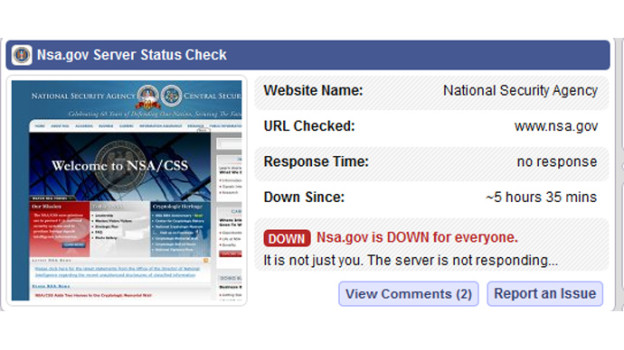
The website for the United States National Security Agency suddenly went offline Friday. NSA.gov has been unavailable globally as of late Friday afternoon, and Twitter accounts belonging to people loosely affiliated with the Anonymous hacktivism movement have suggested they are responsible. Twitter users @AnonymousOwn3r and @TruthIzSexy both were quick to comment on the matter, and implied that a distributed denial-of-service attack, or DDoS, may have been waged as an act of protest against the NSA   Allegations that those users participated in the DDoS — a method of over-loading a website with too much traffic — are currently unverified, and @AnonymousOwn3r has previously taken credit for downing websites in a similar fashion, although those claims have been largely contested. The crippling of NSA.gov comes amid a series of damning national security documents that have been disclosed without authorization by former intelligence contractor Edward Snowden. The revelations in the leaked documents have impassioned people around the globe outraged by evidence of widespread surveillance operated by the NSA, and a massive “Stop Watching Us” rally is scheduled for Saturday in Washington, DC. DDoS attacks are illegal in the United States under the Computer Fraud and Abuse Act, or CFAA, and two cases are currently underway in California and Virginia in which federal judges are weighing in on instances in which members of Anonymous allegedly used the technique to take down an array of sites during anti-copyright campaigns waged by the group in 2010 and 2011. In those cases, so-called hacktivsits are reported to have conspired together to send immense loads of traffic to targeted websites, rendering them inaccessible due to the overload.

More:
NSA site down due to alleged DDoS attack

A DDoS Attack Could Cost $1 Million Before Mitigation Even Starts

A new report suggests that companies are unaware of the extent of the DDoS threat, unaware of the potential cost of an attack, and over-reliant on traditional and inadequate in-house defenses. Marking its inaugural International DDoS Awareness Day, Neustar has released new research into business awareness of contemporary denial-of-service attacks. IDG Research Services questioned more than 200 IT managers for companies with an online marketing or commercial web presence; 70% of which were involved in e-commerce operations. The study finds that it takes an average of ten hours before a company can even begin to resolve a DDoS attack. On average, a DDoS attack isn’t detected until 4.5 hours after its commencement; and a further 4.9 hours passes before mitigation can commence. With outage costs averaging $100,000 per hour, it means that a DDoS attack can cost an internet-reliant company $1 million before the company even starts to mitigate the attack. With the year’s peak shopping period fast approaching, it is something that cannot be ignored. “If an attack results in an outage lasting days, the economic results could be catastrophic. To some companies, it could even be fatal,” warns Neustar. One problem, suggests Susan Warner, Neustar’s market manager for DDoS solutions, is that IT administrators may not be fully aware of the business implications of downtime. “For example,” she says, “an administrator may believe that if the system goes down for a few hours it’s not a big deal, but may not realize there is going to be hundreds of thousand of dollars of marketing spend lost for every hour of site downtime.” A second problem is either a misunderstanding of the nature of modern attacks, or a basic belief that DDoS attacks will always go after someone else. Most companies rely on in-house technology to defend against attacks: 77% have firewalls, 65% have routers and switches, and 59% have intrusion detection. But only 26% use cloud-based mitigation services. Nevertheless, there is a strong belief among these IT managers that they are adequately protected: 86% of the respondents are either somewhat, very or extremely confident in their defenses. But new DDoS techniques such as DNS amplification/reflection, warns Neustar, “can easily overwhelm on-premise defenses and even congest the presumably vaster resources of an ISP.” In fact, in the face of a major attack, in-house defenses can make matters worse. A lot of enterprises, warns Warner, “believe they have some technology already in place that will help them, such as a firewall or a router that can handle some extra traffic, but a high-volume DDoS attack is going to quickly overwhelm those traditional types of defenses and they will rapidly become part of the bottleneck.” “Responding to this new reality,” says the report, “requires actionable continuous monitoring and analysis against realtime threat intelligence, and constantly evolving incident management scenarios.” The answer lies in the cloud. “Cloud-based mitigation is achieved either by redirecting your traffic during an assault or having it always go through a cloud service,” says Warner. “An always-on type of approach can also be achieved through a hybrid solution that provides mitigation resources on-site; if they begin to be overwhelmed, a failover to a cloud service is immediately activated.” Source: http://www.infosecurity-magazine.com/view/35238/a-ddos-attack-could-cost-1-million-before-mitigation-even-starts

View article:
A DDoS Attack Could Cost $1 Million Before Mitigation Even Starts

IBM unveils new cloud solution

IBM announced a new cloud solution that combines software analytics and cloud security services to fend off web-based DDoS attacks for organizations doing business on the web and in the cloud. The new…

View the original here:
IBM unveils new cloud solution

If there’s somethin’ strange in your network ‘hood. Who y’gonna call? Google’s DDoS-busters

Project Shield guards activists, charities from web storms Google will shelter charities and activists from distributed denial-of-service attacks by wrapping their websites in its protection technologies.…

More:
If there’s somethin’ strange in your network ‘hood. Who y’gonna call? Google’s DDoS-busters

Google Project Shield protects “free expression” sites hit by DDoS

Before you ask: this Google’s Project Shield has nothing to do with NVIDIA SHIELD, the two being completely different elements – the Google iteration is all about protecting sites that’d otherwise have little to no protection. Google Project Shield makes with the barrier around a website to stop DDoS (Distributed Denial of Service) attacks to keep sites active. This project has been used to keep up all manner of sites that – before this project – had been taken down by the likes of governments and unfriendly hacker groups. This project has been used for several impressive sites in the recent past, Google aiming to make a much bigger deal of it in the near future. One example is the Persian-language social and political blog Balatarin. Another is quick-access site Aymta, kept up by Google in the face of DDoS attacks recently. This site provides early-warning (somehow or another) of scud missiles to people in Syria. Another example of this project is action is the keeping up of election monitoring service iebc.or.ke during a recent election cycle. Project Shield was responsible for keeping this site up for the first time – it’s stayed up for the entire cycle, that is – in history. Google is currently inviting sites in the following categories to join the initiative – webmasters serving: Independent News Human Rights Elections-Related Content Small independent sites in need of the infrastructure and resources Google is able to supply will be able to apply for help through the main Google Project Shield portal where some very, very simple information is required. Though the site says “invite only”, in this case, Google means that you’ll be invited if your application is accepted. There is also an “Other” category in the “type of content you host on your site” portion of the page in addition to those categories listed above. Source: http://www.slashgear.com/google-project-shield-protects-free-expression-sites-hit-by-ddos-21302260/

Read More:
Google Project Shield protects “free expression” sites hit by DDoS

DDoS Attacks Grow Shorter But Pack More Punch

If there was ever a riddle asking the listener to name something that has become bigger and shorter at the same time, distributed denial-of-service attacks (DDoS) would be an acceptable answer. According to a new report from Arbor Networks about the third quarter of 2013, the average attack size now stands at 2.64 Gbps for the year, an increase of 78 percent from 2012. The number of attacks monitored by the firm that are more than 20 Gbps experienced massive growth, to the tune of a 350 percent increase so far this year. Meanwhile, the length of the vast majority of attacks (87 percent) has gone down to less than an hour. “Shorter duration attacks are not inherently harder to detect, but they can be harder to mitigate,” says Gary Sockrider, solutions architect for the Americas, Arbor Networks. “Many organizations today rely on network- or cloud-based mitigation of DDoS attacks. Because they rely on rerouting attack traffic to scrubbing centers, there is a small delay in mitigation while routing or domain name changes propagate. “Ideally you want to have mitigation capabilities on your own network that can react immediately without the need for redirection. I think it’s safe to say that if you have absolutely no mitigation capabilities, then shorter attacks are better. However, if your only protection has inherent delays, then shorter attacks potentially cannot be stopped.” Barrett Lyon, founder of DDoS mitigation firm Prolexic Technologies and now CTO of Defense.net, says that shorter DDoS attacks also have the added benefit of minimizing an attacker’s exposure. “The longer it runs, the more things are obviously clogged up and the more reactive network engineers become,” he observes. “When network engineers start researching a problem like that — congestion in their network or why is this computer slow — it exposes the botnet and makes it much vulnerable than it would be otherwise. So if it’s a short attack but big, [attackers] can kind of quickly see and size up their target. They can quickly determine … what’s the best bang for the buck when it comes to attacking.” A clear trend of increasing attack sizes has emerged during the past several years, Sockrider says. “I believe there [is] a combination of factors enabling this trend,” he says. “First, there is increased availability of simple-to-use tools for carrying out attacks with little skill or knowledge. Second, there is a growing proliferation of DDoS-for-hire services that are quite inexpensive. Third, increasingly powerful workstations and servers that get compromised also have significantly faster connections to the Internet from which to generate attacks.” The largest monitored and verified attack size during the quarter was 191 Gbps, according to the firm. Fifty-four percent of attacks this year are more than 1 Gbps, up from 33 percent in 2012. Some 37 percent so far this year are between 2 Gbps and 10 Gbps. Another general trend is of attacks moving to the application layer. In fact, while volumetric attacks are still common, they are now frequently combined with application-layer and state exhaustion attacks, Sockrider says. In some cases, DDoS attacks have served as diversions meant to draw attention from other activities, such as bank fraud. For example, a report published in April by Dell SecureWorks noted how DDoS attacks were launched after fraudulent wire and automatic clearing house (ACH) transfers. “Most people that follow DDoS trends are aware of the really high-profile attacks against government and financial institutions, but in reality the most common targets are actually business and e-commerce sites,” Sockrider says. “We’re also seeing increased attacks in the online gaming industry, where attacks are waged for competitive advantage. Additionally, some organizations are taking collateral damage because they reside in a data center, and they happen to share infrastructure with a high-profile target. The bottom line is that in the current environment, every organization is a potential target.” Source: http://www.darkreading.com/attacks-breaches/ddos-attacks-grow-shorter-but-pack-more/240162741

See more here:
DDoS Attacks Grow Shorter But Pack More Punch

Video: DIY Command & Control for fun and no profit

Many security professionals have heard about Command & Control botnets, even more have been infected by them. Very few have had the opportunity to actually look inside the server control panel of a C&…

Continue reading here:
Video: DIY Command & Control for fun and no profit

Preparing for DDoS attacks

Not everyone despaired over the Distributed Denial of Service (DDoS) attacks that hit some of the Web’s biggest e-commerce sites in February. Security consultants and developers of security tools seized the opportunity to spotlight their solutions. Simple DoS attacks are not new. During one, a hacker floods a system with packets of useless requests, making the system so busy it denies access to legitimate users. What’s new are the hacker tools that enable DDoS attacks, in which a hacker uses dozens or hundreds of machines to worsen the attack. The hacker uses client software on one PC to install ‘zombie’ or ‘back door’ programs on other servers, which then flood a target system with useless packets. Zombie programs, including TFN (Tribal Flood Network), Trin00, TFN2K (Tribal Flood Network 2K) and Stacheldraht (Barbed Wire), arrived last fall destined for Solaris, Linux and Windows NT servers. Until recently, most security packages designed to thwart such attacks were aimed at the Unix environment. Now, however, hundreds of programs are being designed for Windows NT, ranging from Internet Security Systems’ (ISS) award-winning SAFEsuite software to BindView Corp.’s free and downloadable Zombie Zapper. Some programs scan the addresses of outgoing messages, intercepting wayward messages before they swamp a potential victim. Others allow administrators to block fake messages from entering a system, or stop the echo functions that help create the constant data flood in a DoS attack. While the programs for NT are good news, the task of evaluating them can easily overwhelm an IS staff, according to Aberdeen Group, a consultancy in Boston. Adding pressure are unresolved issues of liability when one’s computers have been compromised because of lax security. To organize efforts and provide a modicum of legal defense, leading security practitioners suggest these guidelines: Perform a security audit or risk assessment of critical systems using system- and network-based vulnerability tools. Identify and empower an Incident Response Team. Establish an Emergency Response and Escalation Plan. Install Intrusion Detection and Response systems. Examine legal liability exposure. If systems are under attack: Alert your Incident Response Team. Contact your ISP; often, hosts can shut down your access line, stopping the attack. Notify CERT/CC. Notify law enforcement authorities at the FBI and the National Infrastructure Protection Center (NIPC). Monitor systems during the attack using network and host-based intrusion detection systems. Enable detailed firewall logging. Collect forensics to prosecute hackers later. Source: http://networksasia.net/article/preparing-ddos-attacks-960134400

Read the article:
Preparing for DDoS attacks