

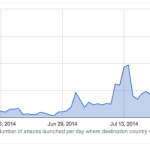
 As conflict between Israel and the Palestinian militant Islamist organisation Hamas escalates, new research has revealed the impact politics has had on cyberattack trends. Tension between countries and changing political landscapes can now often be linked to cybercrime campaigns worldwide. From constant spats between the US and China to increased targeting of Syrian and Thai targets during political unrest, digital weaponry is now a key tool for groups to broadcast their own political messages, spy on governmental agencies and steal valuable data. In a new report released by Arbor Networks, anonymized traffic and DDoS attack data from over 290 ISPs that have deployed Arbor’s Peakflow SP product — collated and analyzed as part of Arbor’s ATLAS initiative — it appears that DDoS attacks are rising in number and volume as a result of the Israel-Hamas conflict. The graph below depicts the number of reported DDoS attacks initiated against Israel daily over the 1 June to 3 August period this year: Distributed Denial of Service (DDoS) attacks are used to flood a website or service with traffic to the point systems cannot cope, denying other users access to the website. Arbor detected a rise in the number of DDoS attacks targeting Israel in the first week of July, going from an average of 30 attacks per day to an average of 150 attacks initiated per day in July — peaking at 429 attacks on July 21st. Linking these cyberattacks to political situations, 30 June is when Israel publicly attributed the deaths of three kidnapped Israeli teenagers to Hamas, and on 7 July, “Operation Protective Edge” was launched by the country. As the political conflict raged on, so did the frequency of DDoS attacks until a drop occurred on 28 July lasting through 2 August. Arbor says the drop in attacks roughly correlates with cease fire talks which began 27 July. From 28 July through 2 August, there were 192 attacks recorded in total. On 3 August, the number of DDoS attacks rose sharply, with 268 attacks in total. In addition to the number of DDoS attacks over these time periods, the security researchers also noticed an increase in the peak size of these attacks. In the graph below, we can see that in June, no attacks exceeded 12Gbps. In July, seven DDoS attacks exceeded this size, with the largest peaking at 22.56Gbps on 12 July. When cease-fire talks fell apart on 3 August, the largest DDoS attack was recorded at a size of 29Gbps. The duration of DDoS attacks has also increased. In June, the average duration was 20 minutes — with a peak duration of 24 hours — and in July, the average duration was 1 hour 39 minutes. “As the intensity of the Israeli-Hamas conflict has increased, so has the number, size and duration of the DDoS attacks targeting Israel,” the researchers say. “Additionally, it even appears as if the attackers have made an effort to adhere to the “real world” calls for a cease-fire, resuming their attacks when the cease fire fell through.” Source: http://www.zdnet.com/israel-hamas-conflict-sparks-surge-in-ddos-attacks-7000032375/#ftag=RSS14dc6a9
Original post:
Israel-Hamas conflict sparks surge in DDoS attacks
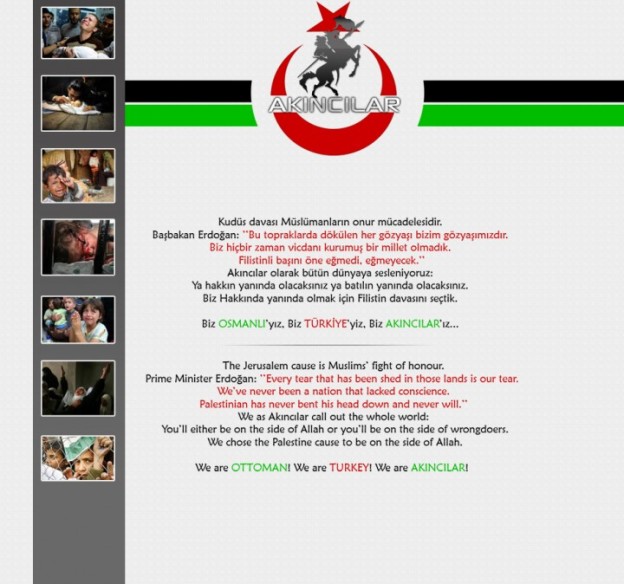
 Hacker collective Anonymous has announced that it has taken down over a thousand of crucial Israeli websites in a huge new coordinated cyber-attack called #OpSaveGaza on 11 July and 17 July, in support of the people of Palestine. Some of the websites, such as the Tel Aviv Police Department’s online presence, are still offline two days after the distributed denial of service (DDoS) attacks, and numerous Israeli government homepages have been replaced by graphics, slogans, and auto-playing audio files made by AnonGhost, the team of hackers who coordinated the attack. The official Israeli government jobs website has had its homepage replaced by a graphic titled “Akincilar”, which is Turkish for the Ottoman Empire’s troops. Akincilar: A graphic and message protesting against the treatment of Palestinians is still replacing the homepage of certain Israeli government websites A message written in English and Turkish – presumably by Turkish hackers – and accompanied by pictures of Palestinians suffering says: “The Jerusalem cause is Muslims’ fight of honour” and says that people who fight for Palestine are “on the side of Allah”. Another Israeli government website now bears an AnonGhost graphic and lists the usernames of 38 hackers. An audio file that auto-plays when the page loads plays music and a synthesized newsreader clip, together with a message beseeching human rights organisations, hackers and activists to attack Israeli websites to become the “cyber shield, the voice for the forgotten people”. AnonGhost’s #OpSaveGaza message has been displayed on many Israeli websites Many of the websites have since been restored. The hackers have also leaked lists of Israeli government email addresses obtained by hacking websites of the Ministry of Immigrant Absorption, the Ministry of Justice, the Ministry of Culture and Sport, the Ministry of Housing and Construction and much more. Israeli websites belonging to restaurants, local businesses, associations, societies, academic foundations and even a symphony orchestra were also attacked, as well as a subdomain belonging to MSN Israel. A message on the main Pastebin page and some of the hacked websites reads : “The act of launching rockets from Gaza sector to Israhell is an acceptable and normal reaction against those pigs, it’s called Resistance and not terrorism. “Israhell never existed its only Palestine, it’s our home. If you are a Hacker, Activist, a Human Right Organisation then hack israel websites and expose to the world their crimes, show to the world how much blood is on their hands, blood of innocent children and women.” Anonymous has previously run another campaign in April targeting Israeli websites, although on a smaller scale. About 500 websites went offline during the OpIsrael campaign and the hackers released the phone numbers and email addresses of some Israeli officials. Source: http://www.ibtimes.co.uk/opsavegaza-anonymous-takes-down-1000-israeli-government-business-websites-1457269