
A 12-year-old Quebec boy is responsible for hacking several government and police websites during the student uprising in spring 2012, creating computer havoc and causing $60,000 damage, court heard Thursday. Some sites were out of service for up to two days and the boy did it in the name of the activist/hacktivist group Anonymous. The Grade 5 student from the Montreal suburb of Notre-Dame- de-Grâce, whose actions were not politically motivated, traded pirated information to Anonymous for video games, court was told. The boy appeared in youth court Thursday dressed in his school uniform and accompanied by his father. He pleaded guilty to three charges related to the hacking of the websites, including those of Montreal police, the Quebec Institute of Public Health, Chilean government and some non-public sites. Police estimate damage to the sites at $60,000 but a more detailed report will be produced in court when the boy is sentenced next month. The little hacker, whose name can’t be published and is said to have been involved with computers since the age of nine, contributed to the crash of some sites and accessed information belonging to users and administrators. He had even issued a warning to others: “It’s easy to hack but do not go there too much, they will track you down.” Court heard the boy used three different computer attacks, one which resulted in a denial of service to those trying to access the websites and flooded servers, making them ineffective. In another method he would alter information and make it appear as the homepage. His third tactic involved exploiting security holes in order to access database servers. “And he told others how to do it,” a police expert testified in Montreal on Thursday. While others were arrested in the scheme, it was the boy who opened the door to the website attacks, court heard. “He saw it as a challenge, he was only 12 years old,” his lawyer said. “There was no political purpose.” In 2000, a 15-year-old Montreal boy, know as Mafiaboy, did an estimated $1.7 billion in damage through hacking. He was sentenced to eight months in youth detention and subsequently received several job offers in cybersecurity. Source: http://www.torontosun.com/2013/10/25/que-boy-12-pleads-guilty-to-hacking-government-websites
Read More:
12 year old Quebec boy Anonymous Hacker Pleads Guilty to DDOS Attack on Government Websites
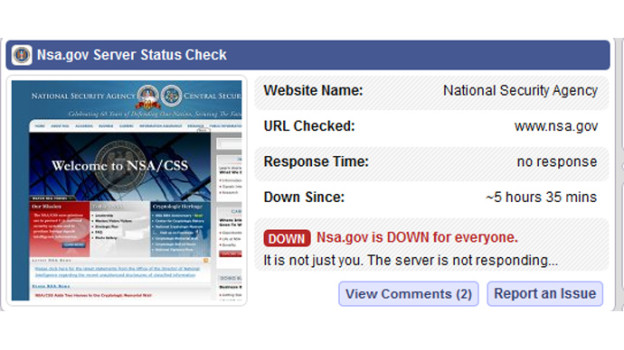
 The website for the United States National Security Agency suddenly went offline Friday. NSA.gov has been unavailable globally as of late Friday afternoon, and Twitter accounts belonging to people loosely affiliated with the Anonymous hacktivism movement have suggested they are responsible. Twitter users @AnonymousOwn3r and @TruthIzSexy both were quick to comment on the matter, and implied that a distributed denial-of-service attack, or DDoS, may have been waged as an act of protest against the NSA Allegations that those users participated in the DDoS — a method of over-loading a website with too much traffic — are currently unverified, and @AnonymousOwn3r has previously taken credit for downing websites in a similar fashion, although those claims have been largely contested. The crippling of NSA.gov comes amid a series of damning national security documents that have been disclosed without authorization by former intelligence contractor Edward Snowden. The revelations in the leaked documents have impassioned people around the globe outraged by evidence of widespread surveillance operated by the NSA, and a massive “Stop Watching Us” rally is scheduled for Saturday in Washington, DC. DDoS attacks are illegal in the United States under the Computer Fraud and Abuse Act, or CFAA, and two cases are currently underway in California and Virginia in which federal judges are weighing in on instances in which members of Anonymous allegedly used the technique to take down an array of sites during anti-copyright campaigns waged by the group in 2010 and 2011. In those cases, so-called hacktivsits are reported to have conspired together to send immense loads of traffic to targeted websites, rendering them inaccessible due to the overload.