
Giant cookies could be used to create a denial of service (DoS) on blog networks, says infosec researcher Bogdan Calin. Such an attack would work by feeding users cookies with header values so large that they trigger web server errors. Calin created a proof of concept attack against the Google Blog Spot network after a customer reported problems with internal security testing. In his subsequent tests, he found that if one sends many cookies to a browser, sets them to never expire and includes pointers to a blog network’s root domain, the user won’t ever be able to see any blogs on the service. Victims can tell if supersized cookies have been stuffed down their browser’s throats when 400 errors such as “Your browser sent a request that this server could not understand. Size of a request header field exceeds server limit” appear. Sydney security bod Wade Alcorn (@WadeAlcorn) said the attack would work if custom cookies could be set. “This attack, denial-of-service by cookies, sets many long cookies, forcing the browser to create a very long request [that] is too long for the server to handle, and simply returns an error page,” Alcorn said. “The vulnerable browser won’t be able to visit that origin until the cookies are cleared. “When a browser visits one of these [user-controlled] subdomains it will allow a cookie to be set on the parent domain [which] means that when a denial-of-service by cookies attack is launched, the victim browser will not be able to visit the parent domain or any of the subdomains.” For an application to be vulnerable it must provide an opportunity for the attacker to set custom cookies in the victim’s browser, Alcorn pointed out. Chrome users were not affected when perusing Blog Spot but were on other unnamed domains. Alcorn said a Google security rep told him the risk was a problem for web browser developers to fix, rather than a lone web app providers, and welcomed ideas that could squash the vector. Source: http://www.theregister.co.uk/2014/07/02/monster_cookies_can_nom_nom_nom_all_the_blogs/
Read this article:
Could Cookies Be Used to Launch DoS Attacks?
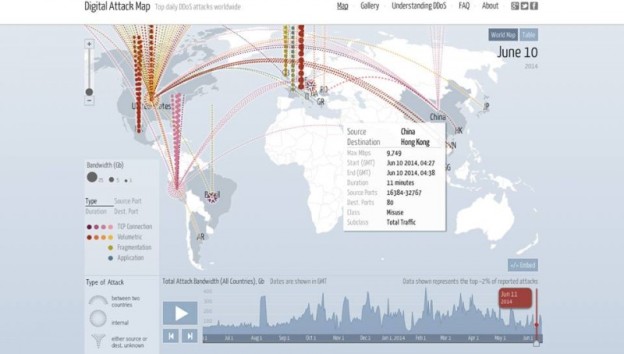
 Just days before a citizen-led online referendum on voting rights, the technical platform that advocates had planned to use for the referendum suffered a massive DDoS attack. From June 20-22, citizens will be invited to vote on a referendum on constitutional reforms that would guarantee all citizens the right to vote in elections that determine who will be the city’s Chief Executive. To build a public consensus around a recent civil proposal on universal suffrage, the civic group “Occupy Central with Love and Peace” appointed the Public Opinion Programme at Hong Kong University and the Center for Social Policy Studies at the Hong Kong Polytechnic University to host the civil referendum on their servers. On June 13, 30 hours after HKU’s Public Opinion Programme (POP) tested their online system by accepting voter pre-registrations, the system endured the largest distributed denial of service attack in its history. Two of their hosting providers have since withdrawn their service for the project. The civil referendum has been criticized by pro-Beijing political groups, sparking controversy concerning channels for nomination. Many Hong Kongers feel that political party nomination and nomination by a nominating committee serve as a filtering mechanism for eliminating candidates who are undesirable for Beijing. According to a press release issued by HKU POP on June 16, the voting system is hosted by Amazon Web Services (AWS), Cloudflare and UDomain. All three web hosting services suffered from large scale DDoS attacks on June 14 and 15. AWS recorded 10 billion system requests with 20 hours, CloudFare recorded a 75Gb DDoS per second and UDomain 10Gb per second. As the scale of attack is tremendous, all three service providers were forced to temporarily suspend their services. An expert estimated that there could be at least 5,000 but possibly more than 10,000 computers involved in the attack. On June 16, Amazon decided to stop providing DNS hosting service to HKU POP and UDomain withdrew its security protection service. Cloudflare is now the only service provider to support the voting system. IT security expert Anthony Lai posted digital attack maps on his Facebook page, comparing the attack scale between June 10 and June 14 (see top), before and after HKU POP tested the voting system: Digital Attack Map on June 10. Destination Hong Kong. HKU POP is working on a solution to the voting system’s vulnerability. They are considering to using 125 telephone lines for voting, but this will not be able to accommodate the expected 70,000 votes in 12 hours. In 2012, the HKU POP was also attacked by DDoS when it hosted a mock universal suffrage poll for the chief executive election. Source: http://advocacy.globalvoicesonline.org/2014/06/17/hong-kong-voting-site-suffers-massive-ddos-attack-before-civil-referendum/