
The 620 Gbps DDoS attack was built on a massive botnet. The security blog KrebsOnSecurity has been hit with one of the largest distributed denial of service (DDoS) attacks of all time. The site, which is run by security expert Brian Krebs, was hit by a DDoS attack of around 620 Gbps on 20 September. KrebsOnSecurity managed to stay online during the attack, due to defences from content delivery network provider Akamai. The largest attack of this kind Akamai had previously defended was one of 336 Gbps earlier this year. Previous large-scale DDoS attacks, including the 336 Gbps attack, used well-known methods to amplify a smaller attack such as using unmanaged DNS servers. Apart from being much larger in terms of scale, the attack on KrebsOnSecurity also differed in that it seemed to instead use a very large botnet of hacked devices. This could have involved hundreds of thousands of systems. “Someone has a botnet with capabilities we haven’t seen before,” Martin McKeay, Akamai’s senior security advocate, said to KrebsOnSecurity. “We looked at the traffic coming from the attacking systems, and they weren’t just from one region of the world or from a small subset of networks — they were everywhere.” Brian Krebs said that there were some signs that the attack had used a botnet that had captured a large number of Internet of Things (IoT) devices. During a DDoS attack, the targeted website is flooded with traffic, designed to overwhelm the resources of the site to crash or suspend its services. “It seems likely that we can expect such monster attacks to soon become the new norm,” wrote Krebs. He suggested that the attack on his site might have been in retaliation for a series he had done on the takedown of a DDoS-for-hire service vDOS, a theory supported by text included in the strings of the DDoS attack referencing the vDOS owners. Source: http://www.cbronline.com/news/cybersecurity/business/renowned-blog-krebsonsecurity-hit-with-massive-ddos-attack-5012622
Excerpt from:
Renowned blog KrebsOnSecurity hit with massive DDoS attack
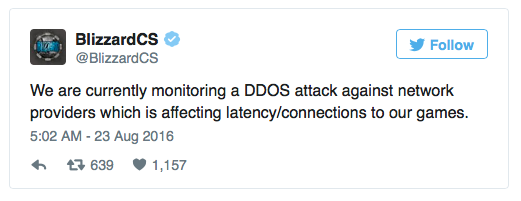
 Gaming servers are a top target of DDoS assaults,’ Imperva security researcher Ofer Gayer told IBTimes UK. Developer Blizzard’s Battle.net servers were hit with yet another DDoS attack on Tuesday (23 August) resulting in latency and connection issues in some of its popular titles including Overwatch, World of Warcraft and Hearthstone. The company acknowledged the interruption on its Twitter support channels in both the US and Europe, indicating that it was not restricted to just one region. The company also said that its sites and forums were “experiencing issues” at the time in a separate tweet. The latest attack is the second such assault targeting the developer’s servers this month and the third since the launch of its popular hero-based shooter, Overwatch, in May. It also comes at the end of which ran from 2 August to 22 August in celebration of the Olympic Games in Rio. On 3 August, Blizzard’s Battle.net servers were crippled by another massive DDoS attack that caused connection, login and latency issues across some of its popular titles. The disruption also occurred on the same day Blizzard launched its Summer Games series. Hacking collective PoodleCorp claimed responsibility for the alleged attack. The same hacker group also claimed responsibility for taking down Pokémon Go’s servers in July. In June, Blizzard’s servers were hit with another alleged DDoS attack claimed by notorious hacker group Lizard Squad that prevented players from accessing their games. DDoS attacks, which are difficult to prevent and defend against, have continued to plague online companies’ networks in recent years, particularly those of major gaming companies’ servers. “Gaming servers are a top target of DDoS assaults,” Ofer Gayer, a senior security researcher at Imperva, told IBTimes UK. “They have been hit with some of the largest and longest attacks on recent record.” He added that mitigating DDoS attacks on game servers is a “particularly complex task”. “Since only gaming platforms are highly sensitive to latency and availability issues, they’re ideal DDoS attack targets,” Gayer said. “Gamers are very sensitive to the impact on latency, so what may be considered negligible for most services, can be very frustrating for the gaming community. This can be affected by multiple factors, most prominently the distribution of scrubbing locations and TTM (time to mitigate).” Imperva’s latest DDoS Threat Landscape Report found that DDoS attacks have increased by a massive 220% over the past year “with no signs of abating”. It also noted that the UK has become the second most popular target for DDoS attacks in the world. Blizzard’s official Customer Support Twitter account later confirmed that the “technical issues” they were experiencing earlier have been resolved. At the time of publication, no hacking group has claimed responsibility for the most recent alleged DDoS attack. Source: http://www.ibtimes.co.uk/blizzards-battle-net-servers-hit-by-yet-another-ddos-attack-1577793