“Follow the money” is a popular catchphrase attributed to the 1976 movie All The President’s Men suggesting a money trail or corruption scheme within high (often political) office. Cybercriminal actors are certainly following the advice. The Deloitte Global Cyber Executive Briefing on E-Commerce & Online payments suggests that as retailers discover the financial rewards of having an e-commerce website, criminals are not far behind. But while robbing a brick and mortar store is wrought with risk of getting caught, the cyber world is proving much more lucrative relative to the effort and investments needed to execute a digital heist. For every e-commerce site that goes up, the potential target expands to include merchant, payment service provider, card company, suppliers, banks and buying customer. That is because e-commerce websites are directly connected both to the internet and to the business’ back-end systems for data processing and supply management. This makes e-commerce website a prime attack point for gaining access to crucial information assets within the organization according to Deloitte. The fourth Neustar annual Worldwide DDoS Attacks and Cyber Insights Research Report reveals that attacks against the financial services and retail industries are on the rise. Industry respondents confirm that it is getting much longer for organizations to detect and respond as cyberattacks grow in volume, complexity and frequency. Financial services institutions (FSIs) under attack There is recognition among industry players that they remain at high risk of malware and data theft (44% in 2017 versus 37% in 2016). Ransomware appears to be on the rapid rise in financial services industry as respondents to the survey indicate an increase in reported attacks from 17% in 2016 to 28% a year later. Financial institutions are also investing against Distributed Denial of Service (DDoS) attacks with 91% of organizations putting in more resources in 2017 compared to 79% in 2016. FSIs continue to be one of the favored targets of hackers as 86% of surveyed respondents confirm being under attack in 2017, up 10% from the previous year. More worrisome is that 88% reported being under attack more than once. Retailers under attack Eighty percent of respondents said they were under attack in 2017, up 7% from 2016. Respondents to the survey also noted that it took longer for them to detect and respond to the attacks in 2017 compared to 2016 suggesting that attack are getting sophisticated. Retailers responding to the survey Industry confirmed that they are spending more for security in 2017 (87%) compared to 2016 (76%). Respondents also report that ransomware attacks have increased from 13% in 2016 to 21% in 2017. Asia Pacific under attack Among respondents in Asia Pacific, 33% reported average revenue loss of at least US$250,000 with 49% reporting ransomware and DDoS attacks occurring in concert. Time to detect for 49% of respondents in the region stood at about three hours while 42% said it was taking them at least three hours to respond following discovery of the attack. In response to escalating frequency, complexity and severity of malware and DDoS attacks, Robin Schmitt, general manager, APAC at Neustar recommended that IT and business leaders need to evaluate the effectiveness of existing security strategies. “The research shows that simply identifying an attack and depending on basic defenses is not enough. Organizations in the region need to adopt stronger defenses and innovative solutions to more quickly and effectively mitigate the growing risk and likely impact of a major DDoS attack,” he said. According to Neustar the data from the research suggests that 2017 will be another challenging one from a DDoS threat landscape perspective. Generic Routing Encapsulation (GRE) based flood attacks and Connectionless Lightweight Directory Access Protocol (CLDAP) reflection attacks are emerging as the new hot attack trends for 2017, suggesting that attackers are constantly eyeing new ways to turn legitimate infrastructure elements against their owners. Source: https://www.enterpriseinnovation.net/article/expect-increase-ransomware-and-ddos-attack-combos-2017-145803210
Original post:
Expect an increase in ransomware and DDoS attack combos in 2017

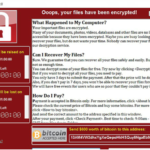 What is it ? WannaCry also know as WanaCrypt 2.0 is a form of malware commonly known as “Ransom Ware”. Where did it come from ? It was originally developed by the NSA in the US called “Eternal Blue” and was a way for them to secretly access computers. It was based on a flaw in windows machines, Unfortunately the NSA did not store this weaponized malware securely enough and someone hacked in and stole it. At this point it was loose and easily findable on the Internet. If you see a screen like this, you’re machine is definitely infected. Here is a link below from Microsoft to check/scan if your PC has a virus. https://www.microsoft.com/security/scanner/en-us/default.aspx Who is responsible for this ? At this point no one knows but there are a lot of smart people working on it and they will be caught eventually…This is my opinion. Is someone making money from this ? Yes, as with all ransom ware there is a money component.These are 3 discovered bitcoin Identifiers that victims are paying the ransom to Which is hardcoded into the Malware. As of 09:15 EST May 14, 2017 The total ransom paid is a total of $15,150.00 USD. This is surprisingly low, it’s definitely going to rise. Check for yourself on its progress by clicking the 3 links below. https://blockchain.info/address/13AM4VW2dhxYgXeQepoHkHSQuy6NgaEb94 https://blockchain.info/address/12t9YDPgwueZ9NyMgw519p7AA8isjr6SMw https://blockchain.info/address/115p7UMMngoj1pMvkpHijcRdfJNXj6LrLn How did my computer get infected ? If you’re on a corporate network, you most likely got it from another computer on your network. If you’re at home on a cable modem you got it through email phishing or visiting a hacked or a sketchy website. How did it spread so quickly ? As you most likely know by now, millions of computers were infected in a few short days and those most affected by this are on corporate, Government and University networks. It spreads on these networks by using a windows flaw that goes from machine to machine using Microsoft’s SMB feature . Here’s a short list of victims from GITHUB NHS (uk) turning away patients, unable to perform x-rays. (list of affected hospitals) Nissan (uk) http://www.chroniclelive.co.uk/news/north-east-news/cyber-attack-nhs-latest-news-13029913 Telefonica (spain) ( https://twitter.com/SkyNews/status/863044193727389696 ) power firm Iberdrola and Gas Natural ( spain ) FedEx (us) ( https://twitter.com/jeancreed1/status/863089728253505539 ) University of Waterloo ( us ) Russia interior ministry & Megafon (russia) https://twitter.com/dabazdyrev/status/863034199460261890/photo/1 VTB (russian bank) https://twitter.com/vassgatov/status/863175506790952962 Russian Railroads (RZD) https://twitter.com/vassgatov/status/863175723846176768 Portugal Telecom ???????? – Sberbank Russia ( russia ) Shaheen Airlines (india, claimed on twitter) Train station in frankfurt ( germany ) Neustadt station ( germany ) the entire network of German Rail seems to be affected ( @farbenstau ) in China secondary schools and universities had been affected ( source ) A Library in Oman ( @99arwan1 ) China Yanshui County Public Security Bureau ( https://twitter.com/95cnsec/status/863292545278685184 ) Schools/Education (France) https://twitter.com/Damien_Bancal/status/863305670568837120 A mall in singapore https://twitter.com/nkl0x55/status/863340271391580 ATMs in china https://twitter.com/95cnsec/status/863382193615159 Renault STC telecom Norwegian soccer team ticket sales Is my website spreading this malware ? I can only say that any DOSarrest customers using our advanced WAF are not spreading this Malware as we won’t allow this type of malicious traffic to get to your server. Is it still spreading ? No, good news ! This thing had a kill switch built into its code, so if any machine can access this site www.iuqerfsodp9ifjaposdfjhgosurijfaewrwergwea.com it won’t spread from that machine. I’m infected, What should I do ? We recommend that you wipe your machine clean and restore from back-ups….of course everyone has backups, Right ? Need more info… Try Github.com Microsoft to get the free patch if you need it. Source: https://www.dosarrest.com/ddos-blog/wannacry-faq/