
While digital ransom attacks come in various types and forms, Distributed Denial of Service (DDoS) attacks are top of the list of methods used by attackers to force money from targeted companies. So says Bryan Hamman, territory manager of Arbor Networks, who points out that in recent weeks, well-known names such as Evernote and Feedly have fallen victim to extortion attacks, but these companies are just the tip of the iceberg when it comes to this very lucrative criminal activity. InfoSecurity Magazine reports that this year the number of network time protocol amplification attacks increased 371.43%. The average peak DDoS attack volume increased a staggering 807.48%. The news aggregator Feedly said it had come under a DDoS attack from cyber criminals, which was preventing users from accessing its service. “Criminals are attacking Feedly with a distributed denial of service attack. The attacker is trying to extort money from us to make it stop. We refused to give in and are working with our network providers to mitigate the attack as best as we can,” said Feedly in a blog post. “‘Pay up or we’ll take your Web site down’, so goes the adage that usually accompanies ransom-based cyber-attacks,” says Hamman. According to Arbor’s ninth annual Worldwide Infrastructure Security Report, DDoS extortion attacks account for 15% of all DDoS attacks. While it may seem like a relatively small percentage, one must consider that as many as 10 000 DDoS attacks occur world-wide every day and the potential cost in damages and reputation can have a significant impact on a targeted organisation, Hamman points out. He explains that DDoS extortion attacks are generally volumetric, high bandwidth attacks launched with the aim of crashing a company’s Web site or server by bombarding it with packets, which originate from a large number of geographically distributed bots. The size of volumetric DDoS attacks continues to increase year on year, and they remain a major threat to enterprises and Internet service providers alike, he adds. “Traditionally, DDoS extortion attacks were used against online gambling sites, around major sporting events. Criminal gangs would initiate attacks that would bring the Web site down just before the event was to start, thus forcing the companies to choose between suffering a major loss in monetary and reputational terms or paying up. Increasingly, however, DDoS attacks are being used to extort money from all sorts of businesses and the reality is that no company should feel safe,” he says. So what is the right response when it comes to extortion demands? Hamman asks. “The answer is simple and always the same – not to give in. Organisations should under no circumstances agree to pay the ransom – it can set a dangerous precedent and encourage more attacks in the future; while it might make the pain go away in the short term, the long-term results are generally not worth it. “Declining to pay comes, of course, with severe consequences – as we saw from recent attacks on Feedly, who suffered from three separate waves of DDoS attacks. However, the company has now recovered from the attack and is operating as normal. Furthermore, it has been praised for its brave decision by the security community and even its own customers,” says Hamman. According to Hamman, many companies still rely on reactive measures such as router filters and firewalls, which are inefficient and not sophisticated enough to protect against organised cyber crime. Instead, he says, organisations need to invest in preventive, multi-layered mitigation, which includes on-premise and cloud protection, as well as allowing for co-operation with their ISP or hosting company. In addition, putting a mitigation strategy in place, should the worst happen, is of crucial importance – especially as only 17% of organisations globally feel they are fully prepared for a security incident. “By building defences, implementing plans ahead of time and refusing to give in, businesses needn’t feel threatened anymore – attackers wanting to make easy money will have to look elsewhere.” Source: http://www.itweb.co.za/index.php?option=com_content&view=article&id=136989:DDoS-extortion-attacks-on-the-rise&catid=265
See the original article here:
DDoS extortion attacks on the rise

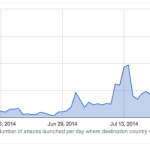 As conflict between Israel and the Palestinian militant Islamist organisation Hamas escalates, new research has revealed the impact politics has had on cyberattack trends. Tension between countries and changing political landscapes can now often be linked to cybercrime campaigns worldwide. From constant spats between the US and China to increased targeting of Syrian and Thai targets during political unrest, digital weaponry is now a key tool for groups to broadcast their own political messages, spy on governmental agencies and steal valuable data. In a new report released by Arbor Networks, anonymized traffic and DDoS attack data from over 290 ISPs that have deployed Arbor’s Peakflow SP product — collated and analyzed as part of Arbor’s ATLAS initiative — it appears that DDoS attacks are rising in number and volume as a result of the Israel-Hamas conflict. The graph below depicts the number of reported DDoS attacks initiated against Israel daily over the 1 June to 3 August period this year: Distributed Denial of Service (DDoS) attacks are used to flood a website or service with traffic to the point systems cannot cope, denying other users access to the website. Arbor detected a rise in the number of DDoS attacks targeting Israel in the first week of July, going from an average of 30 attacks per day to an average of 150 attacks initiated per day in July — peaking at 429 attacks on July 21st. Linking these cyberattacks to political situations, 30 June is when Israel publicly attributed the deaths of three kidnapped Israeli teenagers to Hamas, and on 7 July, “Operation Protective Edge” was launched by the country. As the political conflict raged on, so did the frequency of DDoS attacks until a drop occurred on 28 July lasting through 2 August. Arbor says the drop in attacks roughly correlates with cease fire talks which began 27 July. From 28 July through 2 August, there were 192 attacks recorded in total. On 3 August, the number of DDoS attacks rose sharply, with 268 attacks in total. In addition to the number of DDoS attacks over these time periods, the security researchers also noticed an increase in the peak size of these attacks. In the graph below, we can see that in June, no attacks exceeded 12Gbps. In July, seven DDoS attacks exceeded this size, with the largest peaking at 22.56Gbps on 12 July. When cease-fire talks fell apart on 3 August, the largest DDoS attack was recorded at a size of 29Gbps. The duration of DDoS attacks has also increased. In June, the average duration was 20 minutes — with a peak duration of 24 hours — and in July, the average duration was 1 hour 39 minutes. “As the intensity of the Israeli-Hamas conflict has increased, so has the number, size and duration of the DDoS attacks targeting Israel,” the researchers say. “Additionally, it even appears as if the attackers have made an effort to adhere to the “real world” calls for a cease-fire, resuming their attacks when the cease fire fell through.” Source: http://www.zdnet.com/israel-hamas-conflict-sparks-surge-in-ddos-attacks-7000032375/#ftag=RSS14dc6a9