
Category Archives: DDoS Criminals

Brobot botnet used to launch DDoS attack

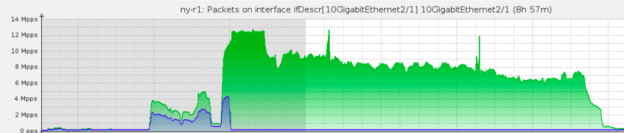
DOSarrest Internet Security had a run in with the notorious Brobot Botnet, if the name sounds familiar it’s because this bot was responsible for sporadic outages on a number of large US based financial institutions in 2013. Said to be operated by al-Qassam Cyber Fighters (AKA QCF). Botnets are born, die, grow, shrink, and morph on a daily basis, if not hourly. It’s hard to keep track of them all. Then there are particularly nasty ones that are large, powerful and sophisticated. These particular botnets have some of their zombies or bots corralled off for research purposes by a number of organizations including private Botnet hunters, government cyber surveillance departments and other large law enforcement agencies. On to the attack Why ? One of our customers is a large media outlet specializing in Middle Eastern news. With all the conflict over there these days, they must have written a few stories that the attackers were not in agreement with. How ? Using Brobot, the attackers threw millions of TCP port 80 requests at the website. Unlike a SYN attack that tries to exhaust your TCP open sessions table buffers, this attack would open and close each session/request: 1)     Request a TCP connection 2)     Once established they would send one character 3)     Then request the TCP session to close. The problem arises when you are receiving approximately 50 million of these per second. Where ? This botnet is comprised of infected webservers using PHP, hosted on various webhosting companies around the globe. Some hosting companies seem to be represented a little more than others. One notable observation of the Brobot is that it’s very US centric, not all of the bots are based in the US but approximately 40%  are, which makes filtering based on countries very difficult. When under a large TCP port 80 attack, usually it is not evenly divided across our scrubbing nodes in the US and Europe. This was different, virtually all of our upstream links in every city had pretty much the same amount of Packets Per Second and Bandwidth. I can’t ever remember seeing that in the last 7 years All links had a graph like the one above Who cares ? Within a couple of hours of the attack starting we were contacted by a private Botnet hunter that knew we were dealing with Brobot. Soon followed by visits to our website from two US federal Law enforcement agencies. Hence the title, not all botnets are equal.

Visit link:
Brobot botnet used to launch DDoS attack

Drastic decline in vulnerable NTP servers due to Heartbleed?

In light of the escalation of DDoS attacks used as a means of extorting money from online businesses, the news that there has been a significant decrease in vulnerable Network Time Protocol (NTP) serv…

Continued here:
Drastic decline in vulnerable NTP servers due to Heartbleed?

Sysadmins rejoice! Patch rampage killing off nasty DDoS attack vector

Server fleet open to NTP attack drops from 400k to just 17,000 Sysadmins rejoice! NSFOCUS researchers say hundreds of thousands of Network Time Protocol (NTP) servers have been patched, reducing the threat from some devastating and cheap distributed denial of service (DDoS) attacks.…

See the original article here:
Sysadmins rejoice! Patch rampage killing off nasty DDoS attack vector

Got a botnet? Thinking of using it to mine Bitcoin? Don’t bother

McAfee says crooks will be better off sticking to spam and DDoS Despite an increase in popularity over recent months amongst botnet operators, malware-powered Bitcoin mining brings little to no financial return, say experts.…

Continue Reading:
Got a botnet? Thinking of using it to mine Bitcoin? Don’t bother

Are DDoS attacks becoming more sophisticated?

If you’ve taken the time to read the various security articles over the last few months, you’ll quickly realise that the relatively nascent Bitcoin is well acquainted with DDoS. Initially, this was to undermine and influence Bitcoin currency, but now it is actually being used to steal Bitcoin funds in the millions of dollars. Of course, the very nature of a “”virtual currency”” is going to be attractive to cyber criminals who see it as an easy target; after all, they only have to steal digital information from a computer. At the end of the day, the attackers are winning with what is all too often considered a crude tool. It begs the question: Is DDoS still to be considered a blunt instrument? From what I have seen, the answer is a resounding no. Here’s why: Unconventional DDoS DDoS is getting more sophisticated – DDoS in its simplest form attempts to bombard a server with so many requests that it can’t handle the volume and therefore just shuts down, making a website inaccessible. The conventional understanding of DDoS is that it is typically massive in terms of bandwidth, packets per second and connection, and the latest attacks on BitStamp suggest there was indeed a high volume aspect to the attack. The more important aspect to this attack was how the attackers were able to masquerade the hash of a user transaction and essentially bombard the exchanges with it- in the hope it would be processed before the actual legitimate sessions. In effect, this was not your typical ‘clog the pipe’ DDoS strategy, which is usually touted in articles detailing a huge DDoS attack. The attackers had quite specific knowledge and did their homework when it came to how best to take advantage of DDoS tools and bring down the exchange. Blurring the lines between DDoS and hacking DDoS and hacking have traditionally been seen as two mutually exclusive security initiatives, each requiring its own set of mitigating strategies. While we have seen the two used in tandem – where the DDoS is the ‘feint’ used to cover backend attempts for data theft – the Bitstamp situation stands apart from these experiences in that the DDoS was the actual tool used to carry out the theft. The spoofing of a digital signature/hash to modify the blockchain record was within the payload of the actual DDoS attack. It’s an alarming development considering that more and more ‘conventional’ companies are implementing public facing tools to carry out transactions, which could be hijacked in a similar manner as seen here. There’s no doubt that the stakes are high when it comes to Bitcoin- on the one hand, there could be a lot to gain as adoption and popularity rises; and on the other, there is the regulatory uncertainty and likely insurance issues to consider. When it comes to protecting yourself, realise that by accepting virtual currency, you also become a target for Bitcoin miners and make sure you have appropriate technology in place to protect yourself from DDoS attacks – whether it is a hardware solution that takes days to install and requires a higher up-front cost; or a provider who offers DDoS protection services that can be up and running in as little as a few hours for a monthly cost. Source: http://www.techradar.com/news/software/security-software/are-ddos-attacks-becoming-more-sophisticated–1254382

Read the original post:
Are DDoS attacks becoming more sophisticated?

Ancestry.com working to fully restore services following DDoS attack

The genealogy website Ancestry.com is working to fully restore its service after it was hit by a Distributed Denial of Service attack. Company spokeswoman Heather Erickson says it means ancestry.com was overwhelmed with bogus traffic Monday. “The attack was overloading our systems with massive amounts of traffic, but it did not access any data in servers,” Erickson said. The site, which has more than 2 million subscribers, was down for much of Tuesday and wasn’t fully operational Wednesday afternoon. Its Web team neutralized the DDoS attack and was working to fully restore services. “This has been a very frustrating and overwhelming experience, and our teams have been fantastic, working around the clock to make it neutralized,” Erickson said. Company officials are hoping to fully recover from the attack soon. Ancestry.com is posting updates on its Facebook and Twitter pages. Erickson said she doesn’t know where the attack came from. “These types of attacks aren’t unique to Ancestry. We know of many other companies that have been victim to these types of attacks. It’s unfortunate that any company has to go through something like this,” she said. The attack also impacted Ancestry.com’s sister site Find a Grave, though as of Wednesday afternoon it was back up, according to its Facebook page. Company officials said the sync and search feature in Family Tree Maker were still disabled until the site stability had been fully restored. They recommended people use the feature offline. Source: http://www.deseretnews.com/article/865605393/Ancestrycom-working-to-fully-restore-services-following-DDoS-attack.html

More:
Ancestry.com working to fully restore services following DDoS attack

YOU’RE HISTORY: Ancestry.com goes titsup for TWO DAYS

Did dads storm site on Father’s Day? Some seem to think so The genealogy site Ancestry.com has been blasted off the internet after reportedly being hit by a DDoS attack.…

Read More:
YOU’RE HISTORY: Ancestry.com goes titsup for TWO DAYS

Entirely new trojan quietly wheeled into black hat forums

Pandemiya is 25,000 lines of original password-pinching botnet badassery An RSA researcher claims to have found an entirely new trojan during his trawls of the criminal underground.…

Follow this link:
Entirely new trojan quietly wheeled into black hat forums

Feedly suffers second round of DDoS attacks after perpetrator tried to extort money

Update 7.26am PST (June 12) After initially giving the all-clear for business to resume, Feedly has announced that it’s currently suffering a second round of DDoS attacks. The company says in a blog post: “We are currently being targeted by a second DDoS attack and are working with our service providers to mitigate the issue. As with yesterday’s attack, your data is safe. We apologize for the inconvenience and will update this blog post as more information is available or the situation changes.” Update 3:40PM PT: Feedly has posted on its blog that it has neutralized the DDoS attack as of 3:07PM PT. “You should now be able to access your feedly from both feedly.com, mobile apps and third party applications. Our ops team is closely monitoring the situation in case the attacks resume. It might take a few hours for some of the 40 million feeds we poll to be fully updated. We would like to re-iterate that none of your data was compromised by this attack.” Original post below: If you’ve been having issues accessing your RSS feed via Feedly today, well, there’s a good reason for that. Feedly has announced that it’s currently suffering a DDoS (distributed denial-of-service) attack, with the perpetrator(s) attempting to garner money from the company to make it stop. “We refused to give in and are working with our network providers to mitigate the attack as best as we can,” explains Edwin Khodabakchian, founder and CEO of Feedly. Feedly is assuring its users that their data remains safe, and access will be restored once the “attack is mitigated.” Other companies have been affected by a DDoS too, as Feedly alludes to when it says “we are working in parallel with other victims of the same group and with law enforcement.” Just yesterday, Evernote reported it had been subjected to a similar attack, though it was quickly restored. It’s not clear whether this is directly related to the current attack on Feedly. We’ll update here when we receive any updates. Source: http://thenextweb.com/insider/2014/06/11/feedly-suffers-ddos-attack-perpetrator-tries-extort-money/

More here:
Feedly suffers second round of DDoS attacks after perpetrator tried to extort money

Evernote struck by DDoS attack

The popular online notes and web clippings saving service Evernote has suffered disruption after coming under cyberattack. The firm said it was hit by a distributed denial of service attack that began on Tuesday. Some members were temporarily unable to synchronise their filings from one device to another while it continued. The California-based company announced last month that it had more than 100 million users. Distributed denial of service (DDoS) attacks are caused by what can be thousands of computers sending huge amounts of data to a target’s servers in an effort to overwhelm them. This sometimes involves hijacked PCs – whose owners may be unaware of their involvement – in what is known as a botnet. This is not the first time the storage service has been compromised. In 2013 it said hackers had managed to access user names, email addresses and encrypted passwords. However, it appears that the latest cyber-assault is more limited. Spokeswoman Ronda Scott told the BBC that the cyber-assault, caused by an unknown perpetrator, began at 14:25 local time [22:25 BST] on Tuesday and had not yet ended. “We continue to mitigate the effects of the attack, but have successfully returned Evernote to service,” she added. “As is the nature of DDoS attacks, there was no data loss, and no accounts were compromised.” Source: http://www.bbc.com/news/technology-27790068

More:
Evernote struck by DDoS attack